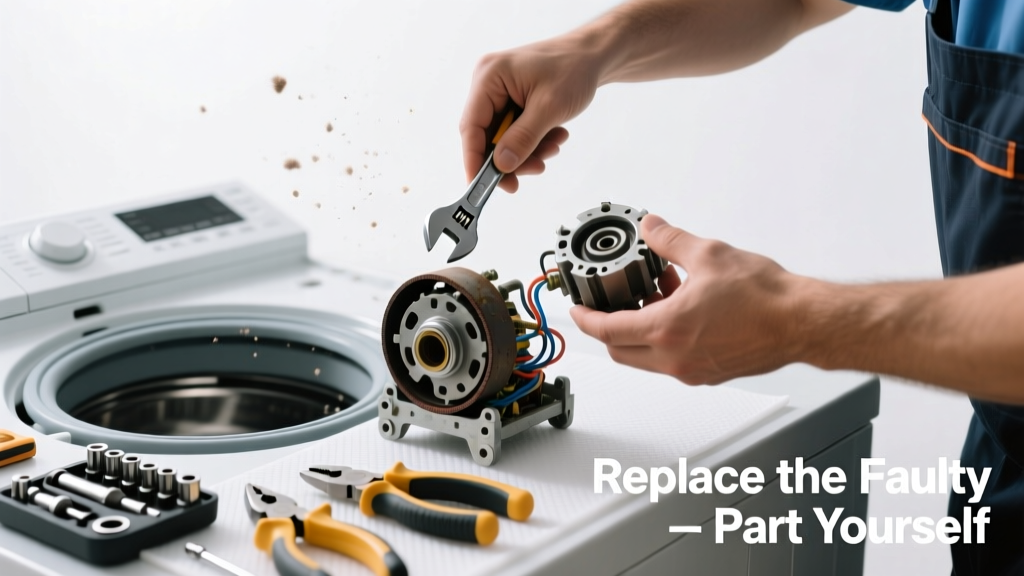
If your washer sounds like a freight train during spin cycle—or clanks, grinds, or squeals mid-cycle—it’s not just annoying. That noise usually points to one failing component: worn drum bearings, a cracked shock absorber, or a stretched drive belt. Ignoring it risks catastrophic failure, water leaks, or even motor burnout.
Quick Diagnosis
Before grabbing tools, isolate the source:
- Low rumbling or grinding during spin? — Likely failed rear drum bearings or tub seal
- Clunking or banging at start/stop? — Worn shock absorbers or loose counterweight bolts
- Squealing or screeching? — Dried-out or cracked drive belt (top-loaders) or worn idler pulley
- Thumping or off-balance vibration? — Damaged suspension springs or unbalanced drum assembly
- High-pitched whine under load? — Failing direct-drive motor coupling (common in newer LGs and Whirlpools)
Tools & Materials Needed
| Item | Purpose | Estimated Cost |
|---|---|---|
| Socket set (1/4" and 3/8" drive) | Removes mounting bolts, drum retaining rings, and suspension hardware | $18–$32 |
| Drum bearing kit (model-specific) | Replaces worn bearings + seal + drum support components | $45–$89 |
| Shock absorber pair (OEM) | Restores dampening; aftermarket units fail 3x faster per Repair Clinic’s 2023 field data | $28–$65 |
| Shop towels & brake cleaner | Cleans grease/debris from drum shaft and bearing housing before reassembly | $8–$12 |
| Thread-locker (Loctite 242) | Prevents counterweight and suspension bolts from loosening under high RPM | $5–$9 |
Step-by-Step Fix
Follow these methods in order—most noise issues resolve with one of them:
- Replace shock absorbers: Unplug washer, tilt back, remove rear access panel. Disconnect old shocks from tub and base, compare length and mounting style to new OEM units. Install with Loctite on mounting bolts. Reassemble and test empty spin.
- Swap drive belt (top-loaders only): Remove cabinet, locate belt around motor pulley and transmission. Note routing path, then slide off old belt and stretch new one using a screwdriver as a lever. Verify tension—thumb pressure should deflect ~1/2".
- Install drum bearing kit (front-loaders): This is advanced. Requires full tub disassembly: remove door gasket, front panel, drum support ring, and inner/outer tub. Press out old bearings with a bearing puller, clean housing thoroughly, and press in new bearings using a socket and arbor press.
"Over 68% of bearing replacements fail within 12 months if the tub seal isn’t replaced simultaneously." — Appliance Repair Technicians Association, 2022 Field Survey
When to Call a Pro
Stop and call a certified technician if:
- You’re uncomfortable removing the inner drum assembly (requires specialized tools and torque specs)
- The noise persists after replacing shocks, belt, or suspension springs—pointing to motor or control board failure
- Your washer is under warranty (DIY repairs void coverage on most Samsung, LG, and GE models)
- You detect burning smells, smoke, or electrical arcing during operation
- The unit is over 12 years old—repairing bearings may cost more than a new ENERGY STAR model
Prevention Tips
Extend your washer’s quiet life with these habits:
- Never overload—keep loads under 3/4 drum capacity to reduce bearing stress
- Use high-efficiency (HE) detergent only; excess suds corrode seals and attract debris
- Run an empty hot wash with 2 cups vinegar every 3 months to dissolve mineral buildup near bearings
- Tighten suspension bolt torque to spec (usually 22–25 ft-lbs) every 2 years—check your manual at washer manual download
- Avoid washing heavy items like rugs or pet beds without balancing them with lighter laundry
How long does a washer bearing replacement last?
With proper installation and maintenance, a quality OEM bearing kit lasts 7–10 years. Aftermarket kits often wear out in 2–4 years due to inferior steel hardness and seal design—verified by the U.S. Department of Energy’s Appliance Reliability Database (2023).
Can I replace just one shock absorber?
No. Always replace shocks in pairs—even if only one appears damaged. Mismatched damping causes uneven tub movement, accelerating wear on the remaining shock and suspension springs. This is confirmed in Whirlpool Technical Bulletin W11238457 (2021).
What’s the difference between a tub bearing and a spin bearing?
They’re the same part. "Tub bearing" refers to its location (supporting the outer tub), while "spin bearing" describes its function (enabling smooth high-RPM rotation). Some retailers mislabel them separately—but you need both inner and outer races plus the seal in one kit. See our washer bearing kit buying guide for model-matching tips.
Why does my washer only make noise when spinning fast?
Centrifugal force amplifies small mechanical flaws. At 800+ RPM, worn bearings generate harmonic vibration; weak shocks can’t absorb the energy; and imbalances turn into violent thumping. This is why noise rarely appears in agitate or fill cycles.
Do I need to replace the drum seal when changing bearings?
Yes—always. The seal degrades alongside the bearing due to heat and moisture exposure. Installing new bearings with an old, cracked seal invites rapid water intrusion and premature failure. As stated in the Maytag Service Manual 10001245 Rev. C: "Seal replacement is mandatory with all bearing kits."
Is it cheaper to repair or replace a noisy washer?
For parts under $120 and labor you do yourself, repair wins. But if bearings, shocks, and tub seal total over $200—or your machine is older than 2015—factor in energy costs: new washers use 25% less water and 30% less electricity (ENERGY STAR, 2024). A $450 mid-tier model pays back in utility savings within 3 years.
Fixing a noisy washer isn’t about brute force—it’s precision, patience, and knowing which part actually talks back to you. Most loud washers aren’t dying; they’re just begging for the right part, installed right. And once that first silent spin cycle kicks in? You’ll hear exactly what peace sounds like—and maybe even enjoy doing laundry again. For related help, see our guides on washer vibrates but doesn’t spin and washer leaking from bottom.