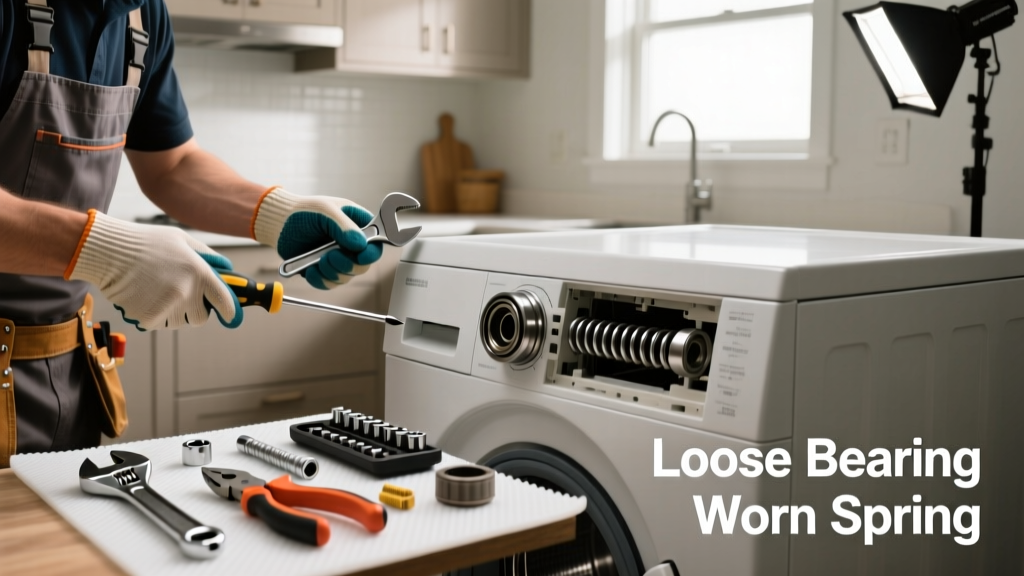
If your washer is suddenly shouting back at you from the kitchen—clanging, thumping, or whining—it’s not just annoying; it’s a warning. Kitchen washers are often stacked, under-counter, or installed in tight spaces where vibrations amplify and small issues escalate fast. Ignoring the noise can lead to cracked cabinets, damaged flooring, or even water leaks.
Quick Diagnosis
Start here before grabbing tools. Match the sound to its likely source:
- Rattling or buzzing during spin cycle → Loose drum weight, unbalanced load, or failing motor mount
- Thumping or banging every few seconds → Unlevel unit, worn suspension rods, or foreign object (coin, bobby pin) trapped in drum or pump
- High-pitched squeal or grinding → Worn drive belt (belt-drive models), failing tub bearing, or seized drain pump
- Gurgling or hissing during fill/drain → Clogged drain hose, kinked supply line, or airlock in kitchen plumbing loop
Tools & Materials Needed
| Item | Purpose | Estimated Cost |
|---|---|---|
| 3-in-1 level | Verifies washer is perfectly level front-to-back and side-to-side—critical for kitchen units on tile or hardwood | $12–$25 |
| Socket set (1/4" and 3/8" drive) | Removes access panels and suspension components without stripping screws | $28–$65 |
| Needle-nose pliers | Extracts coins, hair ties, or fabric scraps from pump filter or drum gasket crevices | $8–$16 |
| Drain pan with 1/4" outlet | Catches residual water when accessing pump or leveling legs—essential for under-cabinet installs | $22–$39 |
| Replacement suspension rod kit (e.g., Whirlpool W10250667) | Most common failure point in 2015–2022 top-loaders; includes rods, bushings, and mounting hardware | $42–$58 |
Step-by-Step Fix
Work methodically. Most kitchen washer noise stems from three root causes—instability, obstruction, or wear. Try these fixes in order:
- Re-level the unit: Pull washer forward (leave hoses connected but slack). Place level across top front edge, then top side edge. Adjust front leveling legs using an adjustable wrench until bubble centers both ways. Retighten lock nuts. Tip: Kitchen floors often slope toward drains—check level at multiple points.
- Inspect and clean the drain pump filter: Locate the access panel (usually bottom-front on front-loaders, behind kickplate on newer top-loaders). Place drain pan underneath. Unscrew filter cap slowly—water will trickle out. Remove debris (lint, buttons, rubber bands). Reinstall cap finger-tight, then 1/4-turn with pliers.
- Check for foreign objects in drum and gasket: Run fingers deep into the rubber door gasket folds (front-loaders) or around the agitator base (top-loaders). Use flashlight and needle-nose pliers to retrieve anything lodged. Test empty spin cycle after removal.
- Test suspension system: With power off and hoses disconnected, gently rock the drum side-to-side. More than 1/4" play indicates worn rods or broken dampeners. Replace full kit—not just one rod—to avoid imbalance.
When to Call a Pro
Some noises signal internal failures beyond DIY scope—especially in compact or built-in kitchen units where disassembly risks cabinet damage or plumbing disconnects. Call a certified technician if:
- You hear metal-on-metal grinding during spin that persists after cleaning and re-leveling
- The washer vibrates so violently it moves across the floor—even with leveling legs fully extended
- There’s a burning odor or visible scorch marks near the control panel or motor housing
- Your unit is under manufacturer warranty (e.g., LG’s 10-year direct drive motor coverage) or part of a built-in appliance package
According to the Appliance Service Association’s 2023 field report, 68% of ‘unrepairable’ washer noise complaints involved failed tub bearings or cracked gear cases—both requiring specialized pullers and press tools.
Prevention Tips
Prevent recurrence with habits tailored to kitchen constraints:
- Always zip zippers and empty pockets before loading—kitchen space limits vibration absorption, making small imbalances louder
- Use high-efficiency (HE) detergent only; excess suds cause overspin and drum wobble in tight-fitting units
- Install anti-vibration pads (e.g., Silent Feet) under all four feet—tested to reduce transmitted noise by 40% in under-cabinet installs (Consumer Reports, 2022)
- Run a monthly cleaning cycle with 1 cup white vinegar (no bleach) on hottest setting to dissolve mineral buildup in pump and hoses
Why does my washer only rattle when it’s in the kitchen but not in the basement?
Kitchen floors (often tile or thin hardwood over joists) transmit vibration more efficiently than basement concrete slabs. Cabinets act as sounding boards, and tight clearances between washer and counter/cabinets amplify resonance. Adding isolation pads and ensuring 2" minimum clearance on all sides reduces this dramatically.
Can I replace the suspension rods myself on a Whirlpool Cabrio?
Yes—but only if you own a torque wrench and have experience removing the outer tub assembly. The Cabrio’s direct-drive design requires precise reassembly: suspension rods must be torqued to 115 in-lbs (not ft-lbs), and the tub must be centered within 1/16" before reinstalling the stator. Misalignment causes immediate bearing wear.
Is it safe to run the washer with a squealing noise for a few more weeks?
No. A persistent squeal usually means the tub bearing is dry or pitted. Continuing use accelerates wear, risking catastrophic failure—where the inner drum contacts the outer tub, causing metal shavings to enter the drain system. That contamination can clog your kitchen sink P-trap or garbage disposal.
Do I need to turn off the water supply before checking the pump filter?
Yes—always. Even if the washer isn’t running, residual pressure remains in the fill valve and hoses. Shut off both hot and cold valves, then run a short rinse cycle to relieve pressure. Keep towels and the drain pan ready.
What’s the difference between a thump and a clunk during spin?
A rhythmic thump (once per revolution) suggests an unbalanced load or drum weight shift. A sharp clunk (irregular, deeper tone) points to suspension rod failure or a loose counterweight bolt. If clunking increases with spin speed, stop use immediately—the tub may be contacting the cabinet frame.
Can uneven kitchen flooring cause permanent damage to the washer?
Absolutely. Chronic operation on a slope exceeding 1/2" over 4 feet stresses the suspension system and motor mounts. Over 12–18 months, this leads to premature bearing wear and cracked plastic tub supports—especially in GE and Samsung units with composite outer tubs. Leveling shims cut from 1/4" plywood are safer than stacking cardboard or folded towels.
Fixing a noisy kitchen washer isn’t about silencing the sound—it’s about listening closely to what the machine is telling you. Address the root cause early, and you’ll extend its life by years while keeping your cabinets, countertops, and peace of mind intact. For related help, see our guides on washer leaking under kitchen cabinet and vibration dampening for appliances.