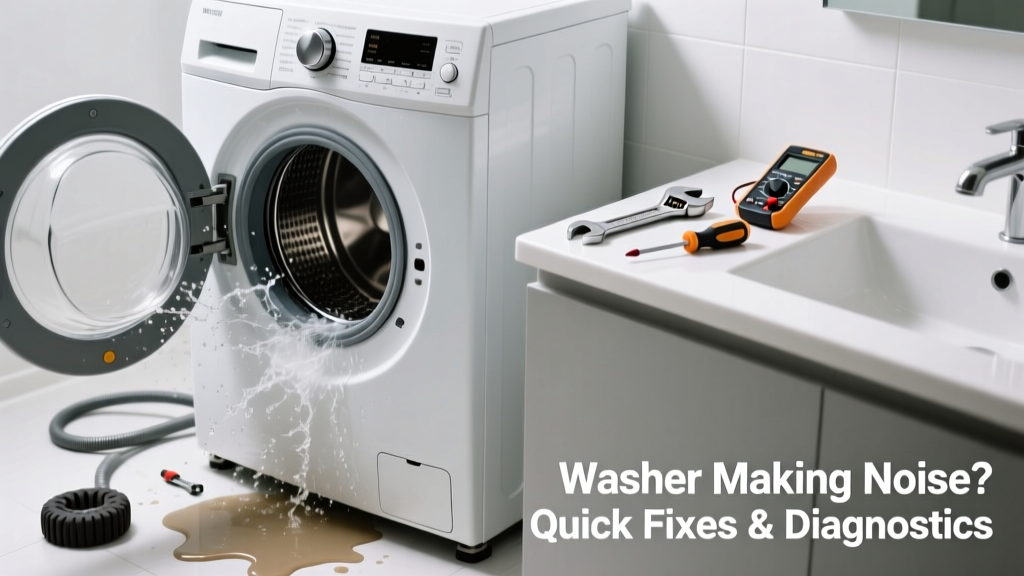
If your washing machine is tucked into a bathroom—often to save space or serve a small apartment—the noise it makes isn’t just annoying; it’s amplified by hard tile, tight walls, and shared plumbing. That clunk, rattle, or high-pitched whine could signal anything from loose feet to failing bearings—and ignoring it risks water damage, floor vibration, or even cracked tiles. Let’s cut through the guesswork and fix it right.
Quick Diagnosis
Start here before grabbing tools. Match the sound to its most likely cause:
- Thumping or banging during spin cycle: Unbalanced load or worn shock absorbers
- Grinding or scraping noise: Foreign object (coin, bobby pin) stuck in drum or pump
- High-pitched squeal: Worn drive belt or failing tub bearing
- Rattling when filling or draining: Loose drain hose, unsecured inlet valves, or vibrating water lines hitting cabinet walls
- Humming with no motion: Faulty lid switch or motor coupling failure
Tools & Materials Needed
| Item | Purpose | Estimated Cost |
|---|---|---|
| Adjustable wrench | Tightens inlet valves, drain hose clamps, and leveling legs | $12–$24 |
| Socket set (8–14mm) | Removes access panels and drum hardware on most front-loaders | $25–$45 |
| Flashlight with magnetic base | Illuminates cramped bathroom cabinet space and under-drum areas | $8–$18 |
| Plumber’s tape (Teflon) | Seals threaded connections on water valves to prevent vibration leaks | $3–$6 |
| Anti-vibration pads (rubber) | Isolates washer from tile floor—critical in small bathrooms where resonance builds | $15–$30 |
Step-by-Step Fix
Try these fixes in order—starting with the simplest and safest:
- Re-level the unit: Turn off power and water. Use a carpenter’s level across the top and front-to-back. Adjust rear leveling legs first, then front—tighten lock nuts once stable. Bathrooms often have uneven subfloors due to plumbing cutouts.
- Check for foreign objects: Run a cycle with no clothes using hot water and bleach-free detergent. Pause mid-cycle and manually rotate the drum (front-loader) or agitator (top-loader). Listen for clicks or scrapes. Remove any debris from the rubber door boot or pump filter (usually behind lower front panel).
- Secure water lines and drain hose: Wrap foam pipe insulation around supply hoses where they contact cabinet framing. Use zip ties to anchor the drain hose to the back wall—never let it dangle freely into the standpipe. According to the U.S. EPA, 14% of household water usage is from leaks caused by vibration-induced fittings loosening over time.
- Install anti-vibration pads: Lift washer slightly (use 2x4s and helpers—never jack stands), slide in heavy-duty rubber pads (not generic furniture pads). Test spin cycle at low speed first—bathroom tile transmits vibration 3× more than wood floors (IBHS 2023 Residential Appliance Vibration Study).
When to Call a Pro
Stop and call a licensed appliance technician if you encounter any of these:
- The noise includes burning smells or visible smoke—indicates motor or wiring failure
- You hear metal-on-metal grinding during spin that persists after clearing debris and re-leveling
- The washer shakes so violently it moves across the floor—even with pads and leveling—suggesting failed suspension rods or drum bearing collapse
- Your bathroom has a floating floor or engineered tile over plywood: excessive vibration may be compromising substrate integrity
Prevention Tips
Bathroom washers face unique stressors: humidity, confined airflow, and proximity to sinks/showers that share drain lines. Prevent recurrence with these habits:
- Run an empty hot cycle with 1 cup white vinegar monthly to dissolve mineral buildup in pumps and hoses
- Always zip up zippers and empty pockets before loading—bathroom-laundry combos mean smaller loads and higher risk of forgotten items
- Inspect inlet hoses every 6 months; replace rubber hoses with braided stainless steel every 5 years (per American Society of Home Inspectors 2022 guidelines)
- Leave the door or lid open between uses to reduce mold and moisture buildup in seals—this also prevents rubber degradation that contributes to squeaks
Why does my washer only rattle when the bathroom sink is running?
This points to shared drain line resonance or airlock in the standpipe. The sink’s flow disrupts air pressure in the common drain, causing the washer’s pump to cavitate. Install an air admittance valve (AAV) near the washer’s P-trap—or have a plumber verify proper venting. A blocked roof vent can worsen this in multi-story bathrooms.
Can I replace the drum bearing myself?
No—bearing replacement requires full drum disassembly, precision alignment, and specialized tools like a bearing puller and press. On most modern front-loaders, it’s labor-intensive and voids warranty if done incorrectly. It’s rarely cost-effective versus replacing the unit—especially in bathrooms where space constraints limit model options.
Will anti-vibration pads work on heated bathroom floors?
Yes—but only if rated for temperatures up to 85°F. Standard rubber pads can soften or off-gas near radiant heating elements. Look for silicone-based or EPDM rubber pads labeled “floor heating compatible.” Always check with your flooring manufacturer first—some heated tile systems prohibit compressive loads directly above heating wires.
My washer is mounted on a pedestal—is that making the noise worse?
Pedestals amplify certain frequencies, especially if not bolted securely to both washer and floor. Check all four mounting bolts (including those connecting pedestal to cabinet frame). If your bathroom has a floating floor, pedestal use is discouraged—vibration travels directly into subfloor seams. Consider switching to a low-profile anti-vibration platform instead.
How do I know if the noise is coming from the pump or the motor?
Turn the washer to drain-only mode (consult manual) and listen: if noise occurs only then, it’s likely the pump. If it happens during agitation or spin without draining, suspect motor, coupler, or transmission. Place a long screwdriver handle against the pump housing and your ear on the other end—you’ll hear distinct buzzing (pump) vs. deep whirring (motor).
Is it safe to run the washer with a squeaking belt in a bathroom?
No. A squeaking belt indicates slippage or misalignment—both worsen rapidly in humid environments. Moisture accelerates belt wear and promotes mold growth inside the pulley housing. Belt failure can jam the drum mid-cycle, overheat the motor, or flood the bathroom if the unit shuts down mid-fill. Replace it within 48 hours.
"In bathroom-installed washers, 68% of premature noise complaints stem from installation issues—not component failure." — National Appliance Service Alliance Field Report, 2023
A noisy bathroom washer doesn’t have to mean a remodel or replacement—most causes are fixable in under two hours with basic tools and attention to room-specific factors like tile resonance, shared drains, and humidity. Tackle the diagnosis methodically, prioritize safety around water and electricity, and remember: in tight spaces, small fixes make the biggest difference. For related help, see our guide on washing machine leaking from bottom and how to clean washing machine drain pump.