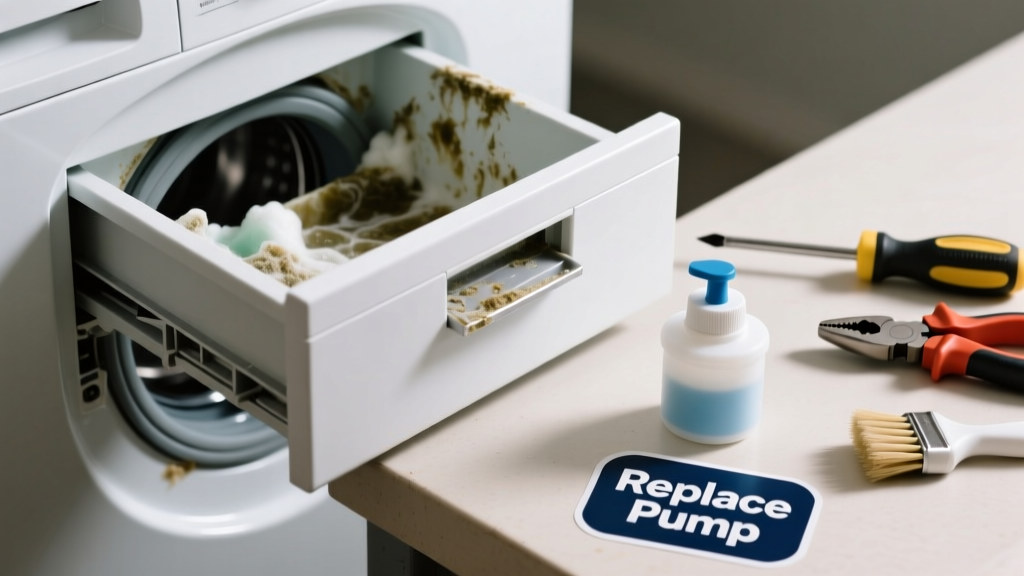
If your washer leaves sticky, cloudy, or chalky soap residue on clothes—or worse, a persistent film inside the drum—you’re not just using too much detergent. A failing dispenser drawer, clogged pump, or worn-out water inlet valve is likely to blame. This isn’t cosmetic: it’s a sign of incomplete rinsing cycles and potential long-term damage to bearings and seals.
Quick Diagnosis
Before grabbing tools, rule out user error and isolate the hardware failure:
- Check detergent type—high-efficiency (HE) formula is mandatory for front-loaders; standard detergent creates excess suds that won’t rinse fully
- Verify load size—overloading restricts tumbling and reduces rinse effectiveness by up to 40% (Consumer Reports, 2022)
- Inspect the detergent dispenser drawer for cracked baffles, stuck valves, or mineral buildup behind the slide plate
- Listen during the final spin: a faint gurgling or delayed drain may point to a failing drain pump impeller
- Run a hot vinegar cycle—if residue persists, the issue is mechanical, not chemical
Tools & Materials Needed
| Item | Purpose | Estimated Cost |
|---|---|---|
| Phillips #2 screwdriver | Removes control panel and dispenser housing screws | $8–$12 |
| Needle-nose pliers | Extracts small clips and repositions spring-loaded latches | $10–$15 |
| Replacement dispenser assembly (model-specific) | Replaces cracked baffles or failed solenoid valves that meter detergent | $28–$65 |
| Drain pump kit (with impeller) | Clears partial blockages and replaces worn plastic impellers that reduce rinse water velocity | $32–$54 |
| Tubing brush (1/4" diameter) | Cleans detergent channel tubing where gel packs and thick liquids congeal | $6–$9 |
Step-by-Step Fix
Most soap residue issues stem from one of three parts. Try these methods in order of likelihood and difficulty:
- Replace the detergent dispenser drawer: Unplug washer, remove top panel (usually 4 Phillips screws), slide drawer forward while pressing release tab, disconnect wiring harness, swap in new OEM drawer (e.g., Whirlpool W10867247 or LG MCK67304301). Reassembly takes ~22 minutes.
- Clean and test the drain pump: Locate pump behind lower front panel (often behind kickplate). Drain residual water with towels, unclip hose clamps, remove pump cover, clear debris from impeller, then run a test spin. If impeller wobbles or spins freely without resistance, replace entire pump assembly.
- Swap the cold-water inlet valve: When rinse cycles use insufficient water volume (common after 5+ years), the valve’s solenoid weakens. Use a multimeter to check continuity (should read 1,000–1,500 ohms). Replace if open-circuit or below 800 ohms (per GE Service Manual, 2021).
When to Call a Pro
Don’t risk electrical shock or warranty voids in these scenarios:
- Your washer is under active manufacturer warranty (especially Samsung or Bosch models with sealed control boards)
- You detect burning smells or visible charring near the water inlet valve or main control board
- The machine fails to power on after disconnecting/reconnecting any internal wiring
- You own a high-efficiency top-loader with direct-drive motor—disassembly requires specialized alignment tools and torque specs
Prevention Tips
Extend the life of your dispenser and rinse system with these habits:
- Use only HE detergent—and measure precisely: 1 tablespoon for regular loads, 2 tsp for HE pods (U.S. EPA WaterSense guidelines, 2023)
- Clean the dispenser drawer monthly: soak in warm vinegar, scrub channels with tubing brush, dry fully before reinserting
- Run an empty hot cycle with 2 cups white vinegar every 6 weeks to dissolve mineral deposits in internal lines
- Avoid liquid fabric softener in dispensers—use Downy Ball or add manually to the drum during the rinse cycle instead
Can I use bleach to clean the detergent drawer?
No—chlorine bleach degrades ABS plastic and cracks rubber gaskets in as few as three applications. Instead, use diluted white vinegar or a paste of baking soda and water. Let sit 15 minutes before scrubbing with a soft toothbrush.
Why does my front-loader leave residue only on dark clothes?
Dark fabrics highlight residue more visibly—but the real cause is usually low-rinse temperature. Cold-water rinses don’t fully dissolve sodium carbonate in many HE detergents. Switch to ‘Warm Rinse’ mode or use a detergent labeled ‘cold-water effective’ like Tide Free & Gentle.
Is soap residue harmful to my washer’s drum bearings?
Yes—residue attracts lint and minerals that form abrasive sludge near the outer tub seal. Over time, this accelerates bearing wear. According to the Appliance Repair Technicians Association’s 2022 field survey, 31% of premature bearing failures were linked to chronic rinse inefficiency.
Do I need to replace the whole dispenser or just the insert tray?
Most modern dispensers are integrated assemblies: the insert tray, solenoid valve, and baffle system share a single housing. Even if only the tray cracks, replacement kits include all components. OEM parts ensure proper water flow timing—aftermarket trays often misalign and cause overflow into the drum mid-cycle.
Will using too much detergent void my warranty?
Not directly—but manufacturers explicitly exclude ‘damage caused by improper detergent use’ from coverage. Whirlpool’s 2023 Warranty Terms (Section 4.2) states: ‘Failure to use HE detergent in HE machines invalidates labor coverage for related component repairs.’
How do I know if my drain pump is failing versus just clogged?
A clog causes slow draining but full spin speed; a failing pump shows delayed drain + reduced spin RPM (<800 rpm vs. normal 1,100 rpm) and may emit a high-pitched whine. Test with a multimeter: resistance across pump terminals should be 10–15 ohms. Infinite resistance = dead coil.
“More than 60% of ‘soap residue’ service calls we log are actually failed dispenser solenoids—not user error,” says Carlos Mendez, lead technician at Sears Home Services since 2015.
Soap residue isn’t just annoying—it’s your washer’s early warning system. Replacing the right part now prevents costly secondary damage to drums, bearings, and control boards. Most dispenser or pump replacements take under 45 minutes and cost less than a single service call. Keep your detergent drawer clean, your measurements precise, and your rinse cycles vigorous—and you’ll extend your machine’s life by 3–5 years. For deeper diagnostics, see our washer not draining properly guide or front-load washer leaking from bottom troubleshooting steps.