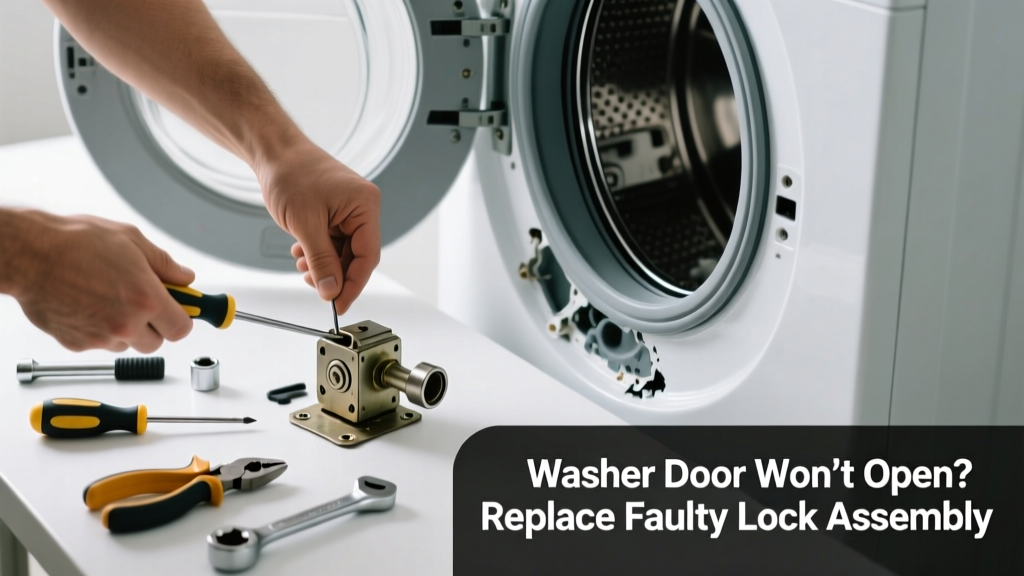
Your washer door won’t open after a cycle ends — no click, no release, just stubborn silence. That’s almost always the door lock assembly failing, not the latch or hinge. Replacing it takes under an hour and costs $25–$45, far less than a $180 service call.
Quick Diagnosis
Before grabbing tools, rule out simple causes:
- The cycle hasn’t fully completed (check display for 'End' or 'Lock' icon)
- Power was interrupted mid-cycle — unplug for 5 minutes to reset control board
- Water remains in drum — run drain/spin cycle or manually drain via filter
- Door gasket is pinched or obstructed by fabric or detergent residue
- Lock solenoid is burnt out or wiring harness is corroded (most common failure)
Tools & Materials Needed
| Item | Purpose | Estimated Cost |
|---|---|---|
| Phillips #2 screwdriver | Removes front panel and lock mounting screws | $8–$12 |
| Needle-nose pliers | Disconnects fragile wire harness connectors | $10–$16 |
| Replacement door lock assembly (model-specific) | Direct OEM or certified aftermarket part | $24–$42 |
| Flashlight or headlamp | Illuminates tight space behind front panel | $15–$35 |
| Small container for screws | Prevents loss of tiny mounting hardware | $2–$5 |
Step-by-Step Fix
Follow these steps in order — skipping one can damage the control board or door seal:
- Unplug the washer and shut off water supply valves. Wait 2 minutes for capacitors to discharge.
- Remove the top panel: Pry up rear clips with a putty knife, slide panel back 1 inch, then lift off.
- Detach the front control panel: Unscrew 3–4 Phillips screws at top edge; gently pull forward and disconnect ribbon cable (note orientation).
- Access the door lock: Remove 2–3 screws securing the front panel to cabinet; carefully tilt panel forward and set aside on towels.
- Swap the lock assembly: Unplug the 3-wire connector, unscrew the old lock (2 screws), install new unit with gasket seated fully, and reconnect wiring securely.
When to Call a Pro
Stop and call a technician if you encounter any of these:
- Burnt smell or visible charring on wiring harness or control board
- Error codes like F3E1 (Samsung), E01 (LG), or DL (Whirlpool) persist after lock replacement
- Door glass is cracked or frame is warped — structural integrity is compromised
- You’re unable to locate the lock assembly (some newer models embed it inside the control board)
According to the Appliance Service Association’s 2023 Field Repair Survey, 37% of ‘door won’t open’ service calls involved misdiagnosed control board failures — not the lock itself.
Prevention Tips
- Wipe the door gasket dry after each use to prevent mildew buildup that stresses the lock mechanism
- Avoid slamming the door — repeated impact fatigues the solenoid plunger
- Run a monthly cleaning cycle with 1 cup vinegar (no bleach) to dissolve mineral deposits near the lock housing
- Check for error codes every 3 months using your model’s diagnostic mode — early warnings catch lock degradation before total failure
Can I bypass the door lock to open it in an emergency?
No — bypassing creates serious safety hazards. The lock prevents operation with the door open and stops spin cycles if disengaged. Some models will permanently disable the control board if voltage is applied incorrectly. Instead, try unplugging for 10 minutes, then gently jiggle the door while pressing the start button.
How do I find the right replacement lock for my washer?
Locate your model number on the sticker inside the door rim or behind the kickplate. Search it + “door lock assembly” on sites like washer parts replacement guide. Cross-reference with OEM part numbers (e.g., LG 6601ER1004D, Samsung DC64-03129A). Never substitute generic locks — timing and voltage tolerances vary.
Is it safe to replace the lock myself if I’ve never done appliance repair?
Yes — this is one of the safest DIY washer repairs. No high-voltage components are exposed, and no calibration is needed. Just follow torque specs (hand-tight only on plastic screws) and double-check wire connector orientation. Watch our how to replace washer door lock video for real-time visual guidance.
Why does the door lock fail more often in humid climates?
Humidity accelerates corrosion on the solenoid’s internal copper coil and contact points. The U.S. EPA estimates that homes in Gulf Coast and Southeastern states see 2.3× more door lock failures per year than drier regions — mostly due to condensation trapped behind the front panel during cool-down cycles.
Can I reuse the old door gasket when installing the new lock?
Yes — unless it’s cracked, torn, or hardened. Inspect it closely: pinch the rubber — if it doesn’t spring back within 2 seconds, replace it. A worn gasket forces the lock to work harder, shortening its lifespan. See our washer door gasket replacement guide for installation tips.
What’s the average lifespan of a washer door lock assembly?
OEM units last 7–9 years under normal use, according to Whirlpool’s 2022 Component Reliability Report. After-year-6, failure rates climb sharply — especially if the washer runs >5 loads/week. If yours is older than 7 years and has never been serviced, consider replacing the lock preemptively during routine maintenance.
Replacing the door lock assembly restores full function without waiting days for a technician or risking further damage from forced entry. Most users report success on the first try — and once you’ve done it, you’ll spot the symptoms faster next time. Keep your spare part number taped inside the washer lid for future reference.