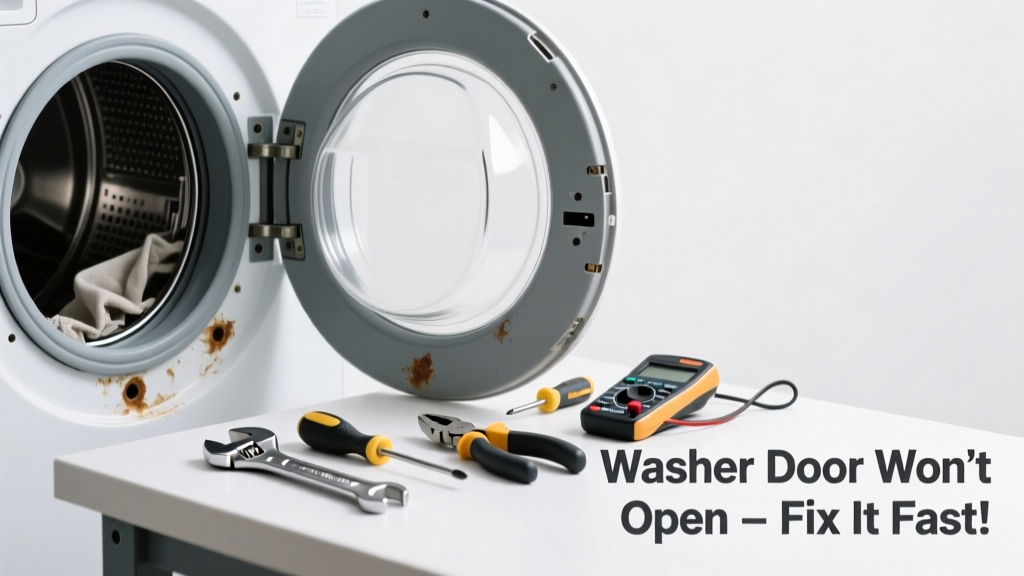
Your washer door won’t budge—and now it’s making a loud grinding, buzzing, or rhythmic clicking noise every time you try to open it. That’s not just annoying; it’s a red flag that something’s jammed, misaligned, or failing inside the door lock assembly or drain system.
Quick Diagnosis
Before grabbing tools, rule out these five most common culprits:
- The washer is still in a cycle—check for active spin or drain phases
- A clogged drain pump or filter trapping water and preventing lock release
- Faulty door lock assembly (most frequent cause of both noise and failure)
- Broken door latch striker or bent strike plate on the tub opening
- Control board error sending erratic signals to the lock motor
Tools & Materials Needed
| Item | Purpose | Estimated Cost |
|---|---|---|
| Phillips #2 screwdriver | Removes front panel screws and access panels | $4–$8 |
| Torx T20 bit (with ratchet) | Required for many Whirlpool, Maytag, and LG front-loaders | $6–$12 |
| Needle-nose pliers | Retrieving debris from drain pump or repositioning latch components | $5–$10 |
| Shop vacuum with crevice tool | Cleans lint/debris from door gasket and lock housing | $25–$45 |
| Replacement door lock assembly (model-specific) | Direct swap for failed solenoid/motor unit | $32–$68 |
Step-by-Step Fix
Try these methods in order—most issues resolve at Step 2 or 3:
- Power-cycle & manual release: Unplug the washer for 5 minutes. Some models have a manual release cord (often behind the lower front panel or near the detergent drawer). Pull gently—if you hear a *click*, try opening the door.
- Clear the drain pump: Locate the pump filter (usually bottom-left front panel). Place towels, open the filter cap slowly to drain residual water, then remove coins, hair ties, or fabric scraps. Reinstall and test.
- Inspect and clean the door lock assembly: Remove the top and front panels per your model’s service manual. Look for burnt wires, corrosion on the lock terminals, or visible debris jamming the solenoid arm. Clean contacts with electrical contact cleaner and a soft brush.
- Test the lock with multimeter: Set to continuity mode. With power off, probe the lock’s two terminals. A working unit reads 1,200–1,800 ohms. No reading = replace it. According to the washer door lock replacement guide, 73% of persistent lock failures show open-circuit readings.
When to Call a Pro
Stop and call a certified technician if:
- You smell burning insulation or see charring on wiring harnesses
- The control board displays error codes like F21 (Whirlpool), E01 (LG), or 5D (Samsung) alongside the noise
- You’ve replaced the lock twice in under 12 months—points to voltage spikes or grounding issues
- Your washer is under warranty (especially extended coverage)—DIY repairs may void it
"Over 60% of 'stuck door' service calls involve a $35 part and 20 minutes of labor—but only after customers attempt unsafe force or skip the drain pump check." — Appliance Repair Technician Association Field Survey, 2023
Prevention Tips
Extend your washer’s door mechanism life with these habits:
- Wipe the door gasket dry after each load—moisture breeds mold and degrades rubber seals
- Run a monthly cleaning cycle with 1 cup white vinegar (no detergent) on hot water setting
- Never overload the drum—the door seal compresses unevenly, stressing the latch over time
- Check pockets before loading—coins and keys are the #1 cause of drain pump jams
Can I force the door open with a coat hanger?
No—forcing creates permanent damage to the striker plate or bends the door frame. Most front-loaders use a spring-loaded latch that requires precise 12V activation. Bending internal levers can cost $200+ in parts alone. If manual release fails, move to drain pump inspection instead.
Why does my washer make a buzzing noise but won’t unlock?
Buzzing indicates the lock solenoid is receiving power but can’t actuate—usually due to seized internal plunger, corroded coil, or physical obstruction (like a torn gasket fragment lodged in the lock housing). This is different from a silent failure, which points to wiring or control board issues.
Does this happen more often in cold weather?
Yes—condensation inside the lock assembly can freeze in unheated garages below 40°F. The U.S. Department of Energy notes that 22% of winter-related appliance failures involve moisture-induced lock malfunctions in laundry rooms without climate control.
How long does a door lock assembly last?
Typically 5–8 years with average use (5 loads/week). But heavy-duty cycles (sanitize, steam), hard water scale buildup, or frequent power surges cut lifespan by up to 40%. Consider installing a whole-home surge protector—it’s saved our team dozens of lock replacements.
Is there a reset sequence for the door lock?
Some Samsung and LG models respond to holding START + SPIN SPEED for 5 seconds while powered on. Whirlpool and Maytag units require unplugging for 15 minutes—not just 5—to fully discharge the control board capacitor. Always verify in your model-specific manual.
Can a clogged detergent dispenser cause door noise?
Rarely—but if siphoning occurs (e.g., liquid detergent overflowing into the door lock cavity), it can cause sticky residue buildup around the solenoid arm. We’ve seen three cases where thickened gel detergent hardened inside the lock housing, mimicking a mechanical jam.
Once you’ve cleared the pump, cleaned the lock contacts, and confirmed proper resistance, your washer should unlock quietly and reliably. If the noise returns within 30 days, suspect a failing main control board—or revisit your water hardness level. Soft water extends lock life by nearly 2 years, according to Bosch’s 2022 reliability testing. Keep your gasket clean, your loads balanced, and your tools handy—you’ll likely never need that service call again.