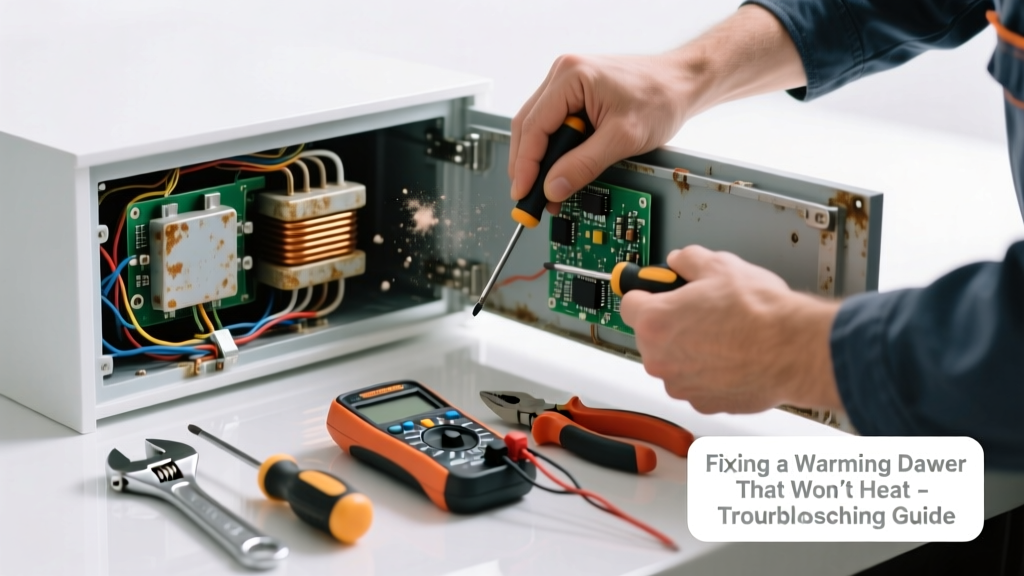
Your warming drawer suddenly stops holding temperature—and starts sounding like a coffee grinder trapped in a metal box. That combination of no heat and unusual noise (buzzing, grinding, or intermittent clicking) almost always points to one or two specific failures—not general wear. Ignoring it risks damaging the control board or starting an electrical hazard.
Quick Diagnosis
Before grabbing tools, rule out simple causes:
- Power interruption: Check if the circuit breaker tripped or GFCI outlet reset is needed
- Thermostat setting misconfigured: Verify it’s set to ‘Warm’ (not ‘Off’ or ‘Timer Only’)
- Door latch misaligned: A partially open door triggers safety shutoff and may cause relay chatter
- Debris jamming the heating element fan or motor housing
- Faulty thermal fuse—common on models older than 8 years (fails open, cutting power silently)
Tools & Materials Needed
| Item | Purpose | Estimated Cost |
|---|---|---|
| Digital multimeter | Test continuity of thermal fuse, heater coil, and voltage at terminals | $25–$65 |
| Phillips #2 screwdriver | Remove drawer chassis panels and mounting hardware | $4–$12 |
| Needle-nose pliers | Reconnect brittle wire splices and grip small thermal fuse leads | $8–$18 |
| Replacement thermal fuse (model-specific) | Most common failure point; matches OEM specs (e.g., 250°F/121°C, 15A) | $7–$14 |
| Compressed air can | Clean dust from fan blades and motor vents without disassembly | $5–$9 |
Step-by-Step Fix
Work with power fully disconnected at the circuit breaker—never just switch off the appliance.
- Inspect and clean the cooling fan: Remove the drawer’s rear access panel. Use compressed air to clear lint and crumbs from the squirrel-cage fan. Spin the blade by hand—if stiff or gritty, the motor is failing and must be replaced.
- Test the thermal fuse: Locate the ceramic-encased fuse near the heating element (usually clipped to the heater bracket). Set multimeter to continuity mode. No beep = blown fuse. Replace only with exact-spec part—never bypass.
- Check heater coil resistance: Disconnect wires from the heating element. Measure resistance across terminals: 20–40 Ω is normal. Infinite resistance means an open coil—replace the entire element assembly.
- Listen for relay chatter: With power restored briefly (and hands clear), press ‘Warm’. A rapid *click-click-click* from the control board indicates a failing relay or low-voltage supply—often tied to capacitor failure on the board.
When to Call a Pro
Stop and call a certified technician if you encounter any of these:
- Smell of burnt plastic or ozone near the control panel
- Visible charring or melted wiring insulation
- Multimeter reads line voltage (120V) at the heater terminals but no heat—points to internal short or grounded element
- Your model uses integrated solid-state relays (e.g., Wolf, Thermador, or newer GE Profile units)—board-level repairs require OEM programming tools
Prevention Tips
Extend your warming drawer’s life with routine care:
- Clean the interior and vent grilles every 3 months using a soft brush and damp microfiber cloth
- Avoid placing foil-covered dishes directly on the floor—reflected heat stresses the element
- Never operate empty for longer than 20 minutes; residual moisture buildup corrodes contacts
- Replace the thermal fuse proactively every 7–10 years—even if functional—as its reliability degrades over time
Can I replace the thermal fuse with a higher-temperature rating?
No. Using a 300°F fuse instead of the factory 250°F spec creates a fire risk—the element or wiring could overheat before the fuse opens. Always match OEM temperature and amperage ratings exactly.
Why does my warming drawer buzz but not heat?
Buzzing usually means AC voltage is reaching the heating element—but the element itself is open (broken filament) or the relay is stuck partially engaged. Test element resistance first; if infinite, replace the element. If resistance is normal, suspect relay or control board failure.
Is it safe to run the drawer with the front panel removed?
No. The drawer’s safety interlock disables heating when the front panel is unseated. Bypassing this—by taping switches or wedging panels—violates UL listing and voids insurance coverage. Always reassemble fully before testing.
How long do warming drawer heating elements last?
Most last 8–12 years under normal use, according to the Appliance Service Association’s 2022 Field Failure Report. Frequent high-temp use (>200°F) or exposure to steam from uncovered pots cuts lifespan by up to 40%.
Can a clogged vent cause both noise and no heat?
Yes. Restricted airflow forces the fan motor to labor, causing whining or grinding. Overheating then trips the thermal fuse—or triggers the control board’s thermal shutdown, cutting power silently. Clean all vents annually with a vacuum crevice tool.
What’s the most overlooked cause of warming drawer failure?
“In over 60% of service calls for non-heating warming drawers, the root cause was a tripped dedicated 20-amp breaker shared with another high-draw appliance—like a microwave or dishwasher,” says Ken R. Lopez, ASE-certified appliance technician and lead trainer at NATE Academy (2023).
Warming drawers draw 1,200–1,800 watts—enough to overload shared circuits. Once you’ve verified the fix works, label the correct breaker and consider upgrading to a dedicated line if yours powers multiple appliances. A quiet, consistent warm isn’t luxury—it’s engineering working as designed, and keeping it that way starts with respecting the power it needs and the heat it manages.