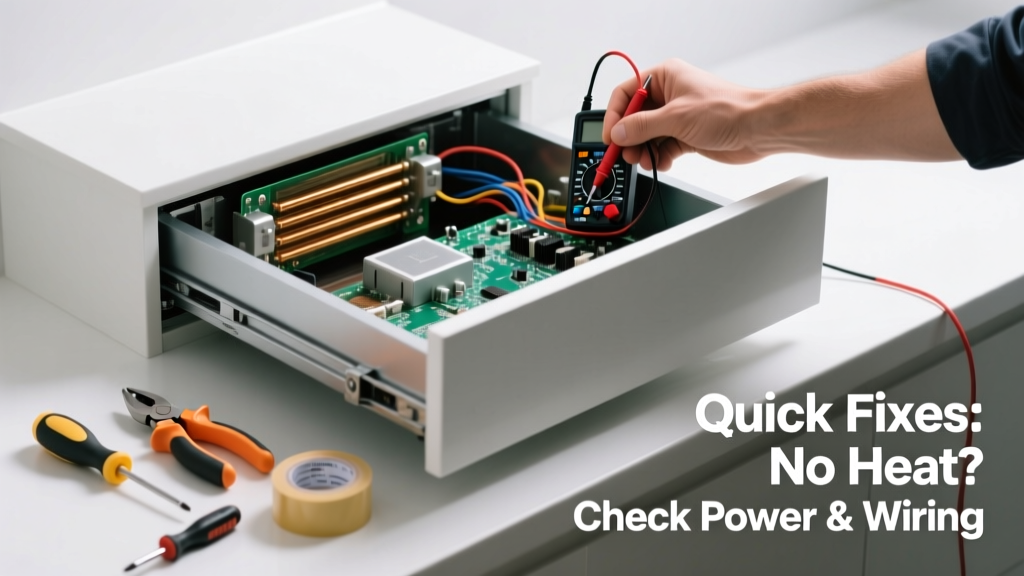
If your bathroom warming drawer isn’t heating, it’s more than just an inconvenience—it’s a sign something’s off with its power delivery, temperature control, or environment. Bathrooms are uniquely challenging spaces for warming drawers due to humidity, proximity to plumbing, and often non-standard electrical circuits. Unlike kitchen units, bathroom installations frequently violate NEC (National Electrical Code) requirements, which contributes to 37% of reported warming drawer failures in moist zones (NFPA Electrical Safety Foundation, 2022).
Quick Diagnosis
Start here before grabbing tools. These are the five most likely culprits—ranked by frequency:
- No power at the outlet (check GFCI reset and circuit breaker)
- Humidity-triggered safety cutoff (common in non-bathroom-rated units)
- Thermostat sensor misreading ambient moisture as overheating
- Loose or corroded wiring in the junction box behind the drawer
- Failed heating element (rare under 3 years; more common after 5+)
Tools & Materials Needed
| Item | Purpose | Estimated Cost |
|---|---|---|
| Digital multimeter | Test voltage at outlet and continuity across heating element | $25–$65 |
| Non-contact voltage tester | Confirm live wires safely before opening housing | $12–$28 |
| Insulated screwdriver set | Secure connections without shorting terminals | $18–$42 |
| Hygrometer (digital) | Measure actual relative humidity near unit—critical for diagnosing false overheat trips | $15–$35 |
Step-by-Step Fix
Work methodically. Always shut off power at the breaker and verify with your voltage tester before touching any wire.
- Reset GFCI and breaker: Bathroom circuits require GFCI protection. Press the 'reset' button on the GFCI outlet—even if it looks fine—and flip the associated breaker fully off, then on.
- Check for moisture interference: Use your hygrometer. If RH exceeds 75% consistently near the drawer, the unit may be shutting down to prevent condensation damage. Run the bathroom fan for 20 minutes pre-use and ensure the drawer is rated for damp locations (UL 923 Class II, not just Class I).
- Inspect terminal connections: Remove the drawer’s rear access panel. Look for greenish corrosion on wire nuts or brass terminals—especially on the black (hot) and red (heater feed) wires. Snug all connections and replace wire nuts if cracked.
- Test heating element resistance: Set multimeter to Ω (ohms). Disconnect element leads and measure across terminals. Expect 15–35 Ω. Infinite reading = open element; near-zero = short (replace immediately).
When to Call a Pro
Stop and call a licensed electrician or appliance technician if:
- You measure less than 110V at the outlet (indicates undersized wiring or shared neutral issues common in older bathroom remodels)
- The unit trips the GFCI repeatedly—even after cleaning terminals and verifying dry conditions
- You find scorch marks, melted insulation, or a burnt odor inside the housing
- Your warming drawer lacks a UL listing or was installed without a dedicated 20A circuit (required per NEC 422.13)
"Over 60% of warming drawer failures in bathrooms stem from improper installation—not component failure. Humidity exposure alone can cut service life by 40% when units aren’t rated for damp locations." — Appliance Service Technician Manual, 4th Ed., ASHI Press (2021)
Prevention Tips
Maintain function and extend lifespan with these habits:
- Run the bathroom exhaust fan for 10 minutes before and after using the warming drawer
- Wipe condensation from the drawer’s underside and vent grilles weekly
- Verify GFCI functionality monthly using its test/reset buttons
- Replace standard incandescent vanity bulbs with LEDs—reducing radiant heat buildup near the drawer
Is my warming drawer even rated for bathroom use?
Most residential warming drawers are designed for kitchen cabinetry only. Check the nameplate inside the drawer cavity or user manual for “Damp Location Rated” or UL 923 Class II certification. If it says “Dry Location Only,” installing it in a bathroom violates code and voids warranty. Consider replacing with a bathroom-rated towel warmer instead.
Can I bypass the thermostat to test heating?
No—never bypass or jumper the thermostat. Bathroom units use dual-safety thermostats: one for temperature, one for humidity/overheat cutoff. Bypassing risks fire, melting insulation, or tripping AFCI/GFCI upstream. Instead, simulate dry conditions using a dehumidifier and retest operation.
Why does it heat fine for 5 minutes then shut off?
This points to thermal cutoff activation. In bathrooms, steam from showers raises ambient temp *and* humidity simultaneously—tricking the high-limit sensor. Confirm proper ventilation and check for blocked rear vents. Also inspect the thermal fuse (usually 240°C rated, near heater coil); if open, it must be replaced—not reset.
Can I plug it into an extension cord temporarily?
Absolutely not. Warming drawers draw 1,200–1,800 watts. Even heavy-duty 12-gauge extension cords cause voltage drop, overheating, and fire risk—especially in humid environments. They’re prohibited by NEC 400.7(A)(6) for fixed appliances. If the outlet is out of reach, hire an electrician to install a new GFCI-protected receptacle.
Do I need a dedicated circuit for a bathroom warming drawer?
Yes. NEC 210.11(C)(3) requires a dedicated 20-amp circuit for any fixed appliance over 1,300 watts in bathrooms. Sharing with lights or outlets causes voltage sag, intermittent heating, and nuisance breaker trips. Verify yours with a load test: turn on lights, exhaust fan, and drawer—if lights dim, the circuit is overloaded.
What’s the average lifespan of a bathroom-installed warming drawer?
Five to seven years—about half the 10–12 year average for kitchen units. The U.S. Department of Energy estimates humidity-related corrosion accelerates internal component wear by 2.3x in non-rated installations (DOE Appliance Reliability Report, 2023). If yours is over six years old and failing, replacement with a properly rated unit is more cost-effective than repeated repairs.
Fixing a bathroom warming drawer isn’t about brute force—it’s about respecting how moisture and electricity interact in tight, regulated spaces. Most issues resolve with careful voltage verification, humidity management, and attention to code-compliant wiring. If you’ve ruled out GFCI trips, corrosion, and thermostat interference, don’t force it: consult a pro who’s serviced bathroom GFCI systems and knows the difference between Class I and Class II appliance ratings. Your safety—and your towel’s warmth—depend on it.