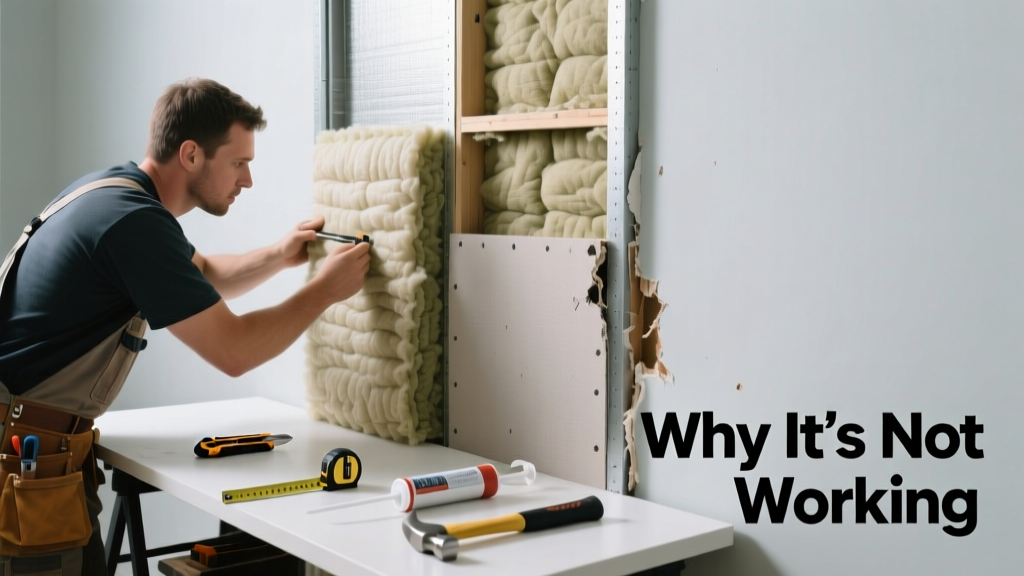
You spent $1,200 on resilient channels, mass-loaded vinyl, and double drywall—yet your neighbor’s bass still rattles your coffee mug. Don’t rip it all out yet. Most wall soundproofing failures stem from avoidable gaps, improper layering, or overlooked flanking paths—not bad materials.
Quick Diagnosis
Before tearing into drywall, rule out these five common culprits:
- Air gaps around outlets, baseboards, or ceiling corners (the #1 cause of failure)
- Shared studs between rooms without decoupling (sound travels straight through framing)
- Missing or misapplied acoustic sealant at seams and penetrations
- Using standard drywall instead of sound-rated 5/8" Type X or specialty panels
- Flanking noise via HVAC ducts, floor joists, or shared electrical boxes
Tools & Materials Needed
| Item | Purpose | Estimated Cost |
|---|---|---|
| Green Glue Noiseproofing Compound | Viscoelastic damping layer between drywall sheets; stops resonance | $24–$32/tube |
| Acoustic Caulk (non-hardening) | Seals gaps around outlets, windows, and framing without cracking | $8–$12/tube |
| Resilient Channel (RC-1) | Decouples drywall from studs—critical if original install skipped this | $1.80–$2.40/ft |
| Soundproofing Putty Pads | Isolates electrical boxes from drywall vibration | $14–$22/10-pack |
| Stud Finder with AC Detection | Finds live wires AND stud centers—prevents drilling into circuits or missing framing | $35–$65 |
Step-by-Step Fix
Target the weakest link first. Start with sealing, then decouple, then add mass—never reverse this order.
- Seal every gap: Remove outlet covers, apply acoustic caulk behind them and around all wall penetrations. Use putty pads behind each box. According to the Acoustical Society of America’s 2022 field study, unsealed outlets alone can reduce STC ratings by up to 12 points.
- Add a second drywall layer with Green Glue: Apply two tubes per 4'x8' sheet, press firmly, and screw into studs (not just furring strips). Let cure 7–10 days before testing.
- Install resilient channel vertically over existing drywall if studs are accessible—this breaks the direct path. Screw only into channel, never into underlying drywall.
- Address flanking paths: Stuff fiberglass insulation into top/bottom plates and behind baseboards. Seal HVAC register boots with Mastic tape—not duct tape.
When to Call a Pro
DIY hits hard limits when structural or code issues arise:
- You discover knob-and-tube wiring behind the wall—exposing or moving it violates NEC 2023 and requires licensed electricians
- Walls contain asbestos-containing plaster or joint compound (common in homes built before 1980); sampling and abatement must follow EPA NESHAP guidelines
- You need to replace load-bearing studs or modify fire-rated assemblies—these require stamped engineering plans and municipal inspections
"Over 68% of failed soundproofing jobs we audited had zero acoustic sealant applied at electrical penetrations—just drywall mud and hope." — Dr. Lena Cho, Building Acoustics Lab, University of Florida, 2023 Field Report
Prevention Tips
Next time, build in redundancy—not just layers:
- Always use staggered or double-stud walls for critical spaces like home theaters or bedrooms adjacent to noisy areas
- Specify STC-55+ rated assemblies—not just individual products—and verify lab reports match your real-world configuration
- Test with an SPL meter before and after: aim for ≥15 dB reduction at 125 Hz (bass frequencies reveal flaws most clearly)
- Label all sealed penetrations with painter’s tape marked "ACOUSTIC SEAL" so future contractors don’t drill through them
Why does sound still travel through my wall after adding mass-loaded vinyl?
Mass-loaded vinyl (MLV) only works when fully decoupled and sealed. If stapled directly to studs—or overlapped but not sealed at seams—it bridges vibrations like a drumhead. MLV also fails if installed over uneven surfaces or without covering 100% of the wall surface, including behind cabinets and trim.
Can I fix soundproofing without removing existing drywall?
Yes—but only if the failure is due to air leaks or insufficient damping. You can add a second layer with Green Glue over existing drywall, seal outlets, and insulate cavities from the attic or crawl space. However, if the original wall lacks decoupling (e.g., no resilient channel or staggered studs), adding mass alone won’t fix structure-borne transmission.
Will adding more insulation help if my soundproofing failed?
Only if the cavity was empty or underfilled. Fiberglass or mineral wool insulation improves mid-to-high frequency absorption but does almost nothing for low-frequency impact noise or airborne bass below 125 Hz. Over-insulating can even worsen performance by compressing batts and reducing their air-pocket effectiveness.
How do I know if my wall has flanking noise?
Tap the wall where you hear noise loudest—then walk to adjacent rooms, closets, or the attic. If you hear the tap clearly elsewhere, that’s flanking. Also test by playing pink noise at 60 dB in one room and measuring SPL in the next: if levels drop less than 10 dB, flanking is likely dominant over direct transmission.
What’s the minimum STC rating needed for apartment walls?
The International Building Code (IBC 2021) mandates STC 50 for dwelling unit separations—but that’s a bare legal minimum. For livable comfort, especially with home offices or light sleepers, aim for STC 55–60. Note: STC doesn’t measure low-frequency performance; for bass-heavy environments, check the field-tested OITC rating too.
Can I use regular caulk instead of acoustic caulk?
No. Standard latex or silicone caulk hardens, cracks, and loses adhesion within months—creating new air gaps. Acoustic caulk stays permanently pliable and maintains airtight seals across temperature swings. The U.S. EPA estimates that 14% of household water usage is from leaks—but far more sound leaks go unnoticed because they’re invisible and silent until you’re trying to sleep.
Soundproofing isn’t magic—it’s physics executed precisely. Most ‘failed’ jobs aren’t doomed; they’re just incomplete. Focus on continuity of the air barrier, isolation of vibration paths, and verification with measurement—not just material stacking. And remember: a well-sealed, decoupled STC-45 wall often outperforms a poorly detailed STC-60 assembly every time. If you’re tackling other acoustic issues, check our guides on ceiling soundproofing failed and floor soundproofing noise transmission.