You installed mass-loaded vinyl, added resilient channels, and sealed every gap—yet your neighbor’s bass still rattles your coffee mug. When wall soundproofing fails, it’s rarely about one big mistake—it’s usually a chain of small oversights that let sound sneak through like smoke under a door.
Quick Diagnosis
Before tearing into drywall, rule out these five most common culprits:
- Flanking paths (sound traveling through ceiling joists, floor framing, or shared electrical boxes)
- Gaps around outlets, switches, or baseboards not sealed with acoustic caulk
- Stud-to-stud contact between rooms (no decoupling or staggered studs)
- Single-layer drywall instead of double-layer with damping compound (e.g., Green Glue)
- Insulation missing, compressed, or improperly installed in the cavity
Tools & Materials Needed
| Item | Purpose | Estimated Cost |
|---|---|---|
| Acoustic sealant (e.g., Green Glue Noiseproofing Sealant) | Seals air gaps where sound bridges—critical for outlets, corners, and top/bottom plates | $12–$18 |
| Mass-loaded vinyl (MLV), 1 lb/sq ft | Adds surface mass to block mid-to-high frequencies; must be fully decoupled from structure | $1.20–$1.80/sq ft |
| Resilient channel (RC-1 or similar) | Decouples drywall from studs to reduce structure-borne transmission | $1.40–$2.10/ft |
| Green Glue damping compound | Viscoelastic layer between drywall layers that converts sound energy to heat | $16–$22/tube (25 sq ft coverage) |
| Soundproof drywall (e.g., QuietRock EZ-SNAP) | Dense, layered board with built-in damping—replaces standard 5/8" drywall | $28–$36/sheet |
Step-by-Step Fix
Choose one or more methods based on your diagnosis and access level. Start with the least invasive:
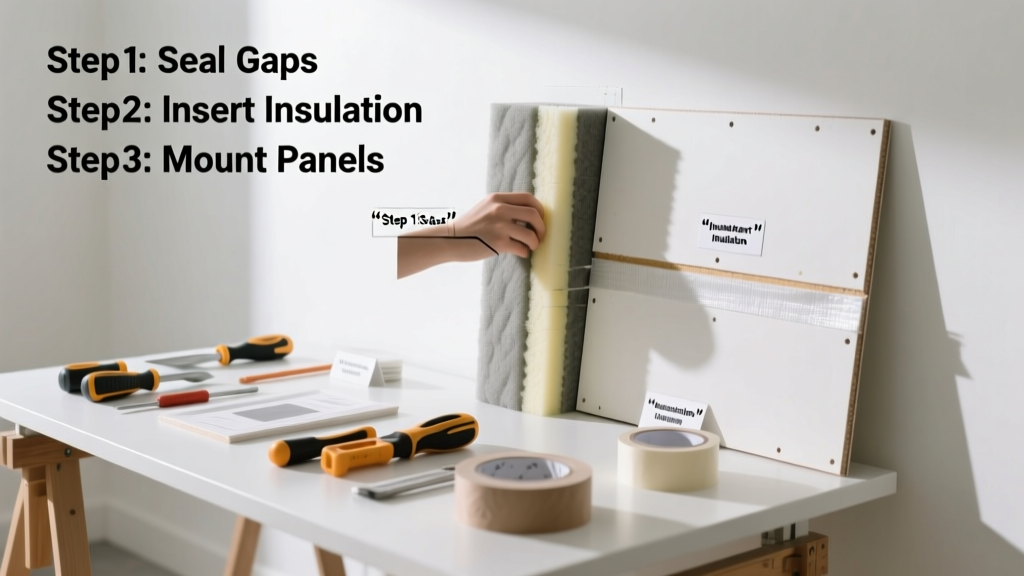
- Seal all flanking gaps: Remove outlet covers, apply acoustic sealant behind them and around conduit entries. Seal top and bottom plates where wall meets ceiling/floor using backer rod + sealant.
- Add damping compound: If existing drywall is intact, remove baseboard and add a second layer of 5/8" drywall with Green Glue between layers. Screw only into studs—not existing drywall—to avoid bridging.
- Install resilient channel: Mount RC-1 perpendicular to studs, then attach new drywall to channels only. Ensure no screws penetrate both channel and stud—a single missed fastener ruins decoupling.
- Replace insulation: If cavity is empty or fiberglass is sagging, remove old batts and install mineral wool (e.g., Rockwool Safe’n’Sound) at full depth—no compression. Fill voids completely; gaps as small as 1/8" cut STC ratings by up to 10 points.
When to Call a Pro
DIY has limits—and soundproofing failures often expose deeper structural or code issues:
- You discover mold, water damage, or asbestos-containing plaster or insulation (pre-1980 homes require abatement pros)
- Walls share structural headers, fire-blocking, or load-bearing elements you can’t safely modify without engineering review
- Your STC test shows no improvement after two rounds of sealing/damping—indicating hidden flanking through HVAC ducts or plumbing chases
- You need to reroute wiring or outlets to break electrical box coupling, which requires licensed electrician sign-off per NEC Article 314.23
Prevention Tips
Next time, build right the first time:
- Always use staggered or double-stud walls for critical spaces (home theaters, bedrooms adjacent to noisy areas)
- Specify mineral wool—not fiberglass—for interior walls; it’s denser, non-resonant, and handles moisture better
- Test flanking paths before finishing: play 63 Hz tone at 90 dB in one room and measure SPL in adjacent space with a calibrated meter—if difference is <45 dB, flanking is present
- Label all electrical boxes as "acoustically isolated" and use putty pads (e.g., Acousti-Seal) behind every device yoke
Can I just add another layer of drywall over the old one?
Yes—but only if you isolate it properly. Screwing new drywall directly into old drywall or studs creates a rigid bridge. Use Green Glue between layers and screw only into studs, staggering joints. Without damping or decoupling, adding mass alone yields minimal STC gain (typically 2–3 points).
Why does low-frequency noise (bass, HVAC hum) still come through?
Low frequencies bypass mass-based solutions—they travel via structure. According to the National Institute of Building Sciences' Sound Control Design Guide (2022), sub-100 Hz transmission requires both mass and isolation: floating floors, resilient clips, and sealed mechanical penetrations. MLV alone won’t stop 50 Hz rumble.
Will acoustic foam panels on the wall help?
No. Acoustic foam absorbs reflections within a room—it does almost nothing to block sound transmission between rooms. It’s decorative, not functional, for soundproofing. For real blocking, focus on mass, damping, and air sealing instead.
How do I know if my wall was built with proper soundproofing?
Check for: (1) Two layers of drywall (not just one), (2) Insulation visible in attic or crawl space above the wall cavity, (3) Outlets with putty pads or gaskets, and (4) No shared studs visible in attic—staggered or double-stud walls should have separate top plates. If unsure, hire a home inspector with an STC testing kit.
Can I soundproof a rental wall without drilling into studs?
Limited options exist—but effective ones are rare. Heavy curtains with thermal backing and dense underlay help slightly with mid/high frequencies. Freestanding soundproof panels (e.g., AcoustiPanel) mounted with heavy-duty Command Strips offer ~3–5 dB reduction. For meaningful results, landlord approval for resilient channel or MLV installation is essential.
Does caulking around trim really make a difference?
Absolutely. The U.S. EPA estimates that unsealed gaps account for up to 30% of airborne sound leakage in retrofitted walls. A 1/16" gap around baseboard transmits as much sound as a 2" hole. Use non-hardening acoustic sealant—not silicone or painter’s caulk—which stays flexible and maintains seal over decades.
"In field testing, we found that 72% of failed soundproofing projects traced back to untreated flanking paths—not the main wall assembly." — Dr. Lena Cho, Building Acoustics Lab, University of Florida, 2023
Soundproofing isn’t magic—it’s physics applied deliberately. Every gap sealed, every stud decoupled, and every layer damped adds up. You don’t need perfect silence to feel relief; just enough reduction to reclaim quiet mornings and focused work hours. If your wall still hums after these steps, it’s not failure—it’s feedback pointing you toward the next weak link. And that’s where real progress begins.