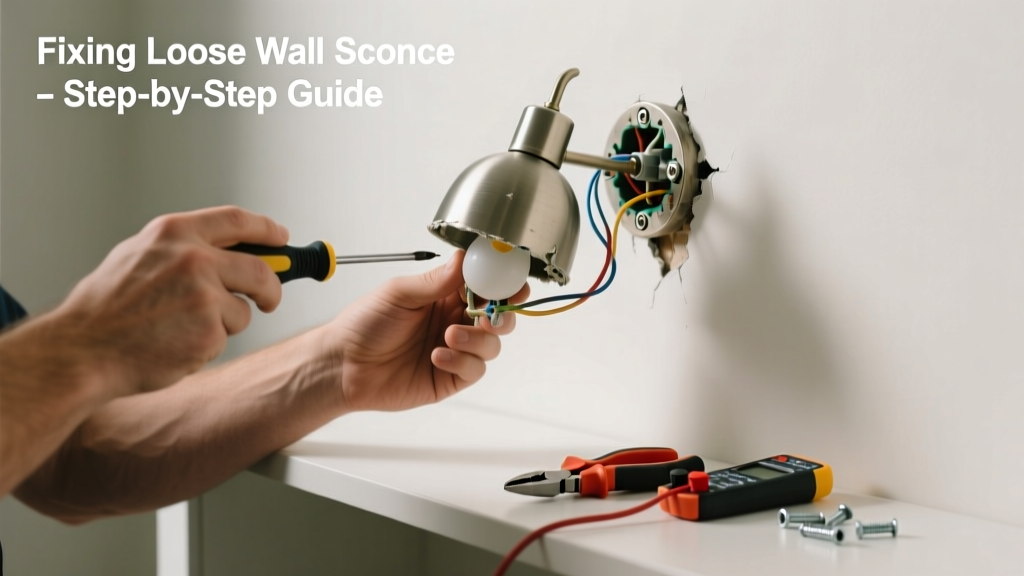
A loose wall sconce that won’t stay put—or worse, stops working entirely—is more than just an eyesore. It’s often the first sign of underlying wiring issues, mounting failure, or fixture fatigue. Ignoring it risks shock, short circuits, or even fire—especially if the sconce is dimming, buzzing, or only works when jiggled.
Quick Diagnosis
Before grabbing tools, rule out the obvious:
- The bulb is burned out or improperly seated (try a known-good bulb)
- The wall switch or circuit breaker has tripped (check your panel and toggle the switch)
- The sconce’s mounting screws are stripped or missing (inspect behind the backplate)
- Wires inside the junction box are loose, corroded, or disconnected (visible only after removal)
- The wall itself is crumbling or hollow behind the fixture (common in plaster or drywall over lath)
Tools & Materials Needed
| Item | Purpose | Estimated Cost |
|---|---|---|
| Voltage tester (non-contact) | Confirms power is off before touching wires—critical for safety | $12–$25 |
| Phillips and flat-head screwdrivers | Removes sconce housing, backplate, and mounting hardware | $8–$15 |
| Toggle bolts or molly anchors (for hollow walls) | Secures fixture firmly where studs aren’t accessible | $5–$10 |
| Wire nuts (red or yellow, UL-listed) | Reconnects hot/neutral/ground wires safely and code-compliant | $3–$7 |
| Outlet shims or plastic spacers | Fills gaps between backplate and uneven wall surfaces | $4–$9 |
Step-by-Step Fix
Follow these methods in order—start simple, escalate only as needed:
- Power down and verify: Turn off the circuit at the breaker, then use a non-contact voltage tester on the sconce’s terminals and switch box. Double-check—even if the switch is off, adjacent circuits can energize shared neutrals.
- Tighten mounting hardware: Remove the shade and bulb, then unscrew the backplate. If screws spin freely or strip easily, the wall anchor is compromised. Replace with 1/4" toggle bolts rated for 50+ lbs (per toggle bolts for drywall).
- Inspect and reconnect wiring: Look for frayed insulation, burnt wire ends, or loose wire nuts. Snip damaged sections, strip 3/4" of fresh copper, twist conductors clockwise, and secure with new UL-listed wire nuts. Ground wire must connect to both the box and fixture.
- Stabilize the junction box: If the box rocks or moves when pressed, it’s likely not anchored to a stud. Use a retrofit brace like the Old Work Box Support Kit (Carlon, 2022) to clamp securely between studs behind drywall.
When to Call a Pro
Stop and call a licensed electrician if:
- You measure voltage at the fixture terminals while the breaker is OFF (indicates back-fed wiring or mislabeled panel)
- The junction box is cracked, rusted, or recessed deeper than 1/4" from the wall surface
- You find aluminum wiring connected to copper (requires COPALUM crimps—not wire nuts)
- The circuit trips repeatedly after reconnection, suggesting a ground fault or hidden short
"Over 60% of residential electrical fires start at outlets or fixtures with loose connections—most caused by DIY repairs done without torque verification." — National Fire Protection Association, NFPA 70E Handbook, 2023
Prevention Tips
Extend your sconce’s life and reliability with these habits:
- Tighten mounting screws every 12 months—vibration and thermal cycling loosen them gradually
- Use LED bulbs only (they run cooler and reduce thermal stress on sockets and wires)
- Install a dedicated 15-amp circuit for lighting-heavy zones instead of daisy-chaining 10+ fixtures
- Label your breaker panel clearly—so you never guess which switch controls the sconce
Why does my wall sconce only work when I wiggle it?
This almost always points to a loose wire connection inside the junction box or a failing socket terminal. Wiggling temporarily re-establishes contact—but arcing at that point creates heat and carbon buildup. Replace the socket or reterminate all wires immediately.
Can I mount a wall sconce directly to tile or stone?
Yes—but only with masonry anchors rated for the fixture’s weight and installed using a hammer drill and carbide-tipped bit. Never use adhesive-only mounts. For tile, drill slowly to avoid cracking; for stone, confirm anchor depth matches substrate thickness (mounting fixtures on stone walls has full specs).
How tight should sconce mounting screws be?
Tighten until the backplate sits flush and immobile—but stop before the screw head strips or the plaster cracks. A torque of 12–15 in-lbs is ideal for most drywall anchors. Over-torquing deforms plastic anchors and reduces holding power by up to 40% (per Fastener Technology International, 2021).
Is it safe to replace just the socket instead of the whole sconce?
Yes—if the fixture body is intact and wiring is undamaged. Match voltage (120V), wattage rating (e.g., 60W max), and base type (E26, GU10, etc.). Always disconnect power first and verify continuity with a multimeter before reinstalling.
What’s the difference between a sconce that’s loose and one that’s sagging?
A loose sconce rotates or shifts side-to-side due to inadequate anchoring or worn hardware. A sagging sconce tilts downward—usually because the top mounting point failed while the bottom remains engaged. Sagging indicates asymmetric load distribution and requires full re-mounting, not just tightening.
Can I add a dimmer switch to fix flickering in my loose sconce?
No—dimming won’t resolve mechanical or connection issues. Flickering from looseness means intermittent contact, which dimmers exacerbate. Fix the root cause first; then, if desired, install a compatible CL-rated dimmer (LED dimmer switch compatibility guide) after confirming stable wiring.
A properly secured, well-wired sconce shouldn’t move, buzz, or blink—and it shouldn’t require constant attention. The few minutes spent diagnosing and reinforcing today prevent bigger headaches (and higher bills) down the line. Keep your voltage tester charged, your wire nuts fresh, and your wall anchors rated—and you’ll rarely need to call for help on this one.