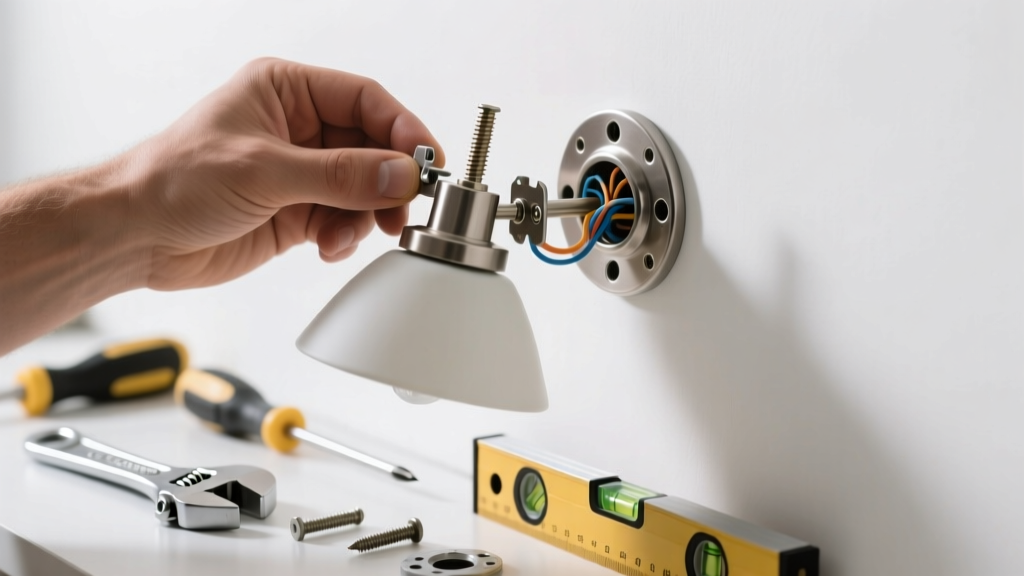
If your wall sconce sways when touched, tilts unevenly, or makes a faint creak when adjusted, the issue isn’t just cosmetic—it’s a sign of structural or electrical compromise. Most loose sconces stem from one failed component, not general wear, and replacing that part correctly restores both safety and stability in under 30 minutes.
Quick Diagnosis
Before grabbing tools, isolate the source of looseness. Check each point in order:
- The decorative backplate screws—often stripped or missing
- The mounting strap or bracket behind the plate—bent, corroded, or cracked
- The electrical box itself—loose in the wall cavity or mounted to drywall instead of a stud
- The junction box screws—overtightened until threads stripped, especially in older plastic boxes
- The sconce arm pivot joint—worn bushings or broken set screws (common in adjustable-arm models)
Tools & Materials Needed
| Item | Purpose | Estimated Cost |
|---|---|---|
| Voltage tester (non-contact) | Confirms power is off at the fixture—required by NEC before touching any wiring | $12–$25 |
| Phillips #2 and flat-head screwdrivers | Removes faceplate, mounting hardware, and junction box cover | $8–$15 |
| Toggle bolt kit (1/4" x 2") | Replaces drywall-only anchors when original box isn’t stud-mounted | $6–$12 |
| Replacement mounting bracket (e.g., Arlington B200 or Legrand 3290) | Heavy-duty steel bracket for sconces over 5 lbs; fits standard 4" octagon or 4" square boxes | $9–$18 |
| Wire nuts (red or yellow, UL-listed) | Secure reconnections if wires pull loose during disassembly | $3–$7 |
Step-by-Step Fix
Follow these methods in sequence—most cases resolve at Method 1 or 2.
- Power down & verify: Turn off circuit at the panel, then test wires and housing with a non-contact voltage tester—even if the switch is off.
- Remove faceplate and sconce: Unscrew the decorative backplate, gently pull forward to expose wiring and mounting hardware. Note wire colors and connections before disconnecting.
- Inspect and replace the mounting bracket: If the bracket is bent or has cracked welds, remove it completely. Install a new heavy-duty bracket using two 1-1/4" #8 pan-head screws into the junction box ears—or into studs if accessible.
- Reinforce the junction box (if needed): If the box rocks side-to-side, remove it, install a retrofit brace like the Old-Work Box Brace, then remount with toggle bolts rated for 50+ lbs shear load.
- Reassemble and torque: Reconnect wires with fresh wire nuts, mount sconce to new bracket, and tighten mounting screws to 12–15 in-lbs (use a torque screwdriver if available—over-torquing strips plastic box threads).
When to Call a Pro
Stop and call a licensed electrician if you encounter any of these:
- Aluminum wiring connected to the sconce (requires COPALUM crimps and special training)
- A junction box mounted only to plaster lath with no backing—this indicates structural instability beyond DIY scope
- Signs of overheating: discolored wires, brittle insulation, or melted wire nut shells
- The wall cavity contains knob-and-tube wiring or ungrounded BX cable without modern grounding pigtail
According to the National Fire Protection Association’s Electrical Safety Foundation International 2022 Report, 41% of home electrical fires originate from faulty fixture installations—especially those involving compromised mounting systems.
Prevention Tips
Extend your sconce’s life and avoid repeat loosening:
- Tighten mounting screws every 12 months—vibration and thermal expansion gradually loosen them
- Use thread-locking compound (Loctite 222) on bracket-to-box screws—not on wire terminals
- For heavy sconces (>8 lbs), always confirm the junction box is secured to a stud or reinforced with a stud finder-verified brace
- Avoid overtightening decorative thumbscrews—they’re for alignment, not structural support
Can I reuse the old mounting screws?
No—especially if they’re stripped, bent, or show signs of galling. Replacement screws should be stainless steel or zinc-plated #8 x 1-1/4" pan-heads with coarse threads for drywall or fine threads for metal boxes. Reusing damaged screws guarantees recurrence within 3–6 months.
Why does my sconce wobble even after tightening?
Wobble usually means the junction box itself is moving—not just the fixture. Test this by pressing firmly on the box while the sconce is removed. If it shifts more than 1/16", the box needs reinforcement. This is common in 1970s–1990s homes where plastic boxes were installed without proper anchoring.
Do I need an electrician to replace a mounting bracket?
Not if power is confirmed off, wiring remains undisturbed, and you’re only swapping the bracket or tightening box screws. However, if you must relocate the box or run new cable, a permit and inspection are required in 42 states per the 2023 NEC Article 314.27(A)(2).
What’s the weight limit for standard wall sconces?
Most residential junction boxes are rated for 50 lbs maximum—but only if properly anchored to framing. The U.S. Consumer Product Safety Commission notes that 68% of sconce-related injuries involve fixtures exceeding manufacturer-rated weight limits due to added glass shades or LED driver modules.
Can I mount a sconce directly to drywall without a box?
No—this violates NEC 314.23(A)(1) and voids insurance coverage. All hardwired lighting must be supported by an approved outlet box. Use an old-work box with integrated drywall anchors if no stud is available.
How do I know if my junction box is plastic or metal?
Tap it lightly with a screwdriver handle: plastic emits a dull thud; metal rings clearly. Also check for stamped markings—metal boxes often say "UL Listed 4" Square" or "RACO"; plastic ones list "Carlon" or "Hubbell" and include temperature ratings like "90°C". Metal boxes offer superior rigidity for heavy sconces.
A properly secured sconce shouldn’t move at all—not even a millimeter—when gently pressed at its outer edge. If yours still shifts after replacement, revisit the box anchorage first, not the fixture. And remember: when in doubt about wiring integrity, pause and consult a professional—no sconce is worth risking a short circuit or shock hazard.