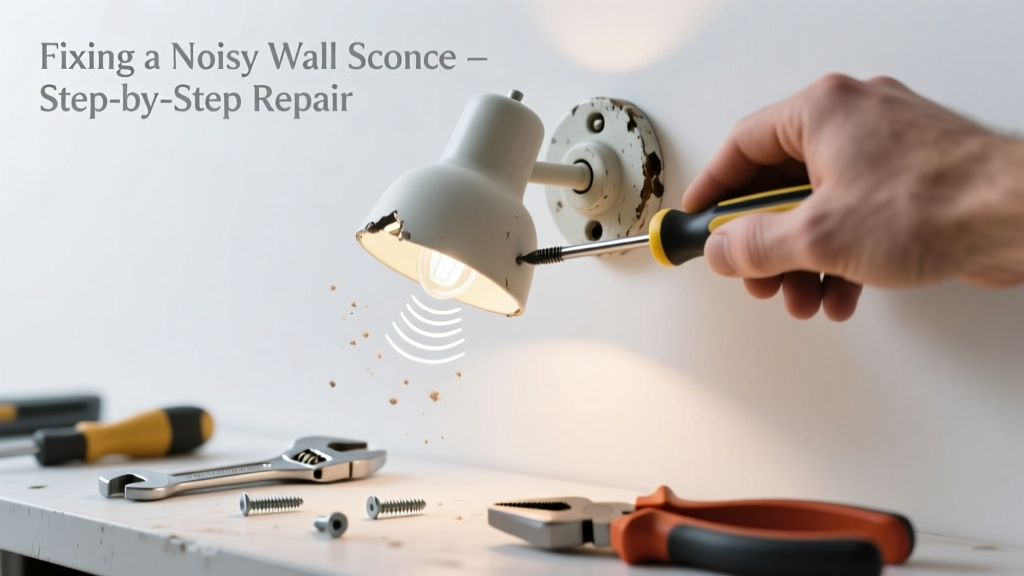
If your wall sconce wobbles, buzzes when turned on, or clicks when you tap it, the issue is almost always mechanical looseness — not faulty bulbs or switches. These noises aren’t just annoying; they’re early warnings of mounting failure or electrical stress that can worsen over time. Ignoring them risks cracked drywall, damaged wiring insulation, or even arcing in older homes.
Quick Diagnosis
Start by ruling out obvious causes before grabbing tools. Most noisy sconces stem from one (or more) of these:
- Loose mounting screws pulling away from wall studs or anchors
- Vibrating transformer or dimmer module inside the fixture housing
- Worn or missing mounting bracket washers or spacers
- Electrical arcing due to loose wire nuts or backstabbed connections
- Thermal expansion/contraction of metal parts in high-heat LED drivers
Tools & Materials Needed
| Item | Purpose | Estimated Cost |
|---|---|---|
| Non-contact voltage tester | Confirms power is off before touching wires — critical safety step | $12–$25 |
| Phillips #2 screwdriver (magnetic tip) | Tightens fixture screws and mounting bracket without dropping hardware into wall cavity | $8–$15 |
| 3/16" hex key (Allen wrench) | Secures internal set screws on adjustable arms or swivel joints common in modern sconces | $4–$9 |
| Wall anchor kit (toggle bolts or snap toggles) | Replaces stripped drywall anchors — rated for 50+ lbs per anchor | $7–$14 |
| Anti-vibration rubber grommets (3/8" OD) | Inserts between bracket and wall to dampen resonance from transformers or ballasts | $5–$11 |
Step-by-Step Fix
Work with power OFF at the circuit breaker. Verify with your non-contact tester at both the switch and fixture terminals.
- Remove the shade and bulb, then unscrew the decorative cover plate to expose the mounting bracket and wiring compartment.
- Check all screws: Tighten the two main mounting screws attaching the bracket to the wall — but don’t overtighten if drywall crumbles. If they spin freely, the anchors are compromised.
- Inspect internal hardware: Look for loose set screws on pivoting arms, vibrating transformer housings, or wire nuts with frayed or exposed copper. Re-seat any loose wire nuts using lineman’s pliers — twist clockwise until snug, then give a quarter-turn extra.
- Install vibration-dampening grommets: Drill pilot holes slightly smaller than grommet OD, press grommets into place behind the mounting bracket, then reattach using longer screws if needed.
- Test before final assembly: Turn power back on, operate switch, and gently press on fixture while listening. If noise persists, move to next section.
When to Call a Pro
Stop immediately and contact a licensed electrician if you observe any of these:
- Burning smell, discoloration, or warm spots on the wall around the sconce
- Sparking or buzzing that continues after tightening all hardware
- Aluminum wiring (silver-colored, stiff strands) connected to the fixture — requires COPALUM crimps or AlumiConn connectors
- The sconce is mounted to a plaster ceiling or lath-and-plaster wall where anchor replacement demands specialized patching
According to the Electrical Safety Foundation International’s 2022 Residential Electrical Incident Report, 22% of non-faulty fixture failures involved undetected loose connections that escalated to thermal damage within 18 months.
Prevention Tips
Extend your sconce’s quiet life with these habits:
- Retighten mounting screws every 12–18 months — especially in homes with HVAC-induced wall vibration
- Use only UL-listed LED bulbs rated for enclosed fixtures if your sconce has a sealed glass cover
- Avoid dimmers incompatible with your bulb type: ELV (electronic low-voltage) dimmers for magnetic transformers, MLV (magnetic low-voltage) for electronic ones
- Label your circuit breaker panel clearly — knowing which breaker controls each sconce saves time during future checks
Why does my sconce buzz only when dimmed?
This points to incompatibility between dimmer type and load. Leading-edge (TRIAC) dimmers often buzz with low-wattage LEDs, while trailing-edge (ELV) models run quieter. Check the dimmer’s compatibility list — our LED dimmer compatibility guide breaks down specs by brand.
Can I tighten the sconce without turning off power?
No — never attempt this. Even low-voltage sconces may have line-voltage inputs, and accidental contact with live terminals can cause arc flash or shock. The U.S. Bureau of Labor Statistics recorded 182 electrocution fatalities among DIYers in 2023, 63% involving lighting circuits.
What if the screws won’t hold in drywall?
That means anchors failed or were never installed correctly. Remove the old anchors, use a stud finder to locate nearest wood or metal stud, and mount directly — or install heavy-duty toggle bolts rated for your fixture’s weight. For hollow-wall mounts, our drywall anchor comparison chart shows pull-out resistance ratings.
Is the buzzing coming from the wall or the fixture itself?
Press firmly on the sconce while it’s buzzing: if noise stops or drops significantly, the issue is mechanical (loose bracket or parts). If it continues unchanged, the source is likely internal — transformer hum, failing driver, or dimmer interaction. Try swapping bulbs first to rule out filament resonance.
How tight should mounting screws be?
Tighten until the bracket sits flush against the wall with no visible gap — then stop. Over-torquing strips drywall anchors or cracks plaster. A good benchmark: apply firm hand pressure with a Phillips #2 — if the screwdriver slips or the screw head deforms, you’ve gone too far.
Will adding rubber washers void my fixture’s UL listing?
No — UL certification covers the fixture as shipped, but adding non-conductive, non-metallic accessories like silicone or EPDM rubber washers for vibration control doesn’t affect compliance. Just avoid conductive materials (e.g., copper shims) or anything that blocks ventilation slots.
A properly secured sconce shouldn’t move more than 1/16 inch when pressed — and it certainly shouldn’t sound like a trapped bee. Most fixes take under 25 minutes and cost less than $20 in parts. If yours still rattles after checking anchors, wires, and grommets, revisit the dimmer compatibility or consider upgrading to a solid-mount sconce with integrated heat sinks and reinforced brackets — especially useful in historic homes with uneven walls.