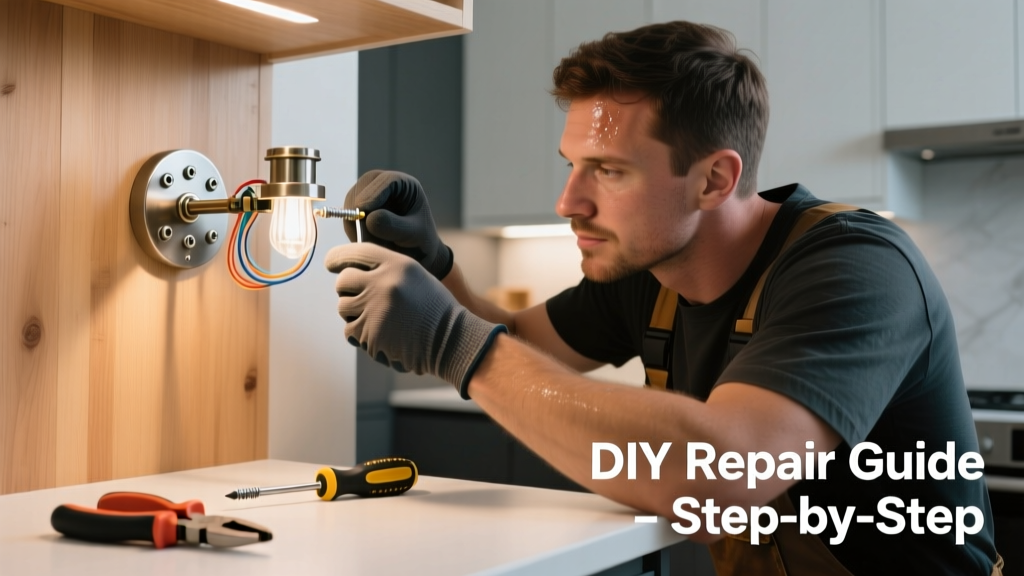
A loose wall sconce in your kitchen isn’t just an eyesore—it’s a subtle red flag. The constant vibration from cabinet doors slamming or even daily use can loosen mounting hardware over time, risking cracked plaster, damaged wiring, or worse: a falling fixture. Don’t ignore that gentle rattle when you flip the switch.
Quick Diagnosis
Before grabbing tools, identify the root cause. Most kitchen sconce looseness stems from one (or more) of these:
- Stripped screw holes in drywall or plaster
- Overtightened or corroded mounting screws
- Loose junction box behind the fixture
- Improperly anchored box—especially in older homes with lath-and-plaster walls
- Vibration from nearby appliances (e.g., dishwasher or range hood)
Tools & Materials Needed
| Item | Purpose | Estimated Cost |
|---|---|---|
| Non-contact voltage tester | Confirms power is off before touching wires—critical for safety | $12–$25 |
| Phillips #2 screwdriver | Tightens mounting screws and terminal connections | $4–$10 |
| Toggle bolts or plastic anchors (1/4") | Replaces stripped drywall holes with secure load-bearing support | $6–$12 |
| Stud finder with AC detection | Locates wall studs *and* verifies no live wires are in drilling path | $20–$45 |
| Wire nuts (red or yellow) | Secures wire connections if re-terminating leads | $3–$8 |
Step-by-Step Fix
Choose the method that matches your diagnosis:
- Method 1: Tighten existing hardware — Turn off power at the breaker. Remove the sconce shade and backplate. Check all screws—including those securing the junction box to framing. Tighten *gently*: overtorquing can strip threads or crack ceramic bases.
- Method 2: Reinforce stripped drywall holes — If screws spin freely, remove them and insert plastic wall anchors rated for 30+ lbs. For heavier sconces (e.g., brass or glass), use snap-toggle bolts—these expand behind the drywall for superior hold.
- Method 3: Secure a loose junction box — If the box rocks or shifts, it’s likely not screwed into a stud or blocking. Shut off power, remove the box cover, and verify mounting. Add a retrofit brace like the Old-Work Box Brace if no stud is accessible.
- Method 4: Replace with a stud-mounted sconce — For recurring issues, relocate the fixture directly over a stud using a new junction box. This requires cutting a small access hole and fishing cable—see our guide on kitchen lighting wiring.
When to Call a Pro
Stop and call a licensed electrician if:
- You detect burning smells, discolored wires, or warm outlets near the sconce
- The junction box is recessed deeper than 1/4" from the wall surface (indicating potential structural compromise)
- You’re working in a condo or rental where altering walls violates building codes
- Wiring shows brittle insulation (common in homes built before 1985) or aluminum branch circuits
"Over 70% of fixture-related electrical fires start at loose connections—not faulty bulbs," says the National Fire Protection Association’s Electrical Safety Foundation Report (2022).
Prevention Tips
Extend your fix’s lifespan with these habits:
- Tighten sconce mounting screws every 6 months during routine cleaning
- Use thread-locking compound (Loctite Blue 242) on non-electrical screws to resist vibration
- Install rubber grommets between metal backplates and wall surfaces to dampen resonance
- Avoid hanging heavy decorative shades without verifying weight rating on the fixture label
Can I reuse the original screws after tightening?
No—especially if they’ve spun in stripped drywall. Reused screws rarely regain holding power. Always replace with longer or wider-diameter screws, or upgrade to toggle bolts. As electrician Maria Chen notes in Residential Wiring Today (2021): “A screw that’s been cycled loose three times has lost over 60% of its pull-out resistance.”
Why does my sconce only wiggle when I touch the shade?
This points to a loose internal connection—not just mounting hardware. The shade attaches to a stem or arm that’s secured by set screws inside the backplate. Remove the shade and inspect for tiny Allen or Phillips screws near the pivot point; tighten with a precision driver.
Is it safe to caulk around the sconce base to stop movement?
No. Caulk hides underlying problems and traps moisture against electrical components. It also violates NEC 314.15, which prohibits sealing outlet/fixture boxes unless rated for wet locations. Use mechanical fasteners—not adhesives—for safety and code compliance.
What’s the weight limit for standard drywall anchors in kitchen walls?
Most plastic anchors hold 30–50 lbs *in ideal 1/2" drywall*. But kitchens add humidity and temperature swings, reducing effective capacity by up to 40%. For sconces over 5 lbs, use metal toggle bolts rated for 75+ lbs—or mount directly to framing.
Can I install a wall sconce over tile without removing it?
Yes—but only with proper anchoring. Use a carbide-tipped masonry bit and epoxy-set anchors like Tapcon screws. Drill slowly to avoid cracking grout lines. Confirm tile thickness first: most kitchen backsplashes are 1/4"–3/8", requiring longer anchors than drywall-only installs.
Do LED sconces vibrate less than incandescent ones?
Not inherently—but many modern LED fixtures include internal dampening and lighter-weight housings. More importantly, LEDs draw less current, reducing electromagnetic hum in transformers and drivers—a common source of subtle buzz-induced vibration in older magnetic low-voltage systems.
A properly secured sconce should sit flush, silent, and steady—even when you gently nudge the shade. If yours still moves after reinforcement, revisit the junction box integrity or consider upgrading to a solid-mount design. And remember: in the kitchen, where steam, grease, and frequent use accelerate wear, a little preventive attention now saves bigger headaches—and potential hazards—down the line.