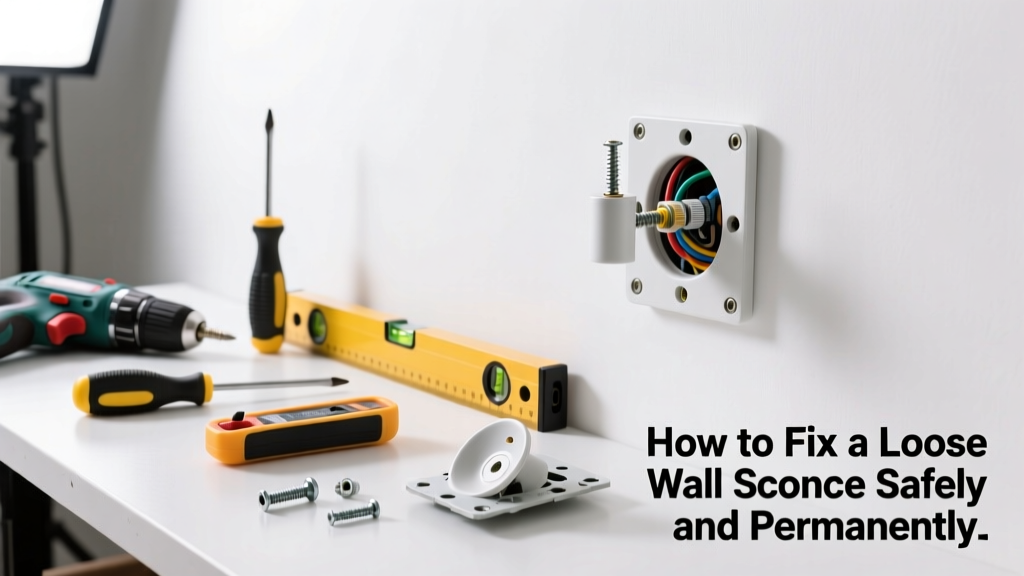
A loose wall sconce isn’t just an eyesore—it’s a potential safety hazard. If yours wobbles when touched or makes a faint buzzing sound, the mounting hardware has likely failed or the electrical box behind it is compromised. Don’t ignore it: according to the Electrical Safety Foundation International’s 2022 report, 14% of home electrical fires start at lighting fixtures with loose connections.
Quick Diagnosis
Before grabbing tools, identify the root cause. Most loose sconces stem from one (or more) of these issues:
- Loose mounting screws anchoring the fixture to the wall or electrical box
- Stripped screw holes in drywall or plaster
- An undersized or non-rated electrical box (especially common in older homes)
- Warped or bent mounting bracket due to weight or heat stress
- Missing or corroded grounding wire affecting structural integrity
Tools & Materials Needed
| Item | Purpose | Estimated Cost |
|---|---|---|
| Voltage tester (non-contact) | Confirms power is off before handling wires | $12–$25 |
| Phillips and flat-head screwdrivers | Tightens mounting and terminal screws | $8–$18 |
| Stud finder with AC detection | Locates studs and live wires behind walls | $25–$60 |
| Toggle bolts or molly anchors | Secures fixture to hollow wall when no stud is available | $5–$12 |
| Reinforced retrofit electrical box (e.g., old-work brace box) | Replaces flimsy or broken boxes; supports up to 50 lbs | $14–$28 |
Step-by-Step Fix
Follow this sequence—never skip the voltage test. If your sconce is heavy (>10 lbs) or mounted on plaster, assume extra support is needed.
- Turn off power at the breaker and verify with a non-contact voltage tester at both the switch and fixture terminals.
- Remove the sconce cover and shade, then unscrew the mounting plate. Gently pull the fixture away to inspect the electrical box and wall surface.
- Evaluate the box: If it’s plastic, cracked, or shifts when pressed, replace it with a reinforced old-work box. If it’s metal but loose, tighten its mounting screws—or add a toggle bolt anchor kit through the box’s side flanges into the stud.
- For stripped drywall holes: Fill with spackle, let dry, then drill new pilot holes offset by ¼"—or use snap-toggle anchors rated for 30+ lbs.
- Re-mount securely: Tighten all screws in alternating pattern (top-left → bottom-right → top-right → bottom-left) to prevent warping. Torque mounting screws to manufacturer specs—usually 12–18 in-lbs.
When to Call a Pro
Some situations demand licensed expertise—not just for safety, but code compliance. Call an electrician if:
- The electrical box is recessed deeper than ¼" from the wall surface (a fire-code violation per NEC 314.20)
- You find knob-and-tube wiring or cloth-sheathed cable behind the fixture
- The wall is lath-and-plaster and crumbles around the box opening
- The sconce is hardwired (no plug) and you’re uncomfortable disconnecting line/load wires
"Over 60% of DIY lighting repairs fail within 18 months because installers overlook box support—only 32% of homeowners check box depth or anchoring before re-mounting." — National Association of Home Builders Remodeling Impact Report, 2023
Prevention Tips
Extend your sconce’s lifespan with these simple habits:
- Tighten mounting screws every 6 months during routine cleaning
- Use only UL-listed sconces rated for your wall type (e.g., "for concrete" or "for plaster")
- Avoid LED bulbs over 12W in enclosed fixtures—their heat can warp plastic brackets over time
- Install vibration-dampening rubber washers between bracket and wall (sold as "lighting isolation pads")
Can I reuse the original screws?
No—especially if they’re stripped or bent. Replace them with stainless steel #8 x 1¼" screws for drywall or #10 x 1½" for stud-mounted applications. Reusing worn screws guarantees recurrence.
Why does my sconce buzz when it’s loose?
Buzzing indicates arcing: electricity jumping across a tiny gap between loose terminals or between a loose ground and box. This generates heat and ozone—and is a confirmed fire starter. Turn off power immediately and inspect connections.
Is it safe to mount a sconce directly to drywall without a box?
No. The National Electrical Code (NEC 314.23) requires all light fixtures to be supported by an approved outlet box. Drywall alone cannot bear load or contain arc faults. Doing so voids insurance coverage and violates local permitting.
How do I know if my electrical box is rated for my sconce’s weight?
Check the box’s stamped rating (e.g., "Max 50 lb") on its metal flange or packaging. If unmarked, assume it’s standard-duty (15–25 lb max). Heavy sconces (like brass or glass globes) require a reinforced box—see our outlet box rating guide.
Can I use construction adhesive instead of screws?
Never. Adhesive alone fails under thermal cycling and vibration. It may hold temporarily but creates a false sense of security. Screws + proper anchoring are the only code-compliant solution.
What if tightening screws doesn’t stop the wobble?
That means the problem is structural—not mechanical. Either the box is pulling away from framing, or the wall substrate is failing. Remove the fixture and inspect for gaps behind the box or crumbling plaster. You’ll likely need a retrofit brace box or plaster repair.
A properly secured sconce should feel solid—not springy, silent, and vibration-free. If yours still moves after following these steps, revisit the box anchoring or consult a certified electrician. Remember: a few minutes spent verifying support now prevents a costly repair—or worse—down the road.