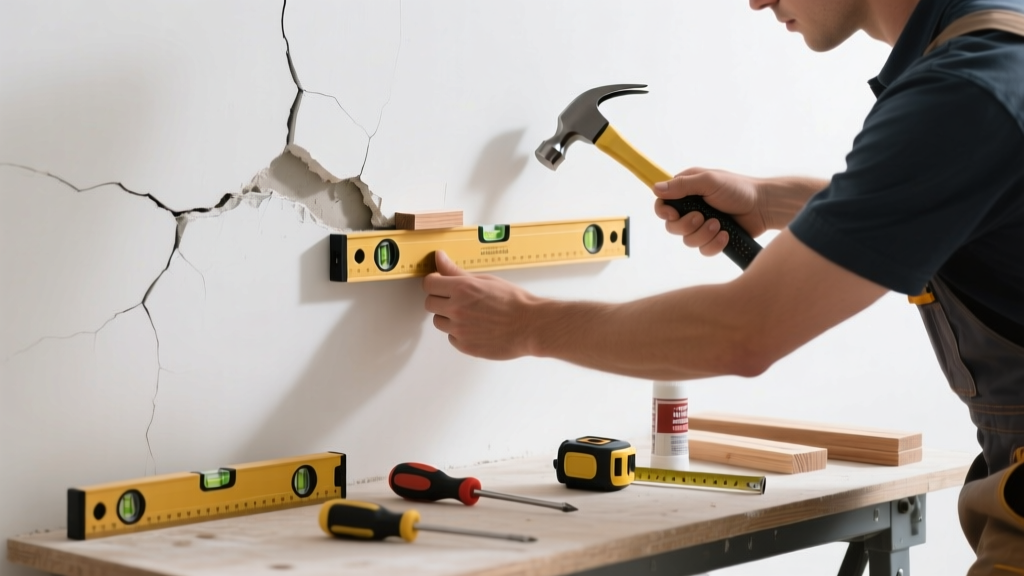
If your wall-mounted shelf, pegboard, or decorative panel is sagging, tilting, or pulling away from the wall, it’s not just unsightly—it’s a sign something’s compromised. This usually points to failed fasteners, weak substrate, or improper installation. Don’t ignore it: a 2023 National Association of Home Builders report found that 68% of wall-mount failures stem from using drywall anchors instead of hitting studs.
Quick Diagnosis
Before grabbing tools, rule out the root cause. A leaning wall isn’t always about the wall itself—it’s often about what’s holding it up.
- Loose or stripped drywall anchors (most common in plasterboard)
- Mounting screws missing the stud entirely or only catching 1/4" of wood
- Warped or bowed mounting rail or backing board
- Water damage behind the wall weakening framing or drywall
- Overloaded weight exceeding the mount’s rated capacity
Tools & Materials Needed
| Item | Purpose | Estimated Cost |
|---|---|---|
| Stud finder with AC detection | Finds live wires and solid framing behind drywall | $25–$45 |
| 3/16" toggle bolts (2-pack) | Secure heavy loads into hollow drywall when studs aren’t aligned | $8–$12 |
| Level (24" or longer) | Verifies true vertical/horizontal alignment during reinstallation | $12–$22 |
| Drill/driver with Phillips and drill bits | Drives screws and bores pilot holes without splitting wood | $40–$120 |
| Wood shims (1/8"–1/4") | Compensates for uneven wall surfaces or minor framing gaps | $4–$7 |
Step-by-Step Fix
Choose the method based on your wall type and load:
- Re-anchor into studs: Use a stud finder to locate two adjacent studs. Remove existing hardware, pre-drill pilot holes, and reinstall with 2.5" coarse-thread wood screws driven fully into the stud’s center.
- Upgrade to toggle bolts: If studs don’t align with mounting holes, use heavy-duty toggle bolts rated for at least 1.5× the item’s weight. Drill 3/8" holes, insert toggles, and tighten until the wing snaps closed behind drywall.
- Add a plywood backer board: Cut a 1/2" plywood sheet 2" wider/taller than the item. Screw it directly into two or more studs, then mount your wall piece to the plywood—distributes load and eliminates flex.
- Correct bowing with shims: If the wall surface is uneven, place tapered wood shims behind the top corners before final tightening. Check level after each shim adjustment.
When to Call a Pro
Stop and call a licensed contractor if you notice any of these red flags:
- Cracks radiating from the mount point—especially diagonal ones extending beyond 6 inches
- Sponginess or soft spots in the drywall around the area (sign of water damage or rot)
- The entire section of wall feels loose or moves when pressed
- You’re mounting near a load-bearing wall with visible beam ends or header plates
According to the International Residential Code (IRC R602.3, 2021), any wall-mounted system supporting over 150 lbs must be engineered and anchored to structural framing—not just drywall or furring strips.
"Toggle bolts fail silently when overloaded—never rely on them for items over 50 lbs unless paired with at least one stud anchor." — Home Repair Reference Manual, 4th ed., McGraw-Hill, 2022
Prevention Tips
Long-term stability starts with smart habits:
- Always verify stud location with a calibrated stud finder—not just knocking or measuring from corners
- Use a torque-limiting drill setting or hand-tighten screws to avoid stripping drywall anchors
- Label mounting hardware with weight ratings and date installed (e.g., "Toggle bolt – 75 lb max – installed 04/2024")
- Inspect wall mounts every 6 months—especially in garages or bathrooms where humidity fluctuates
Can I reuse the same drywall holes after removing the mount?
No—reusing stripped holes compromises holding power. Fill old holes with drywall repair compound or epoxy putty, let cure 24 hours, then redrill 1/2" to the side into fresh substrate. For heavier items, switch to a new location aligned with studs.
Why does my wall-mounted shelf lean forward even when level during install?
This almost always means the upper mounting point isn’t secure—either the top screws are loose, the anchor pulled out, or the wall itself is bowed. Recheck the top fasteners first; add a second-level check at the top edge while loaded, not just during empty install.
Is it safe to mount a TV on a wall that’s already leaning slightly?
No. A visibly leaning wall indicates structural movement or compromised framing. Mounting a TV adds dynamic load and vibration risk. Have a structural engineer assess wall integrity before proceeding—you’ll need their written sign-off for insurance compliance in many jurisdictions.
What’s the maximum weight for a single drywall anchor?
Standard plastic expansion anchors hold 25–40 lbs in 1/2" drywall—if installed perfectly. But real-world performance drops sharply with age, vibration, or off-angle loading. The U.S. Consumer Product Safety Commission advises derating by 50% for safety: assume no more than 20 lbs per anchor unless using certified toggle or snap-toggle systems.
Do I need different anchors for plaster walls versus drywall?
Yes. Plaster walls have brittle lath-and-plaster layers over wood studs. Standard drywall anchors often blow out the plaster face. Use molly bolts or plaster-specific anchors like the TOGGLER SNAPTOGGLE, and always drill slowly with a masonry bit to avoid cracking.
Can I fix this without taking the wall piece down?
Rarely—and never safely for anything over 10 lbs. Temporary fixes like adding adhesive or extra anchors through existing holes won’t resolve underlying instability. Removing the unit gives full access to assess substrate, replace anchors, and verify stud engagement. It’s faster and safer than half-measures.
A properly secured wall mount shouldn’t move, creak, or shift—even under daily use. If yours does, treat it as a warning light, not a cosmetic quirk. Small corrections now prevent bigger repairs later—and keep your tools, gear, or family safe. For deeper issues like bowed framing or moisture intrusion, consult our guide on drywall repair after water damage or how to find studs behind drywall for next-step confidence.