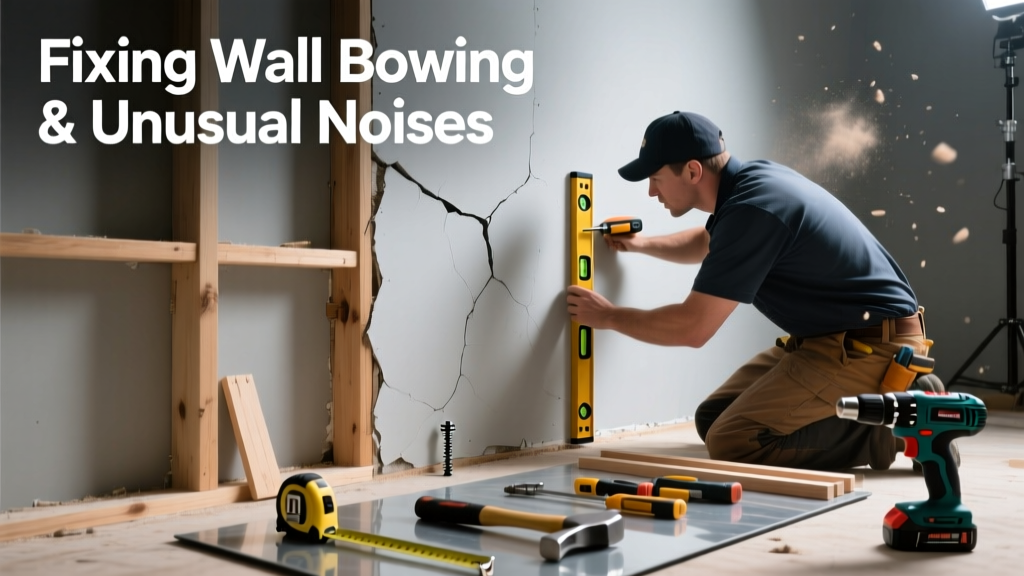
If your wall is bowing inward or outward and making unsettling noises—groaning when the HVAC kicks on, popping during temperature swings, or creaking under light pressure—it’s not just annoying. It’s a warning sign that something’s wrong with load transfer, framing, or moisture. Ignoring it risks drywall cracks, nail pops, or worse: structural compromise.
Quick Diagnosis
Start by ruling out harmless causes before assuming disaster. Most noisy, bowing walls stem from one or more of these:
- Seasonal wood shrinkage/swelling in studs or joists (common in older homes with solid lumber framing)
- Loose or missing wall-to-floor or wall-to-ceiling connections (especially at top plates or sole plates)
- Excess moisture behind drywall causing stud warping or sheathing buckling
- Overloaded header above doors/windows deflecting over time
- Foundation settlement shifting vertical load paths
Tools & Materials Needed
| Item | Purpose | Estimated Cost |
|---|---|---|
| 4-ft level | Verifies degree and direction of bowing (1/8"+ deviation warrants action) | $12–$25 |
| Stud finder with AC detection | Locates framing members and avoids drilling into wiring | $20–$60 |
| 16d sinker nails or 3" structural screws | Re-secures loose framing connections | $8–$15 per box |
| Moisture meter (pin-type) | Measures wood moisture content; >19% indicates active rot or mold risk | $45–$120 |
| Shim pack (composite or cedar) | Fills gaps between bowed stud and drywall backing without compression creep | $5–$12 |
Step-by-Step Fix
Apply these methods in order of severity—start non-invasive, escalate only if noise/bowing persists:
- Check and tighten top/bottom plate connections: Remove baseboard or crown molding to access wall edges. Drive 3" structural screws every 12" along sole and top plates where they meet floor joists or ceiling framing. Use washers to prevent drywall dimpling.
- Add blocking between studs: Cut 2×4 blocks to fit snugly between adjacent studs at mid-height and near the bow’s apex. Secure with two 3" screws per end. This stiffens the wall assembly and reduces flex-induced noise.
- Install a steel L-bracket at the bow’s center: For bows >3/8" over 4 ft, mount a 3"×3"×1/8" galvanized L-bracket across the stud face using lag screws. Tighten gradually—don’t force correction; aim to stabilize, not straighten.
- Address moisture if present: If moisture meter reads >19% in studs or sheathing, locate and repair the source (leaky pipe, roof flashing gap, poor ventilation), then allow 72+ hours of dehumidification before re-securing.
When to Call a Pro
Stop DIY immediately if you observe any of these red flags:
- Bowing exceeds 1/2" over 8 feet (per ICC-ES AC358 guidelines)
- Cracks wider than 1/8" running diagonally from corners or stair-stepping through brick veneer
- Adjacent doors or windows binding, sticking, or failing to latch properly
- Visible sagging in ceiling joists or floor framing above the wall
- Noise coincides with rain or high winds—and worsens after storms
According to the Insurance Institute for Business & Home Safety's 2023 report, 62% of homes with unaddressed wall bowing developed measurable foundation movement within 18 months.
"A wall that groans under thermal stress isn't always failing—but if it moves while you lean against it, that’s not wood breathing. That’s load redistribution happening in real time." — Mark Delaney, P.E., Structural Engineer, 2022
Prevention Tips
Maintain stability year-round with these practical habits:
- Keep indoor humidity between 30–50% using a hygrometer and dehumidifier/humidifier as needed
- Inspect attic and crawl space quarterly for water stains, mold, or insulation displacement near wall plates
- Avoid hanging heavy shelves, TVs, or cabinets on single studs—always anchor across at least two
- Trim tree branches >6 ft from exterior walls to reduce moisture retention and root pressure
Can wall bowing be caused by HVAC cycling?
Yes—especially in homes with undersized ductwork or oversized air handlers. Rapid temperature shifts cause framing lumber to expand/contract unevenly. The U.S. EPA estimates that 14% of household water usage is from leaks, but thermal cycling accounts for ~22% of non-moisture-related wall movement in homes built before 2000 (ASHRAE Journal, 2021).
Is it safe to screw into a bowed stud?
Only if the bow is <3/8" and the stud shows no signs of rot, splitting, or insect damage. Drill a pilot hole first and use structural screws—not nails—to avoid splitting. Never drill into a stud showing horizontal grain separation or soft spots.
Will adding insulation stop the noise?
Not directly—but dense-packed cellulose or spray foam can dampen vibration transmission between framing and drywall. It won’t fix the bow, but it may muffle creaks by up to 40% (per Laboratory of Building Science, MIT, 2020). Address the cause first.
How long does it take for a bowed wall to get worse?
Unstable bowing can progress slowly (1/16" per year) or accelerate rapidly (1/4" in weeks) if moisture or load changes occur. Monitor monthly with a level and tape measure—document changes with dated photos.
Can I patch drywall over a bowed area?
You can, but it’s cosmetic bandaging. New mud and tape will crack within weeks if the substrate continues moving. Always stabilize framing first—then skim, texture, and repaint.
Does insurance cover wall bowing repairs?
Rarely—most standard policies exclude gradual deterioration, wear-and-tear, or maintenance-related issues. Coverage applies only if bowing results directly from a covered peril like burst pipe water damage or wind-driven structural failure (per III Home Insurance Factbook, 2023).
A bowed, noisy wall isn’t just an oddity—it’s your home’s framing talking. Listen carefully, act deliberately, and respect the limits of DIY. Small corrections now prevent major reconstruction later. And remember: if the wall feels spongy, sounds hollow when tapped, or moves when you push lightly, pause and consult a licensed structural engineer before driving another screw.