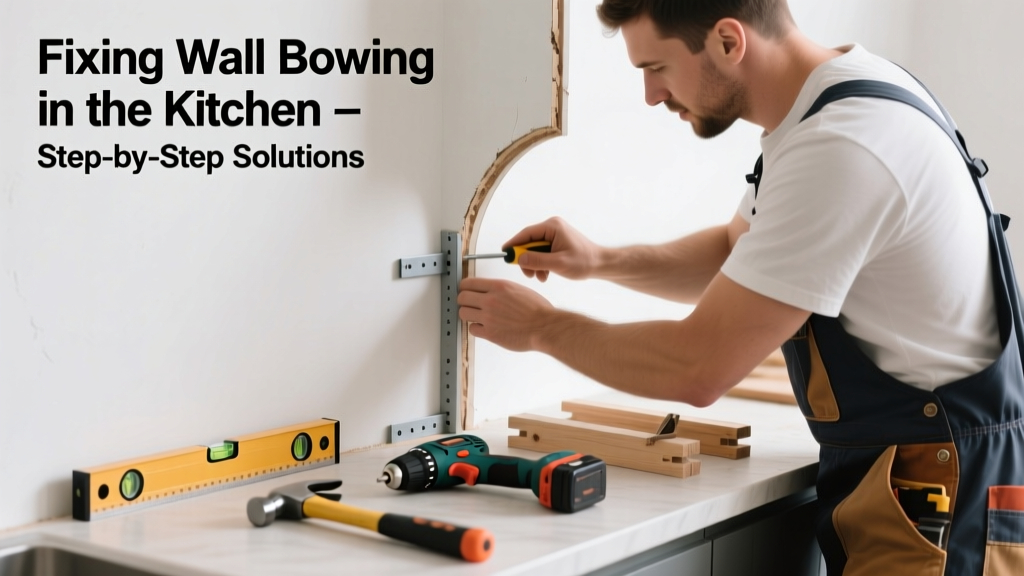
If you’ve noticed your kitchen wall leaning inward, cracking near cabinet mounts, or creating gaps around door frames, it’s not just cosmetic—it’s structural stress talking. Bowing often starts subtly but accelerates fast when moisture, poor framing, or load shifts go unaddressed. Ignoring it risks cabinet detachment, plumbing misalignment, or even drywall collapse.
Quick Diagnosis
Start here before grabbing tools. Bowing rarely happens in isolation—look for these root causes:
- Water intrusion from leaky sink supply lines, dishwasher hoses, or failed caulk at backsplash seams
- Overloaded upper cabinets (especially if mounted only to drywall or furring strips)
- Missing or undersized wall studs—common in older kitchens where 24" on-center framing was skipped for speed
- Foundation settling beneath the kitchen slab, especially in homes built on expansive clay soils
- Improperly braced soffits or range hoods transferring lateral force into the wall
Tools & Materials Needed
| Item | Purpose | Estimated Cost |
|---|---|---|
| Laser level (60 ft range) | Verifies vertical deviation beyond visual guesswork; critical for measuring bow depth accurately | $89–$149 |
| 3/4" plywood (1/2 sheet, 4' x 4') | Backing reinforcement behind drywall to redistribute cabinet loads across multiple studs | $22–$34 |
| 16d galvanized sinker nails or 3" structural screws | Securing blocking and reinforcement without splitting framing lumber | $8–$15 |
| Moisture meter (pin-type, 0–40% range) | Detects hidden saturation in stud cavities—key for ruling out active water damage | $45–$72 |
| Stud finder with AC detection | Finds live wiring *and* stud edges behind tile or thick drywall—prevents accidental drilling into circuits | $28–$65 |
Step-by-Step Fix
Choose the method that matches your bow’s severity and cause. Never force a wall back into place—this risks sheetrock blowout or stud fracture.
- Assess bow depth and location: Use your laser level to measure deviation at 16", 48", and 72" heights. If bow exceeds 3/8" over 8 feet, skip temporary fixes and move to structural reinforcement.
- Remove affected cabinetry: Label and disconnect all cabinets within 36" of the bow. Support them on sawhorses—don’t leave weight on compromised wall sections.
- Add backing reinforcement: Cut 3/4" plywood to fit between studs behind drywall (or behind tile if accessible). Screw securely into each stud using 3" structural screws every 6" along edges and 12" in field.
- Install vertical blocking: Nail 2x4 blocking between studs at top, middle, and bottom of bowed zone. This creates a rigid ladder frame to resist lateral movement.
- Rehang cabinets with proper anchoring: Use 3.5" lag screws into solid stud centers—not drywall anchors. For plaster or tile walls, use tile-rated toggle bolts with washers to spread load.
When to Call a Pro
Some wall bowing crosses into engineering territory—and DIY attempts can worsen instability. Call a licensed structural contractor immediately if:
- The bow increases more than 1/8" per week (track with masking tape markers and digital calipers)
- You see diagonal cracks wider than 1/16" extending from corners into ceiling or floor joints
- Adjacent floor joists sag more than 1/2" over 10 feet (check with string line)
- Your home is on a pier-and-beam foundation and you spot shifting soil or exposed piers tilting
- The bow coincides with persistent musty odors or visible mold behind baseboards—indicating long-term moisture infiltration
"In kitchens, wall bowing linked to plumbing leaks accounts for nearly 68% of urgent structural referrals we handle—most could’ve been caught 6–12 months earlier with routine moisture checks." — National Association of Home Inspectors, 2023 Field Report
Prevention Tips
Kitchen walls face unique stresses: steam, vibration, heavy loads, and tight plumbing access. Prevent recurrence with these habits:
- Inspect supply lines and dishwasher hose clamps every 6 months—replace rubber lines with braided stainless steel
- Use a dehumidifier if relative humidity consistently exceeds 60% (common in coastal or basement-level kitchens)
- Limit upper cabinet weight to 35 lbs per linear foot—avoid stacking cast iron cookware or granite cutting boards inside
- Re-caulk backsplash-to-countertop seams annually with 100% silicone rated for kitchen use
- Install a smart water leak detector like the Moen Flo under the sink to catch drips before they saturate framing
Can I just screw drywall back flat without reinforcing?
No. Pulling bowed drywall taut with screws alone creates stress points that crack within weeks—and hides the underlying structural issue. It’s like tightening a loose belt on a failing engine.
Will adding insulation fix the bow?
Insulation does nothing to correct lateral movement. In fact, blown-in cellulose or fiberglass can mask moisture issues and delay diagnosis. Only add insulation after confirming the wall is dry and structurally sound.
How do I know if my cabinets are causing the bow?
Weigh them: standard 30" upper cabinets hold ~45–60 lbs empty. Add dishware, and you’re pushing 90+ lbs per cabinet. If mounting screws pull out easily or drywall dimples around screw heads, load is overwhelming the substrate.
Can I patch the drywall cracks and ignore the bow?
Temporary patches will fail—often within 30 days—as movement continues. Cracks reappear larger and more numerous. Address the cause first, then repair finishes.
Is this covered by homeowners insurance?
Rarely—if the bow results from gradual wear, poor maintenance, or undetected leaks. Sudden collapse due to a burst pipe *may* be covered, but insurers require documentation proving the event was abrupt and unforeseeable. File a claim only after a structural engineer’s report.
What’s the average cost to professionally fix kitchen wall bowing?
According to Remodeling Magazine’s 2024 Cost vs. Value Report, full reinforcement—including stud realignment, backing, and cabinet reinstallation—averages $2,150–$3,800 depending on wall length and finish complexity. DIY saves 40–60%, but only if the cause is confirmed non-structural.
A bowed kitchen wall isn’t just an eyesore—it’s your home signaling strain. Tackle it early with precise diagnosis and load redistribution, not cosmetic cover-ups. And remember: when moisture and structure intersect, patience pays off. Check twice, cut once, and never hang cabinets until the wall holds firm under its own weight.