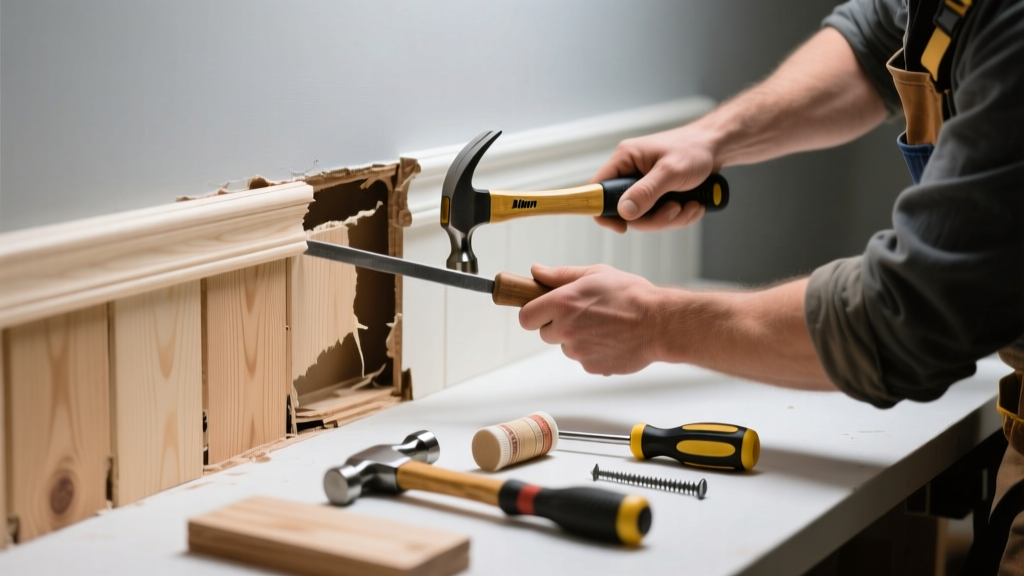
That faint creak when you walk past the dining room wall? The hollow pop when humidity shifts? Warped wainscoting isn’t just an eyesore—it’s a sign of moisture imbalance, poor installation, or structural movement. Left unaddressed, it can loosen fasteners, crack joints, and even pull away from framing.
Quick Diagnosis
Start by identifying the root cause—not all warping sounds the same. Use these clues to narrow it down:
- Localized squeaking near baseboard: Loose nails or missing shims between panel and stud
- Uniform bowing across multiple panels: Moisture absorption (especially in bathrooms or basements)
- Clicking during temperature swings: Wood expansion/contraction due to inadequate expansion gaps
- Soft spots or sponginess: Underlying water damage or rot in substrate or studs
- Visible gaps at top or bottom edges: Improper acclimation before installation or undersized fasteners
Tools & Materials Needed
| Item | Purpose | Estimated Cost |
|---|---|---|
| 3-in-1 pry bar | Lift panels without damaging moldings or drywall | $12–$20 |
| 16-gauge finish nails + nail set | Secure panels flush without visible heads | $8–$15 |
| Moisture meter (pin-type) | Confirm wood moisture content >12% indicates active dampness | $45–$85 |
| Construction adhesive (water-resistant) | Bond panel to stud where nails won’t hold due to warping | $10–$18 |
| 1/8" cedar shims | Fill gaps behind bowed sections for even pressure | $4–$9 |
Step-by-Step Fix
Choose the method that matches your diagnosis. Most cases require a combination:
- Assess and isolate the noise source: Tap along each panel with a rubber mallet; note where sound changes pitch or volume. Mark those zones with painter’s tape.
- Re-fasten loose panels: Remove existing nails near noisy areas. Pre-drill pilot holes, then drive 2" ring-shank finish nails every 8" into solid stud locations (use stud finder). Set nails slightly below surface and fill with wood putty.
- Flatten mild warping with adhesive + clamping: Apply zigzag beads of PL Premium construction adhesive to back of bowed section. Press firmly, then clamp using padded bar clamps against adjacent studs for 24 hours.
- Add shims behind severe bows: Pry panel out 1/4" at highest warp point. Insert tapered cedar shims behind until panel lies flat. Re-nail through shims into stud—don’t overdrive.
- Seal moisture entry points: Check baseboard caulk lines, HVAC vents, and exterior wall penetrations. Re-caulk with silicone-acrylic hybrid sealant where gaps exist.
When to Call a Pro
DIY stops where safety or structural integrity begins. Call a licensed contractor if:
- You detect moisture readings above 19% on two or more adjacent studs (per moisture damage remediation guidelines)
- The wainscoting covers plaster lath that’s crumbling or detached from framing
- Warped panels coincide with visible wall cracks wider than 1/8" or doors that bind in their frames
- You’re working in a historic home with lead-paint layers (testing required before sanding or removal)
"Over 60% of wainscoting noise complaints stem from improper substrate prep—not material failure," says master carpenter Elena Ruiz in Residential Trim & Panel Installation Handbook (2022).
Prevention Tips
Wainscoting shouldn’t move—or talk. These habits prevent recurrence:
- Acclimate new wood panels for 72+ hours in the room where they’ll be installed (maintain 40–55% RH)
- Leave 1/8" expansion gap at top and bottom—cover with cap molding, not caulk
- Use only kiln-dried, FAS-grade hardwood or MDF rated for interior humid environments
- Install vapor-permeable underlayment (e.g., #15 felt) behind panels in high-moisture zones like kitchens
- Run a dehumidifier year-round in basements—even if no visible dampness (U.S. EPA estimates indoor RH above 60% accelerates wood movement)
Can I use bleach on this?
No. Bleach doesn’t stop warping—it damages wood fibers and weakens glue bonds. If mold is suspected behind panels, use a diluted vinegar solution (1:1 with water) and confirm with a lab test before remediation. For cleaning, stick to pH-neutral cleaners like Bona Hardwood Floor Cleaner.
Will painting fix the noise?
Painting masks nothing—it adds weight and may trap moisture. If panels are already warped, paint can accentuate cracks and cause peeling at stress points. Fix the movement first, then repaint with flexible acrylic enamel.
How long does adhesive take to cure fully?
PL Premium reaches handling strength in 4–6 hours but requires 24 hours for full bond development at 70°F and 50% RH. Lower temps or higher humidity extend cure time—wait 48 hours before reattaching hardware or trim.
Can I replace just one warped panel?
Yes—but match grain direction, species, and finish sheen exactly. Even minor mismatches become obvious under directional light. Source replacement stock from the original supplier if possible; otherwise, refinish adjacent panels for consistency.
Is MDF wainscoting less prone to warping?
MDF resists seasonal swelling better than solid wood but fails catastrophically when wet. It also lacks screw-holding power over time. For high-moisture rooms, choose marine-grade plywood or PVC-based alternatives like Kanawha PVC panels.
Do I need to remove all baseboard to fix this?
Not always. In most cases, you can lift just the bottom rail or chair rail to access fasteners and shims. Use a thin pry bar and work slowly—baseboards often hide decades of layered caulk and paint. If the baseboard is cracked or brittle, plan for replacement using a coping saw for tight inside corners.
Wainscoting should feel solid, look intentional, and stay silent. A little attention now—checking humidity, securing fasteners, and sealing gaps—keeps it that way for years. And if the noise returns after your repair? Go back to the moisture meter first. Nine times out of ten, the real culprit isn’t the wood—it’s what’s happening behind it.