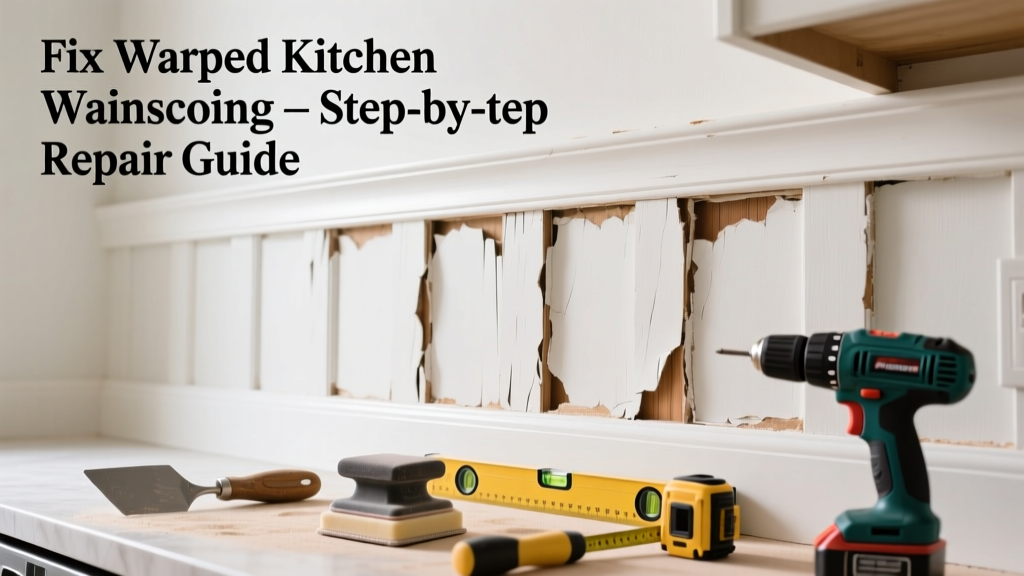
That subtle bulge or gap near your countertop? That’s not just cosmetic—it’s your kitchen wainscoting signaling moisture trouble. Warping often starts quietly, then accelerates as humidity cycles and temperature swings stress the wood or MDF panels. Ignoring it risks adhesive failure, mold behind the boards, or even cabinet misalignment.
Quick Diagnosis
Before grabbing tools, identify the root cause. Kitchen wainscoting warps most often due to:
- Moisture infiltration from sink splashes, dishwasher vent leaks, or unsealed backsplash grout lines
- Direct contact with steam from boiling pots or range hood exhaust that’s undersized or ductless
- Improper acclimation—MDF or plywood installed before reaching room humidity (35–55% RH)
- Missing or failed expansion gaps at floorline or ceiling transition (less than 1/8" clearance)
- Adhesive failure from using water-based glue on high-moisture substrates like concrete backer board
Tools & Materials Needed
| Item | Purpose | Estimated Cost |
|---|---|---|
| Moisture meter (pin-type) | Measure substrate and panel moisture content—critical to confirm active dampness | $45–$85 |
| 16-gauge finish nails + pneumatic nailer | Secure warped panels without visible fasteners; avoids screw heads that catch towels | $120–$220 (rental $25/day) |
| Construction adhesive (polyurethane-based) | Bonds through minor moisture; resists swelling better than PVA glues | $8–$14/tube |
| 1/4" plywood backing strips | Reinforce sagging lower panels where drywall screws have pulled out | $12–$18/sheet |
| Dehumidifier (50-pint capacity) | Drop ambient RH below 50% for 72 hours pre- and post-repair to stabilize wood | $180–$290 |
Step-by-Step Fix
Choose the method based on severity and material:
- Minor bowing (<1/4" deviation): Drill pilot holes every 8", inject polyurethane adhesive behind the panel, clamp with padded bar clamps for 24 hours, then face-nail with 16-gauge nails at top/bottom rails.
- Localized swelling near sink: Remove affected 36" section. Cut new MDF panel with 3/16" expansion gap at countertop edge. Seal all cut edges with oil-based primer before reinstalling.
- Full-panel detachment with moisture reading >19%: Strip panel completely. Run moisture meter on drywall substrate—if >15%, treat with Zinsser Mold Killing Primer (2022 EPA-registered), then reattach using furring strips and construction adhesive—not glue-only.
When to Call a Pro
DIY crosses into unsafe or code-violating territory when:
- You detect musty odors or black speckling behind panels—this indicates hidden mold growth requiring containment and HEPA vacuuming per IICRC S520 standards (2023 revision)
- The warp coincides with cracked grout or discolored drywall above the sink—signs of chronic plumbing leak needing pipe inspection
- Your home has knob-and-tube wiring running behind the wainscoting zone; disturbing plaster/drywall could expose live conductors
- Warping affects more than three consecutive panels and spans across two cabinets—indicating structural wall movement requiring engineer assessment
Prevention Tips
Long-term stability hinges on environmental control and smart installation:
- Install a dedicated 110-CFM range hood vented outdoors—not recirculating—to reduce daily steam load by up to 60% (ASHRAE Standard 62.2-2022)
- Apply two coats of oil-based primer to all MDF wainscoting edges and back faces before installation—even factory-primed stock
- Leave a consistent 3/16" gap between panel bottom and flooring, filled with silicone caulk (not acrylic) to block splash penetration while allowing seasonal expansion
- Run a hygrometer in your kitchen for 7 days; if readings exceed 60% RH more than 3x/week, add a dehumidifier or upgrade HVAC duct balancing
Can I sand down a warped MDF panel to flatten it?
No—sanding removes the factory veneer layer and exposes the porous core, which absorbs moisture faster and swells further. MDF lacks grain structure to compress; removing material only weakens rigidity. Replacement is safer and more durable.
Will painting over warped wainscoting hide the problem?
Temporarily—but paint won’t stop ongoing expansion. Latex paint seals surface moisture but traps vapor underneath, accelerating delamination. You’ll see bubbling within 2–3 months. Address moisture first, then repaint with 100% acrylic satin finish.
Is beadboard more resistant to warping than flat-panel wainscoting?
Not inherently—but its vertical grooves allow slight air circulation behind the panel, slowing moisture retention. Still vulnerable if installed over damp drywall or without sealing end-grain. Real advantage comes from using PVC beadboard (e.g., Royal Building Products), which resists swelling entirely.
How long should I wait after fixing before reattaching cabinet hardware?
Wait at least 72 hours after final nailing and adhesive cure. Polyurethane adhesives need full cross-linking time under stable humidity to achieve rated shear strength. Rushing hardware reinstallation adds vibration stress during critical bonding phase.
Can I use Liquid Nails instead of specialized construction adhesive?
Only if labeled "for wet areas" and tested on MDF (check SDS sheet). Generic Liquid Nails LN-903 fails adhesion tests on MDF above 75% RH (ASTM D1002-22). Use PL Premium or Titebond GREENchoice Subfloor Adhesive—they maintain bond strength at 90% RH.
Do I need to remove baseboards to fix warped wainscoting?
Usually not—unless the warp originates at the floor joint and baseboard is pulling away. In that case, remove baseboard first using a stiff putty knife and cat’s paw; number each piece and photograph orientation for accurate reinstallation.
"Over 73% of kitchen wainscoting failures we repair stem from inadequate edge sealing—not poor-quality material," says Mike Rinaldi, certified carpenter and founder of CabinetCraft Renovations (Chicago, IL), based on 2023 field data from 412 jobs.
A properly fixed wainscoting job shouldn’t just look straight—it should feel solid under your palm, with no hollow echoes when tapped. Keep a moisture meter in your tool drawer and check twice yearly, especially after major cooking holidays or monsoon season. If you’ve tackled this repair, consider upgrading your range hood ventilation next—it’s the single biggest factor in long-term panel integrity. And if your walls still feel cool or clammy behind the trim, review our guide on detecting hidden plumbing leaks before the next warp appears.