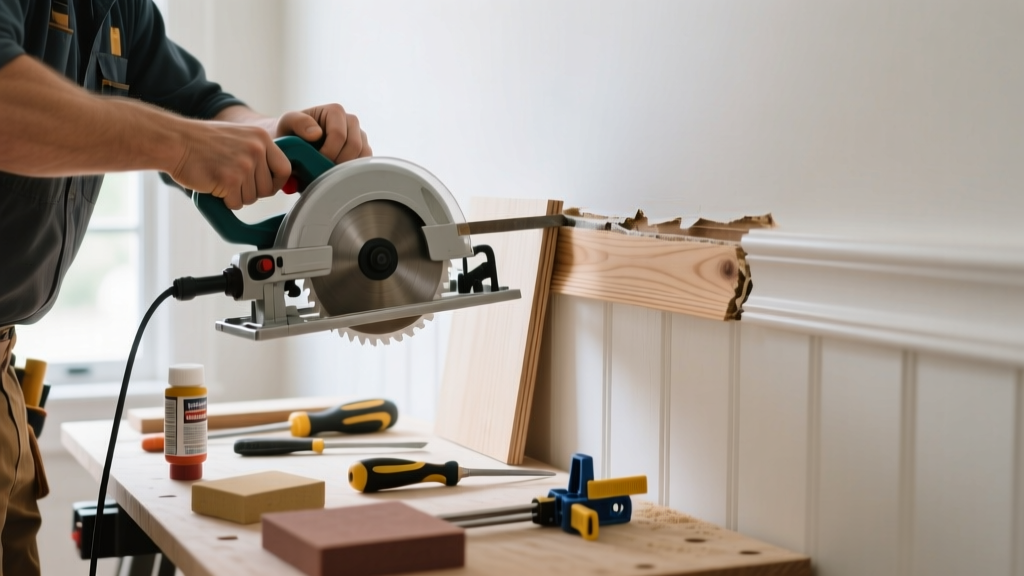
That subtle bulge along your dining room wall isn’t just an eyesore—it’s a red flag. Warped wainscoting often starts quietly, then worsens as moisture migrates or fasteners loosen, compromising both appearance and structural integrity. Left unaddressed, it can signal deeper issues like hidden water intrusion or framing movement.
Quick Diagnosis
Before grabbing tools, identify the root cause. Warping rarely happens in isolation—it’s usually a symptom. Here are the most common culprits:
- High humidity or repeated moisture exposure (e.g., near dishwashers, sinks, or poorly vented bathrooms)
- Improper acclimation of wood before installation—especially MDF or plywood panels
- Inadequate fastening: nails too few, too shallow, or driven into drywall instead of studs
- Subfloor or wall framing movement due to settling or seasonal expansion/contraction
- Direct sunlight or HVAC vents blowing onto panels for extended periods
Tools & Materials Needed
| Item | Purpose | Estimated Cost |
|---|---|---|
| Stud finder with deep-scan mode | Locates solid backing behind drywall to ensure secure re-fastening | $25–$45 |
| 1¼" coated finish screws (No. 6 or No. 8) | Hold panels firmly without splitting; superior holding power vs. nails | $8–$12 |
| Clamp kit (bar or spring clamps) | Temporarily pulls warped sections flush while screws set | $15–$30 |
| Moisture meter (pin-type) | Measures wood moisture content—anything above 12% indicates active moisture issues | $40–$90 |
| Wood filler & matching stain marker | Conceals screw holes and minor surface gaps after repair | $6–$14 |
Step-by-Step Fix
Choose the method based on severity and material. For mild warping (<1/8" bow), try Method 1 first. For persistent or multi-panel distortion, combine Methods 2 and 3.
- Re-fasten with screws: Locate studs using your stud finder. Drill pilot holes slightly smaller than screw diameter, then drive 1¼" coated screws every 8–10 inches along the top rail, bottom rail, and mid-stile—avoiding visible grain lines. Countersink slightly and fill later.
- Apply controlled pressure: Clamp warped sections gently to adjacent flat areas or temporary furring strips. Leave clamps for 24–48 hours *only* if moisture readings are stable (≤12%). Never force aggressively—MDF cracks, pine splits.
- Replace damaged panels: If warping exceeds 3/16" or shows delamination (bubbling MDF, peeling veneer), cut out the panel with a flush-cut saw. Measure carefully—account for reveal gaps—and install new pre-primed MDF or poplar panel, securing to all underlying studs.
When to Call a Pro
Some warping isn’t about technique—it’s about conditions beyond DIY scope. Call a licensed contractor or carpenter if you notice any of these:
- Moisture meter readings consistently >16% in multiple panels or adjacent drywall
- Adjacent baseboards, flooring, or door jambs also showing distortion or separation
- Visible mold growth behind or around the wainscoting (especially black or green fuzzy patches)
- Warping recurs within 6 weeks of repair—even after proper fastening and climate control
According to the Insurance Institute for Business & Home Safety's 2023 report, 68% of interior wood failures linked to moisture go undetected behind trim until secondary damage appears—making early professional assessment critical.
Prevention Tips
Long-term stability depends on environment and installation quality—not just repair skill. Implement these habits now:
- Maintain indoor relative humidity between 35–55% year-round using a hygrometer and dehumidifier/humidifier as needed
- Ensure bathroom and kitchen exhaust fans vent outdoors—not into attics—and run them for at least 20 minutes post-shower or cooking
- Leave a 1/8" expansion gap between wainscoting and floor—never caulk or glue the bottom edge
- Use construction adhesive *in addition to* screws when installing new panels—especially over concrete or in high-humidity zones
Can I steam out the warp like furniture repair?
No—steaming introduces uncontrolled moisture into already compromised wood or MDF, accelerating fiber breakdown. Unlike solid hardwood furniture, wainscoting is typically thin (¼"–½") and laminated, making it highly susceptible to irreversible swelling or face delamination.
Will painting over it hide the warp?
Paint won’t flatten or stabilize warped panels. In fact, thick paint layers can trap moisture and worsen warping over time. Light sanding and primer may reduce visual contrast, but only mechanical correction addresses the structural issue.
Is this covered by homeowners insurance?
Rarely—unless warping stems directly from a sudden, covered peril like a burst pipe or roof leak (with documented proof). Gradual moisture buildup or poor installation is considered maintenance neglect and excluded under standard policies per the III’s 2022 Home Insurance Claims Handbook.
Can I use construction adhesive alone instead of screws?
No. Adhesive helps prevent future movement but lacks immediate holding strength. Panels installed with adhesive-only attachment often sag or buckle within months—especially vertical runs over 36 inches tall. Always combine adhesive with mechanical fasteners anchored into studs.
What’s the best wood species for moisture-prone areas?
Poplar is the top choice for painted wainscoting in kitchens or half-baths: dimensionally stable, affordable, and resists warping better than pine or MDF. For stained applications, quartersawn white oak offers superior resistance to cupping and twisting—backed by USDA Forest Service data from their 2021 Wood Performance Guide.
How long should I wait after fixing before repainting?
Wait at least 72 hours after final screw installation and filling. This allows wood fibers to settle and adhesive (if used) to fully cure. Rushing paint risks telegraphing minor imperfections or trapping residual moisture beneath the film.
A properly repaired wainscoting panel should hold flat for 5–10 years—if environmental controls stay consistent and fasteners remain tight. Recheck screw tension annually during your home’s seasonal maintenance routine, especially before winter heating kicks in. For more on moisture management, see our guide on how to fix humid basement and wood floor cupping repair.