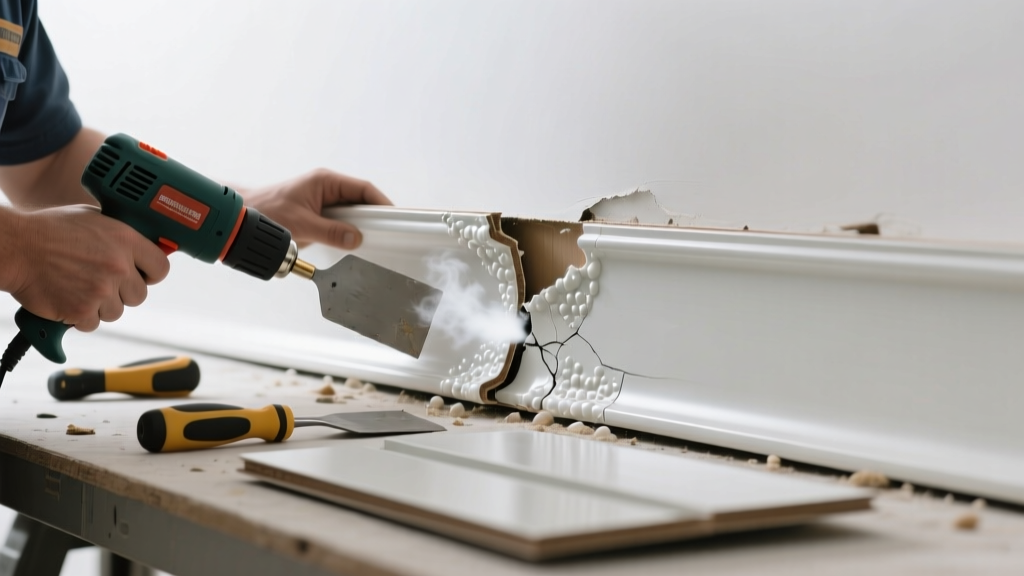
That sharp *pop*, *crack*, or high-pitched squeak every time the sun hits your south-facing wall? It’s not your imagination—it’s melted vinyl siding warping and binding against fasteners or adjacent panels. This isn’t just cosmetic: heat-damaged siding loses structural integrity, traps moisture, and can worsen rapidly in summer.
Quick Diagnosis
Start here before grabbing tools. Melted, noisy vinyl almost always traces back to one or more of these culprits:
- Concentrated sunlight reflecting off nearby windows, glass railings, or solar panels (the #1 cause per the National Association of Home Builders’ Exterior Cladding Safety Bulletin, 2022)
- Proximity to heat sources like HVAC exhaust vents, grills, or recessed lighting housings
- Improper installation—nails driven too tightly or panels butted without expansion gaps
- Low-quality or outdated vinyl (pre-2010 formulations had lower heat deflection temperatures)
- Dark-colored siding absorbing >70% of solar radiation (U.S. Department of Energy, 2021)
Tools & Materials Needed
| Item | Purpose | Estimated Cost |
|---|---|---|
| Heat-resistant vinyl siding removal tool | Lifts panels without breaking interlocks; essential for reseating warped sections | $12–$18 |
| Stainless steel siding nails (1¼" ring shank) | Prevent corrosion and allow controlled expansion; standard galvanized nails corrode and bind | $8–$14 per box of 1,000 |
| Infrared thermometer (non-contact) | Measure surface temps—melting starts at 165°F; helps locate hotspots before visible warping | $25–$45 |
| Reflective window film (3M Sun Control Series) | Reduces reflected heat by up to 65%; critical if neighboring glass is the source | $35–$60 per roll (24" x 10') |
| Replacement vinyl panel (matching profile & color) | Required if melting exceeds ⅛" sag or shows bubbling—don’t patch melted areas | $25–$40 per 12' panel |
Step-by-Step Fix
Choose the method that matches your damage level. Always work on cool mornings—never when panels are above 85°F.
- Isolate the noise source: Use your infrared thermometer to scan the wall at 10 a.m. and 3 p.m. Note any spots hitting 150°F+. Mark them with chalk.
- Loosen bound panels: Insert the removal tool under the bottom edge of the affected panel. Gently lift upward while tapping the top edge with a rubber mallet to release the locking groove. Do NOT force it—heat-weakened vinyl snaps easily.
- Re-seat with proper clearance: Slide panel back in, ensuring ⅛" gap at top nailing flange and ¼" gap between vertical edges. Secure with stainless nails driven *just* until the nail head touches the flange—no deeper.
- Replace if melted beyond recovery: If the panel sags >⅛", shows blistering, or won’t lie flat after cooling, cut out the damaged section using tin snips and snap in a new panel. Match the butt-lock orientation exactly—reversing it causes immediate buckling.
- Block reflection: If heat is coming from adjacent glass, apply 3M Sun Control film to the *source* window—not your siding. Test adhesion on a small area first.
When to Call a Pro
DIY stops where safety or code compliance begins. Call a licensed exterior contractor if:
- You spot black mold or rot behind the melted siding—this means moisture has been trapped for weeks
- The melt affects more than three full panels or spans two stories
- Your home has foam sheathing (like ZIP System) underneath—the wrong removal technique punctures the water-resistive barrier
- You’re asked to remove siding near gas lines, electrical conduits, or roof flashing junctions
According to the Vinyl Siding Institute’s Installation Standards Manual (2023), “Any repair involving structural framing exposure or thermal barrier compromise requires third-party inspection before re-siding.”
Prevention Tips
Melting isn’t random—it’s predictable. Stop recurrence with these field-tested tactics:
- Install exterior-grade awnings or lattice shading over south/west walls—reduces surface temp by up to 40°F (Lawrence Berkeley National Lab, 2022)
- Use only Class A fire-rated, ASTM D3679-compliant vinyl—cheaper grades soften at 140°F instead of 165°F
- Leave 1½" clearance between all heat sources (e.g., dryer vents, recessed lights) and siding—code minimum is 12", but real-world testing shows 1½" prevents warping
- Wash siding twice yearly with mild detergent and low-pressure rinse—dirt buildup increases heat absorption by 12–18%
Can I glue melted vinyl back into shape?
No. Vinyl doesn’t re-fuse once thermally degraded. Adhesives like PVC cement won’t bond to oxidized, heat-damaged surfaces—and they’ll yellow, crack, and fail within months. Replacement is the only reliable fix.
Will painting over melted siding hide the problem?
Painting adds another layer of heat absorption and hides early warning signs like micro-cracking. The U.S. EPA estimates that dark paint on vinyl raises surface temps by 22–30°F—accelerating further degradation. Don’t do it.
How long does replacement vinyl siding last in full sun?
High-quality, light-colored vinyl installed with proper gaps lasts 40–60 years in direct sun—per the Vinyl Siding Institute’s 2023 Longevity Study. Dark colors drop that to 25–35 years due to thermal cycling stress.
Can I use a heat gun to reshape warped panels?
Absolutely not. Applying external heat to already-melted vinyl causes delamination, embrittlement, and toxic fume release (hydrogen chloride gas). The CPSC issued a safety alert in 2021 specifically warning against this practice.
Do I need to replace the entire wall if one panel melted?
Not unless adjacent panels show matching distortion or temperature readings above 155°F. But inspect behind all panels within 3 feet of the damage—melt often starts unseen behind trim or under soffits.
Is this covered by my homeowner’s insurance?
Rarely. Most policies exclude gradual deterioration or improper installation. However, if melting resulted from a sudden event—like a neighbor’s newly installed mirrored balcony reflecting concentrated sunlight—document with timestamped photos and thermal scans. Some insurers treat that as third-party liability.
Once you’ve re-seated or replaced the panel, monitor it for two full weeks during peak afternoon heat. If the noise returns, revisit your reflection analysis—you may have missed a secondary glare source, like a polished metal mailbox or patio furniture. For long-term peace of mind, consider upgrading to fiber-cement or insulated vinyl siding on vulnerable exposures. And if you’re tackling fascia or soffit repairs alongside this, check our guide on soffit sagging repair—it shares many of the same fastening principles. You’ve got this: most melted-siding fixes take under two hours and cost less than $75 in materials.