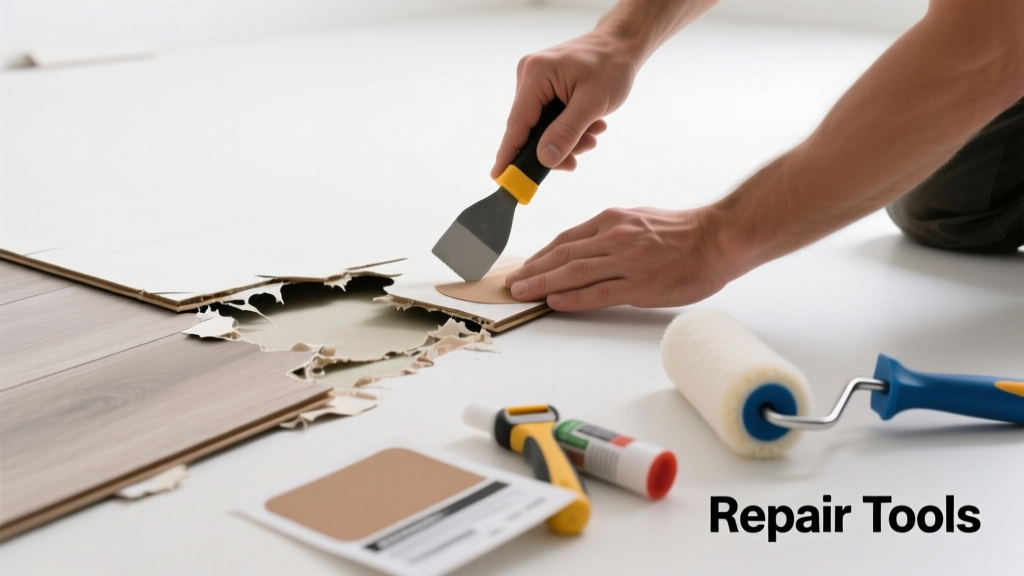
If your vinyl floor is tearing at seams, corners, or under furniture—but you haven’t spilled acid or dragged a dumpster across it—something’s off with installation, subfloor prep, or material compatibility. This isn’t normal wear; it’s a red flag that needs immediate attention before moisture sneaks in or the damage spreads.
Quick Diagnosis
Before grabbing tools, rule out what’s actually causing the tear:
- Moisture trapped under the floor (check for musty odor or spongy spots)
- Improper acclimation—vinyl planks or sheets installed before reaching room temperature (72°F ±5°F for 48 hours)
- Subfloor unevenness exceeding 3/16" over 10 feet (measured with straightedge and feeler gauge)
- Use of incompatible adhesive—especially solvent-based glues on rigid core LVT
- Heavy rolling loads (e.g., office chairs without casters rated for vinyl) concentrating pressure on edges
Tools & Materials Needed
| Item | Purpose | Estimated Cost |
|---|---|---|
| Utility knife with snap-off blades | Clean removal of lifted edges without gouging subfloor | $8–$15 |
| Notched trowel (1/16" x 1/16") | Applying thin-set or vinyl-specific adhesive evenly | $12–$22 |
| Roller (100-lb weighted) | Pressing seams and edges to eliminate air pockets and ensure bond | $25–$45 |
| Moisture meter (pin-type) | Verifying subfloor moisture ≤12% MC for concrete, ≤15% for plywood | $65–$120 |
| Replacement vinyl plank or sheet patch | Matching wear layer thickness and backing type (e.g., WPC vs. SPC) | $2–$8/sq ft |
Step-by-Step Fix
Choose the method based on tear size and location:
- Small seam lift (under 2 inches): Clean debris with isopropyl alcohol, apply vinyl-specific pressure-sensitive adhesive, then roll firmly with 100-lb roller for 60 seconds per foot.
- Tear along wall expansion gap: Trim back damaged edge 1/8" past tear, reposition baseboard, and install quarter-round to conceal 3/8" gap—never force vinyl into zero clearance.
- Central tear with curling or bubbling: Cut out damaged section using straightedge + utility knife, rough-sand subfloor, apply manufacturer-recommended adhesive, and embed new patch with roller. Weight overnight with 2x4s wrapped in felt.
- Multiple tears in high-moisture area (bathroom/kitchen): Pull up affected zone, test subfloor moisture (must be ≤12% MC), install 6-mil poly vapor barrier, then re-lay with waterproof adhesive like Bostik DuraCeramic.
When to Call a Pro
DIY crosses into unsafe or code-violating territory when:
- The tear extends beneath cabinets or fixed appliances you can’t safely move
- You detect mold growth under the vinyl (visible black specks or persistent mildew smell)
- Subfloor moisture readings exceed 15% MC on plywood or 18% on concrete—indicating chronic leakage
- Your home was built before 1980 and the existing vinyl may contain asbestos (testing required before disturbance)
"Over 62% of premature vinyl floor failures stem from subfloor moisture issues—not product defects," states the National Wood Flooring Association’s 2022 Installation Standards Handbook.
Prevention Tips
Stop future tears before they start:
- Always use a moisture meter before installation—even on 'dry' basements
- Install transition strips at all doorways wider than 12 feet to relieve lateral stress
- Replace rubber-backed rugs with non-staining, breathable alternatives like jute or low-pile polypropylene
- Use furniture pads rated for luxury vinyl (not generic felt)—they distribute load across 3+ square inches
Can I use bleach on this?
No. Bleach degrades the PVC polymer matrix and accelerates plasticizer loss, making vinyl brittle and prone to cracking within weeks. Use pH-neutral cleaners like Bona Stone, Tile & Laminate Cleaner instead.
Will Gorilla Glue fix a torn vinyl floor?
Avoid it. Gorilla Glue expands as it cures and contains polyurethane that reacts unpredictably with vinyl’s plasticizers. It often causes discoloration, bubbling, and weak adhesion. Stick to products listed in the vinyl floor adhesive guide.
How long does repaired vinyl last?
A properly executed patch with matching material and correct subfloor prep lasts 8–12 years—matching the original floor’s warranty period. Poor prep cuts that lifespan in half, per data from the Resilient Floor Covering Institute’s 2023 Field Performance Survey.
Do I need to replace the whole room if one plank tears?
Not unless the tear reveals widespread subfloor failure or water damage. Modern click-lock LVT allows precise single-plank replacement using the “cut-and-slide” method—no full-room demo needed.
Why does my vinyl tear near the fridge?
Refrigerators vibrate at 40–60 Hz during compressor cycles, transferring energy into poorly anchored flooring. Anchor the unit’s leveling feet to the subfloor with vibration-dampening pads, and ensure at least 1/4" expansion gap around all sides.
Can I patch luxury vinyl tile with sheet vinyl?
No. Mixing materials creates differential expansion—LVT expands 0.00012 in/in/°F while sheet vinyl expands 0.00021 in/in/°F. This mismatch stresses seams and causes new tears within months.
Fixing a tearing vinyl floor isn’t about brute force—it’s about respecting the material’s engineering limits and honoring the prep work that makes it last. Get the subfloor right, match the chemistry, and treat every seam like a structural joint—not just a visual line. That’s how you turn a repair into a decade of quiet, stable floors.