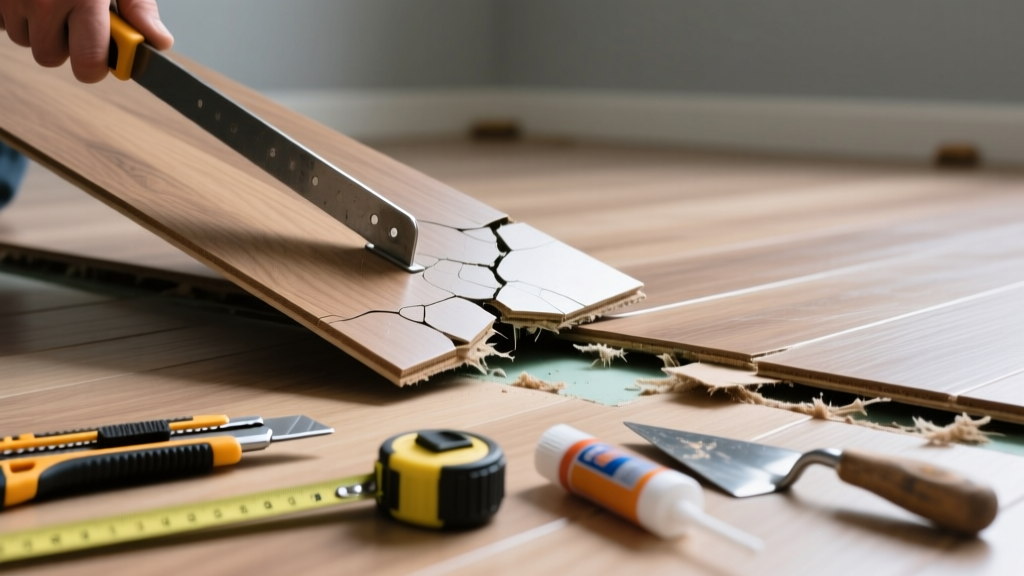
If your vinyl floor is lifting at a seam, corner, or single plank—and it’s not just loose adhesive—you likely need to replace that specific damaged part, not the whole room. This isn’t about temporary taping or gluing over cracks; it’s about precision removal and seamless integration of a matching replacement. Most homeowners can complete this in under two hours if they have the right tools and a spare plank on hand.
Quick Diagnosis
Lifting vinyl flooring rarely happens randomly. Here are the most common root causes:
- Water intrusion beneath the floor (especially near sinks, dishwashers, or leaky toilets)
- Subfloor warping or moisture damage (common in basements or concrete slabs without proper vapor barriers)
- Manufacturing defect in the locking mechanism of click-together LVT/LVP planks
- Improper installation—gaps left during expansion, insufficient acclimation, or missing underlayment
- Heavy furniture dragging or repeated impact near edges
Tools & Materials Needed
| Item | Purpose | Estimated Cost |
|---|---|---|
| Utility knife with fresh blades | Cuts cleanly through vinyl layers and severs stubborn adhesive | $5–$12 |
| Pry bar (3-inch rigid) | Lifts planks without gouging adjacent pieces or subfloor | $8–$15 |
| Replacement plank (exact match) | Must match batch number, wear layer thickness, and locking profile | $2–$8 per plank |
| Notched trowel (1/16" x 1/16") | Applies thin, even layer of vinyl-specific adhesive for partial re-bonding | $6–$10 |
| Acetone or vinyl-safe cleaner | Removes old adhesive residue without damaging surrounding planks | $4–$9 |
Step-by-Step Fix
Follow these methods based on your vinyl type and damage location:
- For glue-down vinyl sheets: Cut out the lifted section using a straightedge and utility knife, scrape adhesive residue with a carbide scraper, apply new adhesive with notched trowel, and press in a patch cut from scrap sheet vinyl (seam with heat-welding iron if professional-grade).
- For floating LVP/LVT planks: Remove adjacent planks to access the damaged one—start from the nearest wall or expansion gap. Use gentle prying to disengage locks. Replace with identical plank, lock into place, and reinstall surrounding rows.
- For perimeter lifting (near baseboard): Remove quarter-round or shoe molding, lift only the affected edge, clean subfloor, apply vinyl-specific adhesive (e.g., Roberts 2057), and weigh down with books for 24 hours.
When to Call a Pro
DIY replacement fails—or becomes unsafe—when:
- The subfloor shows visible rot, mold, or >3/16" deflection when stepped on (requires structural assessment)
- You’re missing the original plank batch and can’t source an exact visual/color match (pros use color-matching dyes and custom-cut patches)
- Lifting spans more than three consecutive planks or covers >10 sq ft—indicating systemic moisture or installation failure
- Your home was built before 1980 and the vinyl may contain asbestos (testing required before cutting or sanding)
According to the National Wood Flooring Association’s 2022 Vinyl Installation Guidelines, "Over 68% of premature vinyl floor failures stem from unaddressed subfloor moisture—not product defects." Always test subfloor moisture with a calcium chloride test (<4.5 lbs/1,000 sq ft/24 hrs) before replacement.
Prevention Tips
Extend the life of your vinyl floor with these practical habits:
- Install a 6-mil polyethylene vapor barrier under concrete slabs—even with 'moisture-resistant' underlayment
- Leave full 1/4" expansion gaps at all walls and permanent fixtures (never caulk or fill them)
- Wipe up spills within 5 minutes—vinyl’s seams aren’t waterproof, just water-resistant
- Use felt pads on all furniture legs and avoid rubber-backed rugs (they trap moisture and degrade backing)
Can I reuse the lifted plank if it looks undamaged?
No—adhesive bond fatigue and micro-fractures in the locking system make reuse unreliable. Even if it appears intact, the plank has likely lost structural integrity at the seam interface. Always replace with new material.
What adhesive should I avoid for vinyl floor repairs?
Avoid construction adhesives like Liquid Nails or Gorilla Glue—they cure too rigidly and prevent natural vinyl expansion/contraction. Stick to pressure-sensitive or acrylic-based vinyl adhesives (e.g., Tarkett Multi-Surface Adhesive or Mannington 9100) rated for interior resilient flooring.
How do I find the exact plank batch number?
Check the label on leftover boxes or the back of installed planks (often stamped near the tongue or groove). If unavailable, contact the manufacturer with your purchase date, retailer, and product SKU—most keep batch records for 5 years. You can also match vinyl floor color using high-res photos and lighting calibration.
Is heat welding necessary for sheet vinyl patches?
Only for commercial-grade sheet vinyl over 2 mm thick. Residential sheet vinyl (under 1.5 mm) uses cold-weld seam sealer (e.g., Weld-On 2000) applied with a seam roller. Heat welding requires specialized equipment and risks scorching thinner materials.
Can I install a replacement plank without removing others?
Rarely—unless it’s a perimeter piece or you’re using a specialty tool like the VinylLift Pro cutter. Most floating LVP systems require sequential disassembly. For glue-down sheets, yes—but only if the damage is isolated and the patch is cut precisely.
How long does adhesive take to fully cure after repair?
Vinyl-specific adhesives reach handling strength in 4–6 hours but require 72 hours for full chemical cure and moisture resistance. Avoid heavy traffic or mopping during this period. Temperature and humidity affect cure time—keep room at 65–75°F and <60% RH.
A well-executed replacement fixes the immediate lift and restores durability—if you’ve addressed the underlying cause. Don’t skip the moisture check or assume ‘it’s just a little lift.’ That small bubble could be your floor’s early warning sign. Keep spare planks stored flat and in climate-controlled space, and revisit your cleaning routine to avoid repeat issues. For complex cases, remember that knowing when to call a flooring contractor saves far more than it costs.