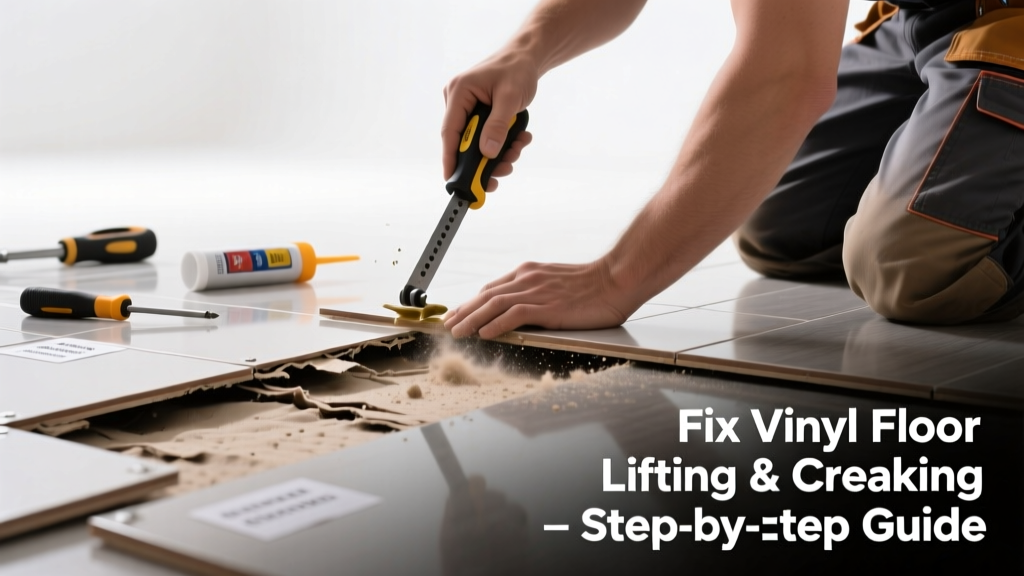
If your vinyl floor lifts slightly when stepped on and responds with a hollow pop, squeak, or crunch, it’s not just annoying—it’s a warning sign. That noise usually means the adhesive has failed, moisture is trapped underneath, or the subfloor isn’t stable. Ignoring it can lead to buckling, mold, or trip hazards.
Quick Diagnosis
Before grabbing tools, identify the root cause. Most noisy lifting stems from one (or more) of these issues:
- Failed glue bond—especially near edges or seams where foot traffic concentrates
- Moisture buildup under the floor from leaks, high humidity, or poor vapor barrier
- Subfloor movement due to loose plywood, gaps between OSB sheets, or joist deflection
- Expansion gap too narrow or blocked by baseboard or trim
- Older vinyl (pre-2010) installed without proper acclimation or over uneven subfloor
Tools & Materials Needed
| Item | Purpose | Estimated Cost |
|---|---|---|
| Utility knife with fresh blades | Cuts precise slits in lifted areas for adhesive injection | $5–$12 |
| Notched trowel (1/16" x 1/16") | Spreads thin-set or vinyl-specific adhesive evenly | $8–$15 |
| Heavy-duty roller (100-lb) | Presses vinyl flat and forces out air pockets after re-adhering | $25–$45 |
| Construction-grade vinyl adhesive (e.g., Bostik Best) | Bonds securely to both vinyl backing and subfloor; resists moisture migration | $18–$32 |
| Moisture meter (pin-type) | Confirms subfloor moisture content is ≤12% before repair | $40–$95 |
Step-by-Step Fix
Choose the method that matches your lift severity and location:
- Small edge lift (under 2 inches): Clean dust and debris from the gap, inject vinyl adhesive using a caulk gun with a fine tip, then weigh down with books or sandbags for 24 hours.
- Mid-slab bubble (3–6 inches wide): Use a utility knife to make two parallel 1/4"-deep relief cuts across the bubble, inject adhesive beneath both flaps, roll firmly with a 100-lb roller, then place weights for 36 hours.
- Large area separation (>1 sq ft) with visible moisture: Cut out the damaged section, test subfloor moisture with a pin-type meter (must read ≤12%), let dry if needed, prime with acrylic primer, then install new vinyl patch using full-spread adhesive and seam sealer.
When to Call a Pro
DIY repairs fail—or become unsafe—when:
- You detect musty odors or dark staining under the vinyl: possible mold or rot requiring structural assessment
- The entire room lifts or waves when walked on: indicates severe subfloor sagging or joist failure
- Your home was built before 1980 and you suspect asbestos-containing vinyl (common in tiles and sheet goods pre-1985)
- Water intrusion is active (e.g., leaking pipe, recurring basement seepage) and hasn’t been resolved
According to the Insurance Institute for Business & Home Safety's 2023 report, 68% of flooring failures linked to noise or lifting were traced to unresolved moisture sources—not adhesive quality.
Prevention Tips
Extend your vinyl floor’s life and silence future creaks with these habits:
- Maintain indoor humidity between 35–55% year-round using a dehumidifier in basements or humid climates
- Install transition strips at doorways to absorb expansion/contraction stress
- Use felt pads under furniture legs—and replace them every 6 months
- Never wet-mop luxury vinyl plank (LVP); instead, use a microfiber mop with pH-neutral cleaner
- Inspect baseboards annually: remove any caulk or paint sealing expansion gaps
Can I use super glue to reattach lifted vinyl?
No. Super glue (cyanoacrylate) creates a brittle bond that cracks under thermal expansion and foot traffic. It also doesn’t penetrate vinyl backing or adhere reliably to concrete or plywood. Use only adhesives labeled for resilient flooring—like Bostik Best or Tarkett ProBond.
Will heat from a hair dryer help flatten a bubble?
Temporarily, yes—but it’s risky. Heat softens vinyl and may warp its pattern or weaken existing adhesive further. If you try it, keep the dryer >12 inches away and move constantly. Better to cut and re-adhere properly. As flooring contractor Mike Rinaldi told Flooring Contractor Magazine in 2022: “Heat fixes are like putting duct tape on a cracked manifold—looks okay until it fails catastrophically.”
How long does vinyl adhesive take to fully cure?
Most premium vinyl adhesives reach handling strength in 4–6 hours but require 72 hours for full bond development. Avoid heavy traffic, moving furniture, or mopping during this time. Cold rooms (<65°F) or high humidity can double cure time—check the product datasheet.
Can I lay new vinyl over existing lifting vinyl?
Only if the old layer is fully bonded, flat, and clean. Any lifting or curling will telegraph through new material. Worse, layering traps moisture and violates most manufacturer warranties. The National Wood Flooring Association (NWFA) advises against overlaying unless the substrate meets strict flatness specs (≤3/16" variation over 10 feet).
Do I need to remove baseboards to fix lifting near walls?
Often, yes—especially if the lift starts within 2 inches of the wall. Baseboards frequently block expansion gaps or get nailed into the vinyl itself. Carefully pry them off with a stiff putty knife and finish nails, label each piece, and reinstall after repair. For tips on safe removal, see our guide on how to remove baseboards without damage.
Why does my vinyl floor pop only in winter?
Low indoor humidity causes vinyl to contract slightly, pulling away from edges where adhesive is weakest. The pop occurs when the sheet snaps back into place under pressure. Installing a whole-house humidifier set to 40% RH reduces seasonal stress—and cuts HVAC-related static electricity too. The U.S. EPA estimates that 14% of household water usage is from leaks, many of which go unnoticed until they affect flooring.
A quiet floor feels like a well-tuned instrument—subtle, consistent, and confident underfoot. Fixing those pops and lifts isn’t just about silence; it’s about preserving your investment and catching hidden problems early. If you’ve patched one spot, walk the full perimeter and tap-test adjacent areas—you might catch the next lift before it sings. For deeper subfloor concerns, check our subfloor repair for squeaky floors guide or how to test for moisture under flooring.