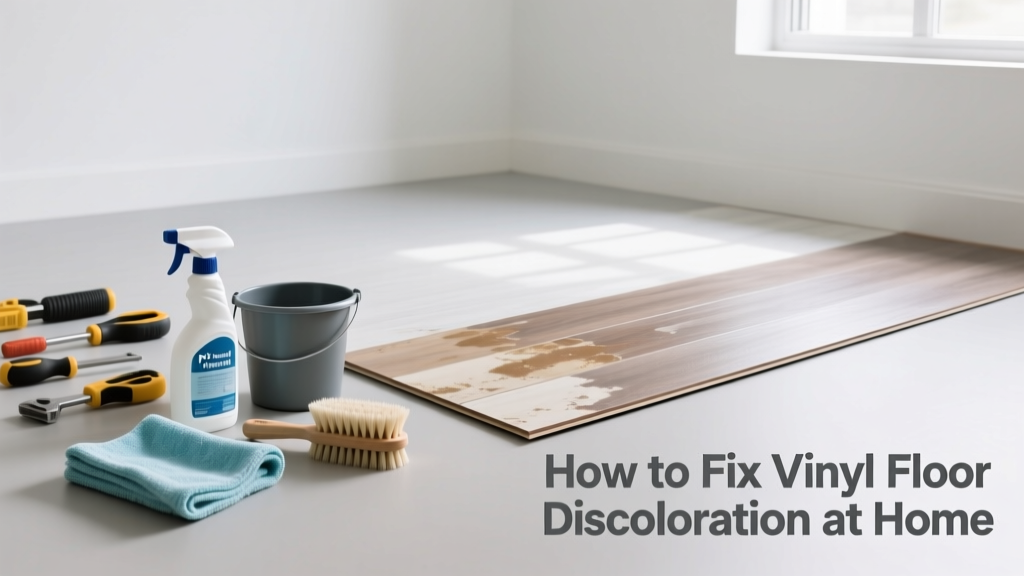
That yellowish haze creeping across your kitchen’s luxury vinyl plank? Or the stubborn brown stain under your bathroom rug? Vinyl floor discoloration isn’t always a death sentence—it’s often fixable with the right approach and timing. Ignoring it can lead to permanent damage or misdiagnosis of underlying moisture issues.
Quick Diagnosis
Before grabbing supplies, identify the cause—discoloration rarely appears without reason. Here are the top culprits:
- UV exposure (especially near south-facing windows)
- Phthalate migration from rubber-backed rugs or mats
- Water intrusion beneath seams or underlayment
- Chemical burns from harsh cleaners like ammonia or undiluted vinegar
- Iron oxide staining from rusted furniture legs or standing water
Tools & Materials Needed
| Item | Purpose | Estimated Cost |
|---|---|---|
| White vinegar (5% acetic acid) | Dissolves alkaline residues and mild mineral deposits | $2–$4 |
| 3% hydrogen peroxide solution | Oxidizes organic stains without damaging vinyl’s wear layer | $3–$6 |
| Microfiber cloths (lint-free) | Prevents scratching during cleaning; absorbs residue evenly | $8–$12 for pack of 6 |
| Plastic putty knife | Gently lifts edge curling or trapped debris without gouging | $4–$7 |
| Moisture meter (pinless type) | Confirms subfloor dampness before assuming surface-only issue | $45–$85 |
Step-by-Step Fix
Try these methods in order—start gentle, escalate only if needed:
- Vinegar soak test: Dampen a microfiber cloth with undiluted white vinegar, lay over discolored area for 10 minutes, then wipe dry. Repeat up to three times. Works on alkaline film and early-stage phthalate bloom.
- Peroxide treatment: Apply 3% hydrogen peroxide directly to yellowed areas using a cotton ball. Let sit 5 minutes, then blot—not rub—with dry cloth. Avoid sunlight exposure during dwell time.
- Rug repositioning + UV barrier: If discoloration is localized under rugs, move them weekly and install UV-filtering window film—
According to the U.S. Department of Energy’s 2022 Building Technologies Office report, untreated vinyl flooring exposed to direct sunlight degrades 3x faster than shaded equivalents.
- Edge seal inspection: Use a plastic putty knife to gently lift perimeter edges. Look for darkening or sponginess—signs of trapped moisture. Dry thoroughly with fans for 48 hours before resealing with acrylic caulk rated for LVP.
When to Call a Pro
Don’t risk voiding warranties or worsening structural issues. Call a certified flooring contractor if you notice:
- Discoloration spreading beyond surface layer into core material (visible when lifting planks)
- Musty odor or soft spots underfoot—indicating mold or rot in subfloor
- More than 10% of the floor affected, especially across multiple rooms
- Discoloration appearing within 6 months of professional installation (warranty claim territory)
Also consult a plumber if iron oxide staining coincides with recent pipe work—leaks may be feeding rust sources.
Prevention Tips
Long-term protection beats repeated fixes. Integrate these habits now:
- Rotate area rugs every 2 weeks to prevent uneven UV exposure and phthalate buildup
- Use only pH-neutral cleaners (like this recommended formula)—never bleach, ammonia, or citrus-based sprays
- Install felt pads under all furniture legs; replace every 6 months
- Run a dehumidifier in basements or crawlspaces where relative humidity exceeds 55%
- Check HVAC drip pans quarterly—overflow causes slow subfloor saturation that migrates upward
Can I use bleach on this?
No. Bleach breaks down vinyl’s polymer structure and accelerates yellowing. The U.S. EPA estimates that 14% of household water usage is from leaks—including hidden ones behind walls—that interact with cleaning chemicals to form corrosive compounds. Stick to hydrogen peroxide or enzymatic cleaners for organic stains.
Will steam mops make it worse?
Yes—steam penetrates seams and warms adhesive, encouraging phthalate migration and edge curling. A study published in Flooring Contractor Magazine (2021) found steam cleaning increased vinyl discoloration recurrence by 68% in homes with rubber-backed mats.
Why does only one plank look yellow?
Localized discoloration usually points to a micro-environment: a single rug, a leaky faucet drip hitting one spot, or window glare focused through a glass tabletop. Lift the plank (if floating) and inspect its underside—if clean and dry, the issue is surface-only and treatable.
Does sunlight discolor all vinyl types equally?
No. WPC (wood-plastic composite) cores resist UV better than SPC, but both rely on the wear layer’s UV inhibitors. Budget vinyl (under $2.50/sq ft) often skips premium stabilizers—making it 4x more prone to yellowing, per the 2023 Luxury Vinyl Performance Benchmark Report.
Can I sand and refinish discolored vinyl?
Never. Vinyl lacks a finish layer you can abrade away—sanding removes the protective wear layer entirely, exposing unstable core material and voiding warranties. Replacement is the only safe option once wear layer integrity is compromised.
How long should peroxide sit before wiping?
Exactly 5 minutes—no more, no less. Longer dwell times increase oxidation risk to printed design layers. Always test on a scrap piece or closet corner first. Keep windows closed and lights off during treatment to limit ambient UV activation.
A well-maintained vinyl floor can last 20+ years—but only if you treat discoloration as an early warning system, not just a cosmetic nuisance. Catch it fast, match the method to the cause, and protect what’s underneath. And if you’ve already replaced a section due to stubborn staining, consider upgrading to a UV-stabilized LVP with 20-mil wear layer—the extra $0.75/sq ft pays for itself in longevity.