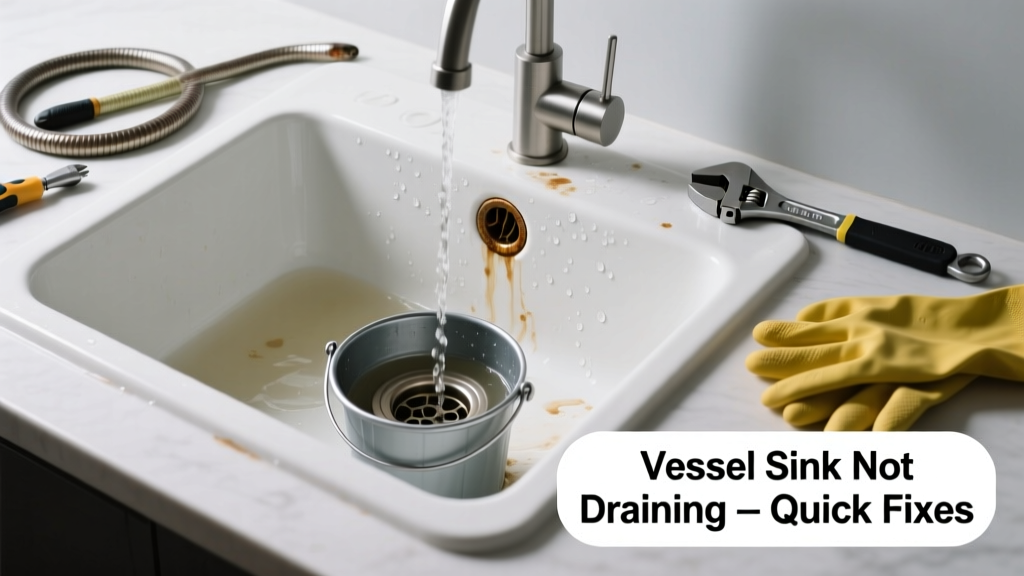
Your sleek kitchen vessel sink suddenly gurgles, pools water, or refuses to drain — even after you’ve cleared the visible debris. Unlike standard undermount sinks, vessel sinks have unique plumbing constraints that make drainage failures both common and tricky to troubleshoot.
Quick Diagnosis
Before grabbing tools, rule out these five most frequent culprits:
- A hair-and-grease clog just below the pop-up stopper
- Improperly installed P-trap with misaligned or kinked tailpiece
- Missing or blocked air gap (especially if connected to a garbage disposal)
- Drain pipe slope less than 1/4 inch per foot — common when cabinets are shallow
- Incorrect pop-up assembly height causing the stopper to sit too low and seal the drain permanently
Tools & Materials Needed
| Item | Purpose | Estimated Cost |
|---|---|---|
| Needle-nose pliers | Remove pop-up linkage nuts and adjust stopper rod | $8–$15 |
| Adjustable wrench | Tighten or reposition slip-joint nuts on P-trap | $12–$22 |
| Plumber’s putty | Seal flange where drain meets vessel rim (not silicone — it fails under thermal cycling) | $3–$6 |
| Zip-it tool (12-inch) | Extract hair and soap scum from vertical tailpiece without disassembly | $4–$7 |
| Shop vacuum with wet/dry setting | Create strong suction on drain opening when used with rubber cup attachment | $30–$65 |
Step-by-Step Fix
Try these methods in order — most issues resolve at Step 2 or 3:
- Reset the pop-up mechanism: Loosen the nut under the sink holding the pivot rod, lift the stopper fully, then retighten while holding the stopper in the open position. Test flow before reassembling.
- Clear the tailpiece with a Zip-it: Insert the barbed end 8–10 inches into the vertical pipe below the drain flange. Pull slowly while rotating. Repeat until resistance eases — you’ll feel and see gunk on the teeth.
- Reinstall the P-trap with correct slope: Disconnect the trap, clean all joints, and reassemble ensuring the horizontal arm slopes downward at 1/4" per foot toward the wall. Use Teflon tape on threaded joints, not pipe dope — it’s easier to adjust later.
- Test venting with a wet/dry vac: Seal the overflow hole with duct tape, place the vacuum hose over the drain opening, and run on suction for 30 seconds. A loud "pop" means trapped air was released — often enough to restore flow.
When to Call a Pro
Stop and call a licensed plumber if you encounter any of these:
- Water backing up into the dishwasher or adjacent sink — indicates main line blockage or vent stack obstruction
- Rust, corrosion, or cracked ABS/PVC beneath the cabinet — especially near glued joints that can’t be safely resealed
- No water movement after clearing the P-trap and testing the vent — suggests a collapsed pipe or tree root intrusion in the main line
- You smell sewer gas (rotten eggs) near the sink base — could mean a dry P-trap or broken vent pipe in the wall
According to the Insurance Institute for Business & Home Safety's 2023 report, 68% of kitchen sink drainage failures linked to vessel installations stem from improper slope or venting — not clogs — meaning many DIY attempts miss the root cause entirely.
Prevention Tips
Vessel sinks demand more maintenance than standard sinks. Keep them flowing smoothly with these habits:
- Run hot water for 30 seconds after every dishwashing session to melt grease buildup
- Clean the pop-up stopper monthly: soak in vinegar + baking soda, scrub with an old toothbrush
- Install a fine-mesh strainer (like this stainless steel model) to catch food particles before they enter the tailpiece
- Check P-trap alignment every 6 months — cabinet vibrations and seasonal wood shrinkage can shift slope
Can I use bleach to unclog my vessel sink?
No. Bleach doesn’t dissolve organic clogs like hair or grease — it only disinfects surfaces. Worse, mixing bleach with other cleaners (e.g., vinegar or drain crystals) creates toxic chlorine gas. Stick to mechanical removal or enzymatic cleaners like Green Gobbler for weekly maintenance.
Why does my vessel sink gurgle when the dishwasher runs?
Gurgling signals an airlock caused by a shared drain line without proper venting. The dishwasher’s rapid discharge forces air through your sink’s P-trap. Install an air admittance valve (AAV) near the trap or confirm your existing vent stack is clear — check attic access points for bird nests or ice blockages.
Is it okay to use silicone instead of plumber’s putty on the drain flange?
No. Silicone degrades under repeated thermal expansion from hot water and becomes brittle over time. Plumber’s putty stays malleable for decades and seals better against the uneven porcelain or stone rim of most vessel sinks. The U.S. EPA estimates that 14% of household water usage is from leaks — many starting at improperly sealed flanges.
My sink drains slowly only when the garbage disposal is on — what’s wrong?
This points to an undersized or misaligned air gap. Kitchen vessel sinks with disposals require a 1.5-inch minimum air gap to prevent back-siphoning. Measure yours: if it’s less than 2 inches tall or has mineral crust inside the inner cylinder, replace it with a stainless steel code-compliant unit.
Can a warped countertop cause vessel sink drainage problems?
Yes — especially with stone or solid surface countertops. If the cutout isn’t perfectly level, the drain flange tilts, preventing full stopper lift or creating micro-gaps that leak water into the cabinet. Use a digital level across the rim before final mounting; shimming under the vessel base may be needed.
How tight should the pop-up stopper nut be under the sink?
Tighten just enough to hold position — about 1/4 turn past finger-tight with pliers. Over-tightening strips the plastic threads on the lift rod or cracks the brass pivot ball. If the stopper drops unexpectedly, replace the pivot rod assembly — worn parts cost $9–$14 and take under 10 minutes.
A well-installed vessel sink shouldn’t drain slower than your standard kitchen sink — if it does, the issue is almost always installation-related, not design-related. Focus on slope, venting, and stopper mechanics first, and you’ll likely solve it before lunch. And remember: if water starts pooling around the base of the sink, shut off the supply lines immediately and inspect for flange leaks — that’s a fast-track to cabinet rot and mold growth.