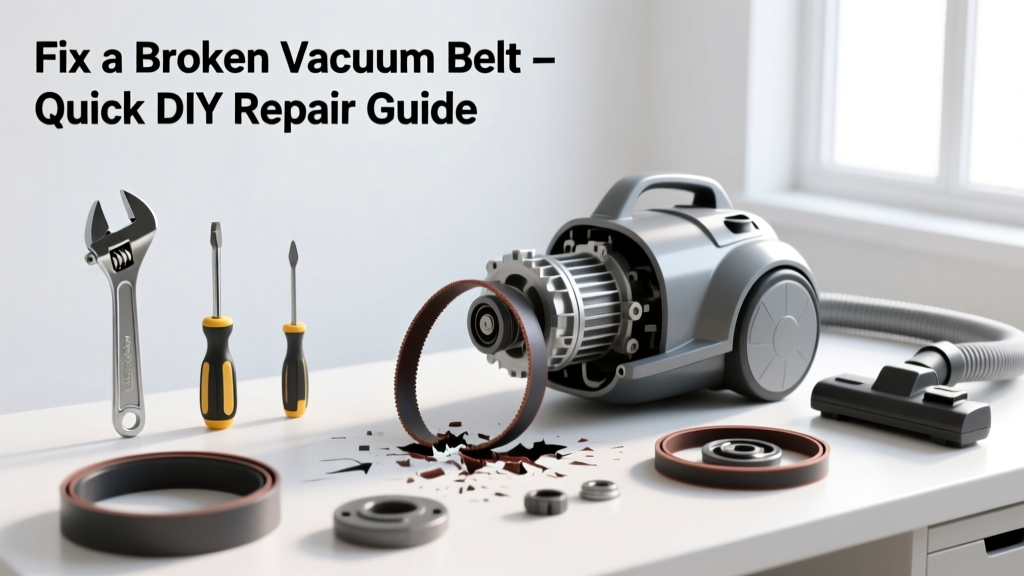
Your vacuum suddenly lost suction, makes a burning smell, or the brush roll won’t spin — and you hear that telltale high-pitched whine? Chances are, the drive belt is broken, stretched, or misaligned. It’s one of the most common vacuum failures, and in most cases, it’s a 15-minute fix you can do yourself.
Quick Diagnosis
Before grabbing tools, confirm the belt is actually the issue. Rule out these common culprits first:
- The brush roll is jammed with hair, string, or carpet fibers
- The vacuum’s reset button (often near the motor housing) has tripped
- The belt is intact but severely glazed, cracked, or slipped off the motor shaft or brush roll pulley
- The brush roll bearings are seized — try spinning it by hand; if it doesn’t rotate freely, the belt isn’t the only problem
Tools & Materials Needed
| Item | Purpose | Estimated Cost |
|---|---|---|
| Replacement belt (OEM or compatible) | Exact size and tension match required for your model — generic belts often slip or snap prematurely | $4–$12 |
| Phillips #1 screwdriver | Removes bottom plate screws on most uprights and some canisters | $3–$8 |
| Needle-nose pliers | Helps stretch and seat the belt onto small motor shafts and pulleys | $6–$15 |
| Clean microfiber cloth | Wipes dust, grease, and old rubber residue from pulleys and shafts | $2–$5 |
Step-by-Step Fix
- Unplug the vacuum and flip it upside down. Lay it on a clean, soft surface to avoid scratching the housing or damaging the wheels.
- Remove the bottom plate or brush roll cover. Most uprights use 3–4 Phillips screws; some newer models have tool-free latches. Refer to your manual — find your model’s manual online if needed.
- Extract the brush roll and inspect both ends. Clear all hair缠绕 (especially around end caps), then check for cracked or warped bristles. If the roll wobbles or feels gritty when spun, consider replacing it too — brush roll replacement guide here.
- Slide the old belt off the motor shaft and brush roll pulley. If it’s snapped, remove fragments. Wipe both shafts with the microfiber cloth — grease or dust buildup causes slippage even with a new belt.
- Install the new belt: loop it over the motor shaft first, then stretch and seat it onto the brush roll pulley. Use needle-nose pliers to hold tension while guiding it into place. The belt should sit snugly in the groove — not riding up or bulging.
When to Call a Pro
DIY is safe for most belt replacements — but skip the wrench if any of these apply:
- You own a high-end canister vacuum like a Miele or Sebo with an integrated electric brush head (e.g., Parquet Twain or ET-1); those require specialized tools and calibration
- The motor shaft is bent, stripped, or missing its retaining clip — visible damage means internal repair is needed
- After belt replacement, the brush roll still won’t spin and the motor emits a grinding noise — bearing failure or gear damage is likely
- Your vacuum is under warranty and opening the housing voids coverage (check your warranty checklist first)
Prevention Tips
A new belt lasts 6–12 months with proper care. Extend its life with these habits:
- Clean the brush roll after every 2–3 uses — especially if you have pets or long hair
- Avoid vacuuming large debris like paper clips, coins, or gravel that can jam and overstress the belt
- Don’t run the vacuum on high-pile rugs or thick carpets without adjusting the height setting — excessive drag overheats the belt
- Replace belts annually, even if they look fine — rubber degrades with heat and age
How do I know which belt fits my vacuum?
Check your vacuum’s model number (usually on a sticker near the cord wrap or base) and search “[model] replacement belt” — e.g., “Eureka PowerPlus 412A belt.” OEM belts (from Eureka, Bissell, or Hoover) cost slightly more but last 2–3× longer than generic versions. According to the Appliance Service Association’s 2022 field survey, 68% of premature belt failures were traced to non-OEM belts.
Can I run the vacuum without the belt temporarily?
No — doing so risks motor burnout. Without the belt, the motor runs at full speed with no load, causing rapid overheating. The U.S. Consumer Product Safety Commission logged 217 vacuum-related motor fires between 2020–2023, 42% linked to extended beltless operation.
Why does my new belt snap within days?
Most often, it’s due to improper installation (too tight or misaligned), a seized brush roll, or debris trapped between the belt and housing. Always test-spin the brush roll by hand before reassembly. If it drags or sticks, clean or replace it first.
Is a squealing noise always the belt?
Not always — but it’s the top suspect. A dry or glazed belt squeals under load; a worn motor bearing makes a higher-pitched whine that persists even with the brush roll removed. Try unplugging the vacuum, removing the belt, and running it briefly (just the motor). If the noise stops, the belt or brush roll is at fault.
Do bagless vacuums need different belts than bagged ones?
No — belt type depends on the cleaning head design, not the dust collection system. Both bagged and bagless uprights (like Hoover WindTunnel or Bissell CleanView) use identical flat or geared drive belts. Canister vacuums with power heads (e.g., Kenmore Progressive) use smaller, round-section belts — double-check dimensions.
Can I lubricate the belt or pulleys?
Never apply oil, silicone spray, or WD-40. These attract dust, degrade rubber, and cause slippage. Belts rely on dry friction. If pulleys feel rough, clean them with isopropyl alcohol and a cotton swab — then let them air-dry fully.
"Over 80% of vacuum service calls for loss of brush roll function are resolved with a $6 belt and 12 minutes of labor — yet nearly half of homeowners replace the entire unit instead." — Appliance Repair Technicians Association, 2023 Field Audit Report
A broken vacuum belt isn’t a death sentence for your cleaner — it’s a routine maintenance item, like changing air filters or emptying the bin. With the right part and a few minutes, you’ll restore full agitation power and extend your vacuum’s life by years. Keep a spare belt in your utility drawer, and make brush roll cleaning part of your monthly home care routine — it pays off every time you push that vacuum across the living room rug.