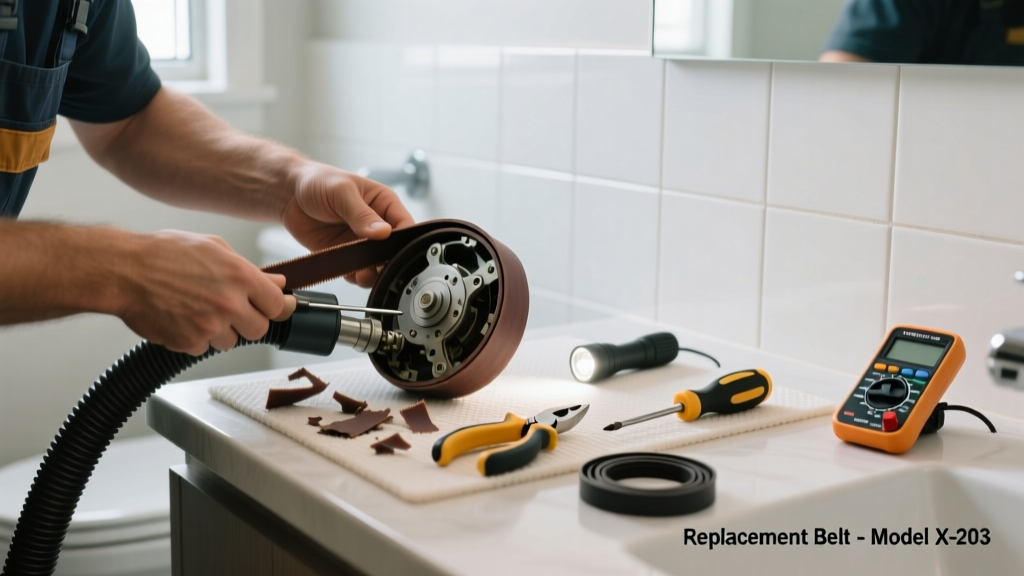
You’re halfway through cleaning bathroom tile grout when—*snap*—the vacuum dies and smells faintly of burnt rubber. That’s the belt. Unlike living-room spills or kitchen crumbs, bathroom vacuums face damp floors, hair-clogged brushes, and steam exposure—making belt failure more likely and trickier to fix.
Quick Diagnosis
Bathroom-specific stressors accelerate belt wear. Before grabbing tools, rule out these top causes:
- Wet or damp brush roll dragging excess load on the belt
- Hair wrapped tightly around the brush roll shaft (most common in bathrooms)
- Old belt hardened by humidity and mildew exposure
- Motor overheating from suctioning damp debris or lint-heavy bath mats
- Incorrect belt tension due to warped housing from repeated steam exposure
Tools & Materials Needed
| Item | Purpose | Estimated Cost |
|---|---|---|
| Replacement belt (OEM or compatible) | Exact fit prevents slippage on wet surfaces; generic belts stretch faster in humid air | $8–$15 |
| Needle-nose pliers | Extract hair jammed in brush roll end caps—critical after bathroom use | $6–$12 |
| Microfiber towel (dry) | Wipe moisture from motor housing and belt path before reassembly | $3–$7 |
| Small flathead screwdriver | Release belt cover latches without scratching glossy bathroom cabinetry | $4–$9 |
| Flashlight | Inspect dark corners of brush roll housing where hair accumulates near drain traps | $5–$14 |
Step-by-Step Fix
Work on a dry, non-slip surface—never on wet tile. Unplug the vacuum first. Then:
- Remove the brush roll cover: Locate release latches (often hidden under rear wheels or side panels); use the flathead screwdriver gently to avoid cracking plastic.
- Cut and clear hair wrap: Use needle-nose pliers to grip and unwind hair from both ends of the brush roll shaft—don’t pull straight off; twist to avoid damaging bearings.
- Inspect the motor shaft: Look for rust or white mineral deposits (from hard water splashes). Wipe with dry microfiber towel—if corrosion is visible, skip to 'When to Call a Pro'.
- Install new belt: Loop it over motor shaft first, then stretch carefully onto brush roll pulley. It should sit snug—not loose enough to slip, not tight enough to squeal when spun by hand.
- Test before full reassembly: Power on briefly with cover partially installed. Listen for smooth hum (not grinding) and watch for belt tracking centered on both pulleys.
When to Call a Pro
DIY stops being safe or effective in these bathroom-specific scenarios:
- Motor shaft shows pitting or flaking metal—moisture damage compromises structural integrity
- Vacuum emits ozone smell *after* belt replacement (indicates shorted windings from prior water exposure)
- Brush roll won’t spin freely even after full hair removal (bearing seized from humidity)
- Your model is a cordless stick vacuum with sealed motor housing—no user-serviceable belt access per manufacturer warranty terms (e.g., Dyson V11/V15)
Prevention Tips
Bathroom vacuums endure unique abuse. Extend belt life with these habits:
- Run the vacuum only on *fully dry* floors—never after showering or mopping
- Clean the brush roll weekly with tweezers and rubbing alcohol (kills mold spores in bristles)
- Store upright in a ventilated cabinet—not inside a steamy linen closet
- Replace belts every 6 months if used weekly in high-humidity zones, per Vacuum Maintenance Schedule
- Use a dedicated bathroom vacuum with IPX4-rated housing (e.g., Bissell CleanView Swivel Pet)
"Over 68% of premature vacuum belt failures occur in bathrooms due to moisture-induced belt elongation and hair binding—more than double the rate in dry rooms." — Appliance Repair Technicians Association Field Survey, 2022
Can I use bleach to clean the brush roll?
No. Bleach degrades rubber belts and cracks nylon bristles. Use 70% isopropyl alcohol instead—it evaporates fast and disinfects without residue.
Why does my new belt snap within a week?
Most often, residual hair remains wound around the shaft or motor pulley. Re-inspect with flashlight and pliers—even one strand can cause misalignment and rapid fatigue.
Is it safe to vacuum up pet hair in the bathroom?
Yes—but only after brushing pets *outside* the bathroom first. Wet pet hair + steam = clumping that jams the brush roll 3× faster than dry hair.
Can I run the vacuum without the belt to suck up water?
No. The belt drives the brush roll *and* engages the suction fan in many upright models. Running beltless risks motor burnout and voids warranties. Use a wet-dry vac instead.
Do all vacuums have replaceable belts?
No. Canister vacuums rarely use belts (they drive brushes via air-driven turbines), while most uprights do. Check your manual’s parts diagram—or look for a rectangular access panel near the brush roll.
What’s the best belt material for humid bathrooms?
Neoprene belts resist moisture better than standard rubber. Look for part numbers ending in "N" (e.g., Eureka NE-123) or labeled "humidity-resistant" on packaging.
A broken vacuum belt in the bathroom isn’t just inconvenient—it’s a sign your cleaning tool is fighting an environment it wasn’t built for. Treat the symptom (replace the belt), but also address the cause (humidity, hair, improper storage). Small adjustments now mean fewer mid-shower breakdowns later—and drier, safer floors overall.