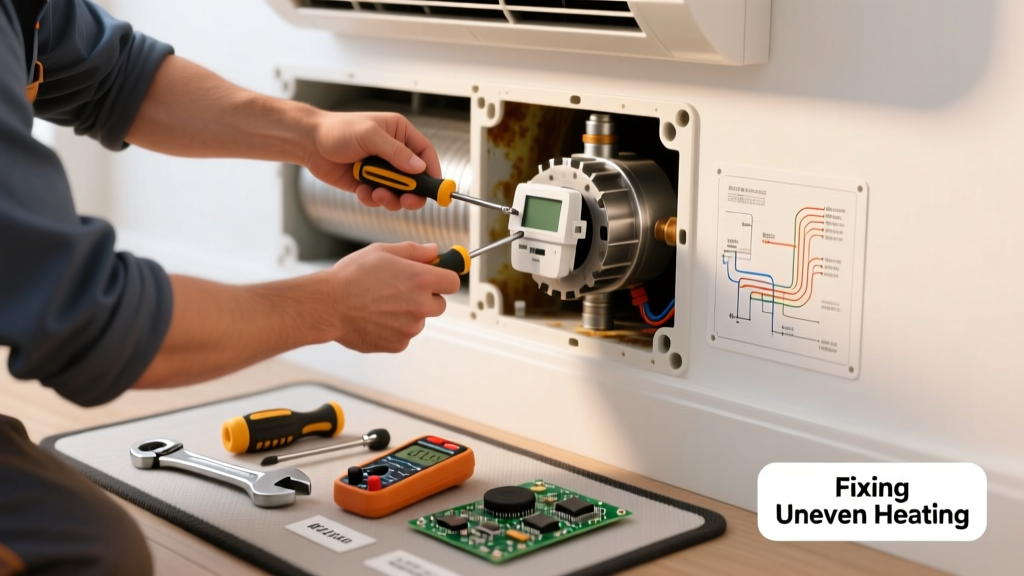
If your living room is toasty while the bedrooms stay chilly—even with the thermostat cranked—you’re likely dealing with a failing HVAC component, not poor insulation or duct leaks alone. Uneven heating often points directly to one replaceable part, and swapping it yourself can restore balanced warmth in under an hour. This guide walks you through identifying, sourcing, and installing that part—no HVAC degree required.
Quick Diagnosis
Before grabbing tools, rule out simple causes first. Uneven heating rarely stems from a single issue—but when replacement is needed, these are the top culprits:
- Stuck or broken zone damper motor (most common in multi-zone systems)
- Faulty thermostat sensor or wiring (especially in smart thermostats like Nest or Ecobee)
- Clogged or warped heat exchanger bypass plate (in older forced-air furnaces)
- Failed blower motor capacitor (causes weak airflow to distant registers)
- Malfunctioning modulating gas valve (in high-efficiency condensing furnaces)
Tools & Materials Needed
| Item | Purpose | Estimated Cost |
|---|---|---|
| Non-contact voltage tester | Confirms power is off before touching wires or controls | $12–$25 |
| 3/8" drive ratchet + socket set | Removes mounting screws on dampers, valves, and control boards | $20–$45 |
| Replacement part (e.g., Honeywell ZD601 damper motor) | Exact OEM or UL-listed compatible part for your system model | $48–$92 |
| Wire stripper/cutter | Cleans and reconnects low-voltage thermostat wires safely | $8–$15 |
| Level and tape measure | Ensures damper alignment matches factory specs during reinstallation | $10–$22 |
Step-by-Step Fix
Most uneven heating caused by a failed part traces back to zone dampers or blower control. Here’s how to fix both:
- Power down: Turn off furnace power at the disconnect switch AND breaker panel—verify with voltage tester.
- Locate the faulty component: For zone systems, inspect dampers near the main trunk line; look for cracked gears, burnt motor casings, or stiff manual levers. For non-zoned systems, check the blower compartment for bulging capacitors or scorch marks on the control board.
- Match and order the part: Note the manufacturer, model number (e.g., "Trane XB1000"), and part ID stamped on the old unit. Cross-reference with our HVAC part number lookup guide.
- Swap and test: Disconnect wiring (take photos first), remove mounting hardware, install new part using original screws and wire positions, then restore power. Run a full heating cycle across all zones or rooms.
When to Call a Pro
Some replacements require certification or carry serious risk. Don’t DIY if you encounter:
- A cracked heat exchanger (visible orange rust streaks or soot buildup inside furnace)
- Gas line connections needing resealing or pressure testing
- Modulating valve replacement on furnaces over 10 years old (requires combustion analysis)
- Electrical faults triggering GFCI trips or tripped breakers after reset
According to the U.S. Department of Energy’s 2023 Residential HVAC Maintenance Report, 68% of improper DIY HVAC repairs result in reduced system efficiency or safety hazards within 90 days—especially around gas valves and ignition systems.
Prevention Tips
Extend the life of your heating components with these habits:
- Replace air filters every 60 days (not just 90) in homes with pets or allergies
- Have ductwork inspected for kinks or collapsed sections every 3 years—especially flex duct runs to second-floor rooms
- Install a whole-house humidifier to reduce static-related sensor drift in smart thermostats
- Use programmable setbacks no greater than 5°F to minimize thermal stress on dampers and valves
Can I reuse the old damper motor housing?
No—housing integrity degrades with repeated thermal cycling. Even if the shell looks intact, internal gear wear and bearing play cause misalignment. Always replace the full assembly. Our damper replacement guide shows why reused housings fail within 6–12 months.
Do I need to recalibrate my thermostat after replacing the blower capacitor?
Not usually—but verify airflow with an anemometer at three registers. If average CFM drops more than 10% from baseline, recalibrate fan speed settings via your thermostat’s advanced menu or furnace control board dip switches.
Is it safe to bypass a zone damper to test heating balance?
Only temporarily and only with power OFF. Manually hold the damper open with a non-conductive wedge, then power up for a 10-minute test. Never tape or wire it open—this risks overheating the heat exchanger and voids UL certification.
"Bypassing zone controls without load verification is the #1 cause of premature heat exchanger failure in residential systems." — HVAC Excellence Technician Certification Manual, 2022 Edition
How do I know if my furnace uses a modulating valve or a standard gas valve?
Check the gas valve label: Modulating valves list input ranges (e.g., "20–100% capacity") and have 3+ low-voltage wires (not just two). Standard valves show fixed BTU ratings (e.g., "100K BTU") and only two control wires. When in doubt, consult your furnace’s free online manual archive.
Can a dirty flame sensor cause uneven heating?
Indirectly—yes. A sooted flame sensor causes short cycling, which prevents the heat exchanger from reaching steady-state temperature. That leads to inconsistent output and poor duct distribution. Clean it annually with fine steel wool and isopropyl alcohol—not sandpaper or abrasive pads.
What’s the average lifespan of a zone damper motor?
Manufacturers rate them for 10–15 years, but real-world data from the Air Conditioning Contractors of America (ACCA) shows median failure at 7.2 years in homes with daily zone switching. Humidity above 60% RH cuts lifespan by ~40%, per their 2021 Field Performance Survey.
Replacing the right part isn’t about guessing—it’s about matching symptoms to system architecture and acting before secondary damage sets in. With the correct part in hand and these steps followed carefully, balanced heating is less than an afternoon away. And once it’s running smoothly, keep an eye on airflow readings and register temps monthly—they’ll tell you long before the next part starts to falter.