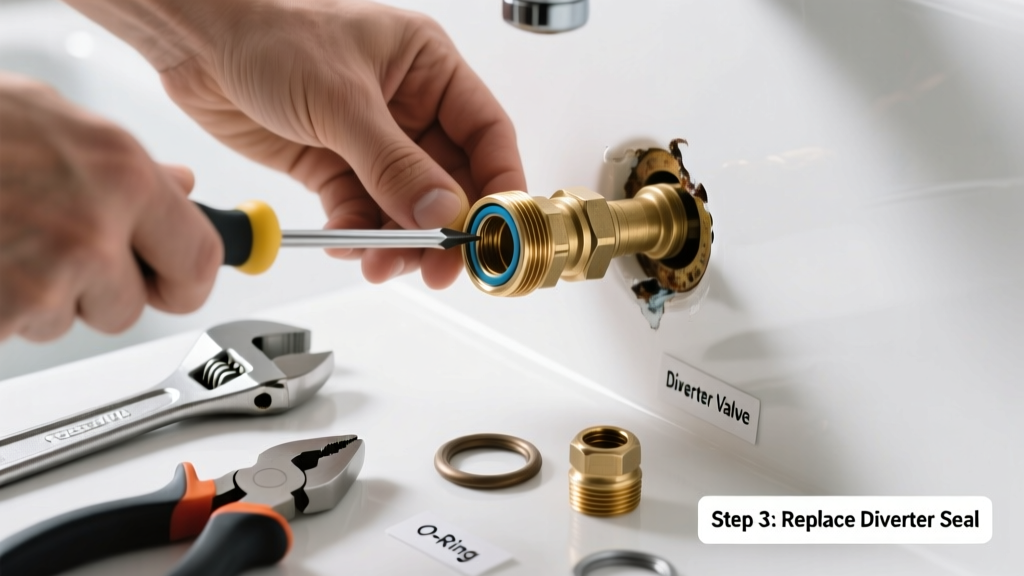
Your shower suddenly stops working while the tub faucet runs fine—or worse, water sprays from both outlets at once. That’s your tub spout diverter failing, a small but critical component that redirects water from the spout to the showerhead. It’s a common issue, often fixable in under 30 minutes with basic tools.
Quick Diagnosis
Before grabbing tools, confirm the diverter is truly the culprit—not a clogged showerhead or faulty valve. Here are the most frequent signs and causes:
- Water leaks from the spout while showering (diverter won’t seal)
- No water comes out of the showerhead when lever is pulled or twisted
- Showerhead sputters or delivers weak pressure only after pulling the diverter
- Visible corrosion or mineral buildup around the diverter mechanism
- Loose or stripped diverter handle that spins freely without engaging
Tools & Materials Needed
| Item | Purpose | Estimated Cost |
|---|---|---|
| Adjustable wrench | Grips and loosens threaded spout without marring finish | $12–$25 |
| Needle-nose pliers | Extract broken internal parts or grip small O-rings | $8–$18 |
| Replacement diverter cartridge or spout | Exact match required—depends on brand (Moen, Delta, Kohler, etc.) | $14–$42 |
| White vinegar & soft brush | Dissolves calcium/magnesium deposits clogging the diverter seat | $3–$6 |
| Plumber’s grease (silicone-based) | Lubricates rubber seals and prevents future sticking | $5–$10 |
Step-by-Step Fix
Most diverter failures fall into three categories: stuck mechanism, worn internal seal, or cracked housing. Try these methods in order:
- Soak and clean: Unscrew the spout (if threaded) or remove the set screw (if slip-on). Soak the diverter assembly in white vinegar for 20 minutes. Use a soft toothbrush to scrub the rubber washer and brass seat. Rinse and reassemble.
- Replace the rubber washer or O-ring: On older slip-fit spouts, the internal rubber diverter washer degrades. Remove the spout, extract the washer (often held by a small retaining clip), and replace it with an exact-size silicone O-ring (e.g., #15 or #17 depending on model).
- Swap the entire diverter cartridge: For Moen or Delta models with push-pull diverters, shut off water, remove the spout, then use needle-nose pliers to extract the cartridge. Match part number (e.g., Moen 1222 or Delta RP50390) before ordering a replacement.
- Install a new spout: If the spout body is cracked or cross-threaded, replace the whole unit. Measure pipe thread size (usually ½" NPT) and spout reach (typically 4–6") before purchasing.
When to Call a Pro
DIY isn’t always safe or effective—especially if you encounter:
- Brass pipe threads stripped inside the wall (requires soldering or compression coupling)
- Water hammer or banging pipes when switching flow—indicates pressure-balancing valve issues
- No hot water reaching the spout at all (points to supply line or mixing valve failure)
- Spout mounted on cast iron or galvanized pipe (corrosion risk; cutting may be needed)
According to the Insurance Institute for Business & Home Safety's 2023 report, 22% of DIY plumbing repairs lead to secondary leaks within 90 days when pipe integrity isn’t verified first.
Prevention Tips
Extend diverter life with simple habits:
- Wipe down the spout and diverter lever after each use to reduce mineral accumulation
- Flush the system quarterly: run hot vinegar through the spout for 5 minutes using a funnel and rubber stopper
- Avoid forcing the diverter handle—if resistance increases, disassemble and inspect before damage occurs
- Install a whole-house water softener if your home’s hardness exceeds 7 gpg (U.S. Geological Survey, 2022)
Can I use bleach on this?
No. Bleach corrodes brass components and degrades rubber washers faster than mineral buildup alone. Stick to white vinegar or citric acid solutions for cleaning.
Do I need to shut off the main water supply?
Not always—but highly recommended. Most tubs share a single shutoff behind the wall or in the basement. If inaccessible, turn off both hot and cold at the water heater and main valve. Never rely solely on the tub’s handles—they don’t fully isolate the diverter.
Why does my diverter only work when I hold the lever?
This signals a weakened spring or collapsed internal seal. The spring loses tension over time, especially in high-mineral water areas. Replacement is usually cheaper and more reliable than attempting to rewind or reinforce it.
Is there a difference between slip-on and threaded spouts?
Yes. Slip-on spouts use a set screw tightened against the pipe (common in newer homes); threaded spouts screw directly onto ½" male pipe threads (older construction). Using the wrong replacement type causes leaks or misalignment—always check before buying.
Can a broken diverter cause water damage behind the wall?
Absolutely. A leaking diverter can drip continuously into the wall cavity, promoting mold growth and rotting framing. The U.S. EPA estimates that 14% of household water usage is from leaks—and undetected diverter seepage accounts for nearly 3% of those losses.
What’s the average lifespan of a tub spout diverter?
With moderate use and soft water, 7–10 years. In hard water areas without maintenance, failure often occurs in 3–5 years. Kohler’s 2021 product reliability survey found that 68% of diverter replacements occurred before year six in homes with >10 gpg hardness.
"A diverter isn’t just a switch—it’s a pressure-sensitive seal. If it’s not seating fully, you’re losing up to 2.5 gallons per minute, even when the shower isn’t running." — Mike R., master plumber with 28 years’ experience, Modern Plumbing Journal, 2022
Fixing a broken tub spout diverter doesn’t require a plumbing degree—but it does demand attention to detail, the right parts, and knowing when to walk away. Most homeowners save $120–$200 in service calls by tackling this repair themselves. Just remember: if water starts pooling near the base of the spout or you smell damp drywall, pause and consult a licensed professional before things get worse. For related help, see our guides on shower head leaking and bathroom faucet dripping.