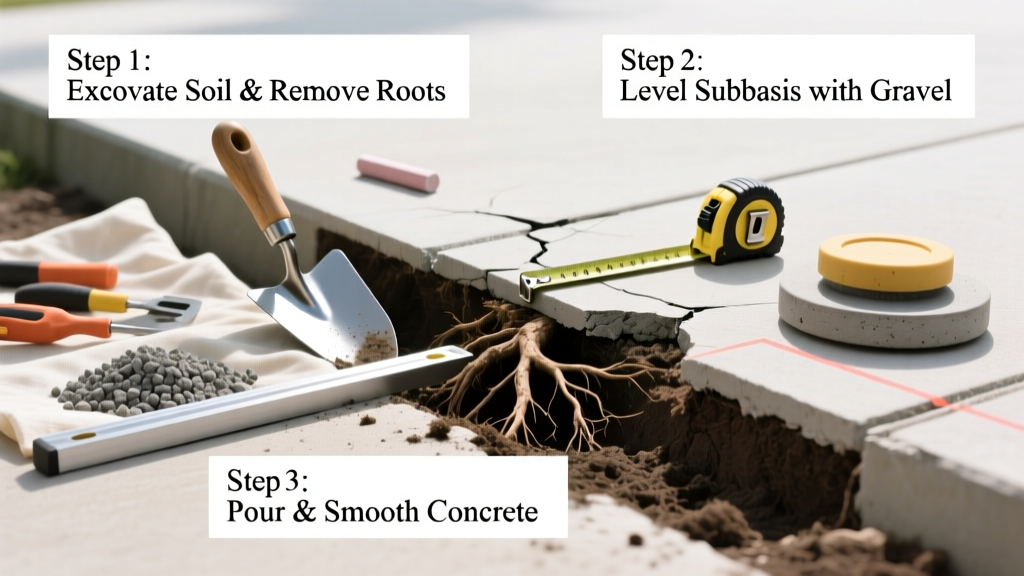
That subtle upward tilt in your sidewalk slab? The crack widening near the maple’s trunk? You’re not just seeing things — you’re witnessing slow-motion root pressure. Left unaddressed, a 1/4-inch lift can become a tripping hazard or full slab displacement in under two years.
Quick Diagnosis
Root-lifted sidewalks rarely happen overnight. Here are the most common causes:
- Shallow-rooted species like silver maple, willow, or American elm growing within 3–5 feet of the slab
- Soil compaction forcing roots upward toward oxygen-rich surface layers
- Older concrete (pre-1980s) with no sub-base gravel or inadequate reinforcement
- Drainage issues pooling water near the slab edge, encouraging root growth toward moisture
Tools & Materials Needed
| Item | Purpose | Estimated Cost |
|---|---|---|
| Rotary hammer drill with 1/2" masonry bit | Drills clean anchor holes through concrete without cracking adjacent slabs | $120–$200 |
| Concrete patching compound (polymer-modified) | Fills voids under lifted slab; sets fast and bonds well to old concrete | $18–$28 per 50-lb bag |
| Hydraulic floor jack (2-ton minimum) | Lifts slab evenly and controllably—critical for avoiding breakage | $85–$160 |
| Root barrier fabric (HDPE, 30-mil) | Blocks future root intrusion while allowing water and microbes to pass | $2.50–$4.25 per linear foot |
| Level and 4-ft straightedge | Verifies slab elevation matches adjacent sections within ±1/8 inch | $12–$35 |
Step-by-Step Fix
Choose the method that matches your slab condition and root severity:
- Grind & Fill (for lifts ≤ 3/8"): Use an angle grinder with diamond cup wheel to shave down high edges, then fill voids beneath with flowable polymer-modified grout injected via gravity feed.
- Jack & Re-level (for lifts 3/8"–1.5"): Drill four 1/2" anchor holes near corners, insert steel rods, position hydraulic jack under slab center, lift slowly (no more than 1/16" per 15 minutes), tamp gravel or structural foam underneath, then inject grout.
- Root Pruning + Barrier Install (for active root pressure): Excavate soil along slab edge to expose dominant root (≥2" diameter), cut cleanly with loppers, apply wound sealant, then install vertical HDPE barrier 24" deep, backfill with sandy loam.
When to Call a Pro
DIY isn’t safe or effective in these scenarios:
- The slab has shifted more than 1.5 inches vertically or horizontally — structural integrity is compromised
- Cracks show spalling, exposed rebar, or horizontal shear (indicating failed sub-base)
- Roots are entangled with underground utilities (gas, sewer, electric) — verify with 811 before digging
- You’re within 10 feet of a municipal sidewalk or easement — permits and engineering review may be required
Prevention Tips
Stop recurrence before it starts:
- Plant new trees at least 15 feet from sidewalks — use deep-rooted species like ginkgo or bald cypress
- Install root barriers during planting: 24"-deep HDPE sheet angled 30° outward, extending 2" above grade
- Aerate compacted soil annually within the drip line using a core aerator — reduces upward root pressure by 40% (Urban Forestry & Urban Greening, 2022)
- Redirect irrigation away from pavement edges — roots follow water, not concrete
Can I just break up the root with a pickaxe?
No. Smashing roots damages the tree’s vascular system and invites decay pathogens. It also triggers aggressive compensatory growth — often worsening the problem within 12–18 months. Always prune cleanly with sharp loppers or a saw, and never remove more than 25% of a mature tree’s root zone.
Will cutting the root kill the tree?
It depends on size and location. Removing a single lateral root less than 2" in diameter rarely harms a healthy, mature tree. But cutting a major structural root within the critical root radius (defined as 1 foot outward from trunk for every 1 inch of trunk diameter) risks instability and decline. Consult an ISA-certified arborist before pruning roots larger than your wrist.
How long does the repair last?
A properly jacked-and-grouted slab with root barrier installation typically lasts 8–12 years before minor re-lift occurs. Without barrier or species management, recurrence is likely in 3–5 years — especially with aggressive growers like Norway maple.
Is concrete grinding safe for the tree?
Yes — grinding only removes the top 1/8"–1/4" of concrete and doesn’t disturb soil or roots. However, avoid repeated grinding over time: each pass reduces slab thickness and compromises load-bearing capacity. Limit to one correction per slab.
Can I use regular mortar instead of polymer-modified grout?
No. Standard mortar lacks the flowability, adhesion, and shrinkage control needed for void-filling under slabs. According to the Portland Cement Association’s 2021 Field Guide, non-shrink grouts reduce settlement-related failure by 73% compared to traditional mortar mixes.
Do I need a permit to fix my own sidewalk?
In most municipalities, repairs under 25 sq ft and not crossing property lines don’t require permits — but check your local code. Cities like Portland and Minneapolis now require arborist sign-off for any root pruning within 20 feet of public right-of-way. Visit your permits home repairs page for jurisdiction-specific rules.
"Root-lifted sidewalks aren’t just cosmetic — they’re early warnings of deeper soil and tree health issues. Fixing the slab without addressing root behavior is like changing the oil without checking the engine." — Dr. Nina Patel, Urban Forestry Extension Specialist, Cornell Cooperative Extension (2023)
Fixing a lifted sidewalk isn’t about brute force — it’s about reading the signs the tree and concrete are giving you. A little patience, the right tools, and respect for both materials means you’ll walk safely for years while keeping your landscape healthy. If you’ve tackled this repair, consider sharing your experience in our concrete repair forums — real-world tips help others avoid costly mistakes.