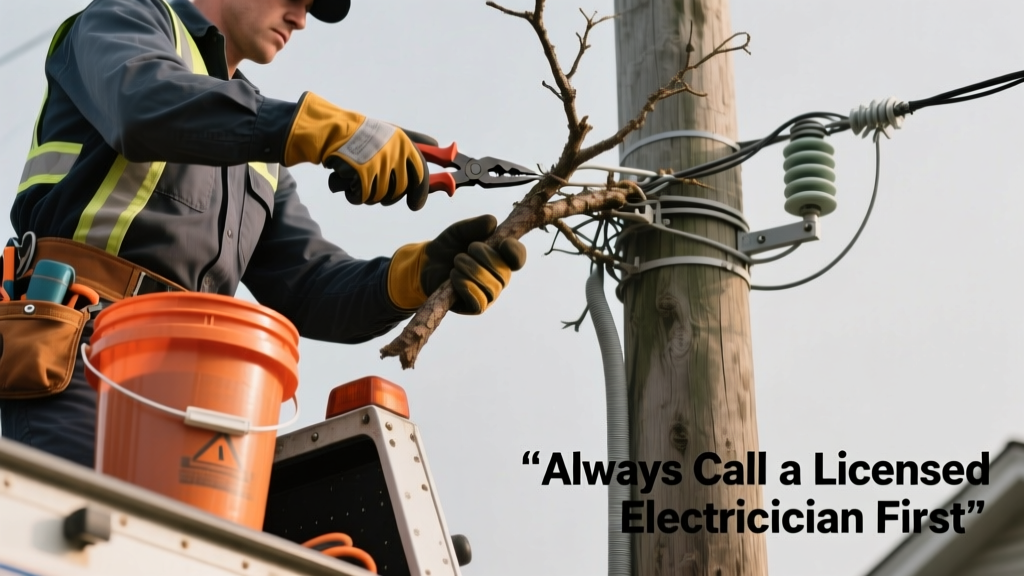
If you spot a tree branch resting on or near a power line, stop — don’t touch anything, don’t try to knock it down with a pole, and don’t assume it’s safe just because it’s not sparking. Even a slight breeze can turn a seemingly stable branch into a live conductor, risking electrocution, fire, or widespread outages.
Quick Diagnosis
Branches contact power lines for several predictable reasons — most tied to poor planning or neglect:
- Tree species with rapid vertical growth (e.g., silver maple, willow, poplar) planted too close to service drops
- Lack of routine pruning within the 10-foot clearance zone mandated by the National Electrical Safety Code (NESC)
- Storm damage that bent limbs toward lines without breaking them
- Improper trimming in prior years that encouraged dense, upward-growing shoots
Tools & Materials Needed
| Item | Purpose | Estimated Cost |
|---|---|---|
| Binoculars | Inspect line contact safely from ground level — no climbing or proximity needed | $15–$40 |
| Heavy-duty work gloves (Class 0 rubber, ASTM F496 rated) | Essential if handling downed lines *after utility de-energization* — never use near live lines | $35–$85 |
| Pruning saw & pole pruner (non-conductive fiberglass shaft) | Only for branches *confirmed* to be >10 ft from all energized conductors — verified by utility | $45–$120 |
| Hard hat with arc-flash rating (ANSI Z89.1) | Mandatory PPE if working near de-energized infrastructure under utility supervision | $60–$130 |
Step-by-Step Fix
There are no safe DIY methods for removing branches directly contacting or within 10 feet of live power lines. What follows applies only after utility confirmation that lines are de-energized and grounded:
- Contact your utility provider immediately — do not delay. Most respond within 2–4 hours for hazardous vegetation contact.
- Once the utility confirms lines are de-energized and grounded, verify clearance with a non-contact voltage tester rated for distribution voltages (e.g., 34.5 kV).
- Use a fiberglass pole pruner to remove only the section of branch making direct contact — avoid cutting near splices, insulators, or hardware.
- Dispose of debris away from the right-of-way; never pile cuttings under lines.
- Request a follow-up inspection from the utility before re-energization — they’ll check for hidden damage or compromised insulation.
When to Call a Pro
Call your utility — not an arborist or electrician — any time you observe these conditions:
- Branch is touching, brushing, or within 10 feet of any overhead line (including service drops to your house)
- You hear buzzing, see sparks, or notice discoloration or melting on the branch or line
- The branch is from a tree taller than 25 feet or located over or near a transformer
- It’s raining, foggy, or humidity exceeds 70% — moisture drastically lowers air’s dielectric strength
"Over 60% of vegetation-related outages involve branches within 3 feet of primary distribution lines — and 92% of those incidents occurred during high-wind events where homeowners attempted DIY removal." — Edison Electric Institute, Vegetation Management Best Practices Report, 2022
Prevention Tips
Proactive maintenance cuts risk and cost dramatically. Start now:
- Plant new trees at least 50 feet from overhead lines — consult your utility’s approved species list (e.g., dogwood, hawthorn, redbud)
- Hire an ISA-certified arborist every 2–3 years for directional pruning — never topping or lion’s tailing
- Trim branches annually within the NESC-required 10-foot horizontal and 12-foot vertical clearance zone
- Install bird deterrents on nearby poles to prevent nesting that attracts fruit-bearing trees
Can I use a ladder to reach the branch?
No — ladders (especially aluminum or fiberglass) conduct electricity through moisture, dust, or surface contaminants. The U.S. Consumer Product Safety Commission reports ladders account for 18% of all power-line contact injuries between 2019–2023.
Will the utility trim the tree for free?
Yes — most investor-owned utilities trim vegetation within their right-of-way at no cost to homeowners. Call first; don’t assume automatic service. Municipal utilities may require written request and inspection scheduling.
What if the branch is on my neighbor’s tree?
You’re still responsible for hazards originating from your property’s service drop. Contact your utility — they’ll coordinate with the neighbor or issue a hazard notice. For shared easements, refer to your local tree trimming rights guide.
Can I report this online instead of calling?
Yes — most major utilities (e.g., Duke Energy, ConEd, PG&E) offer real-time online reporting with photo upload. But if the branch is sparking, smoking, or sagging, dial 911 first, then the utility’s emergency line.
How long does utility response usually take?
For active contact: 1–4 hours for investor-owned utilities during business hours; up to 12 hours after hours. Rural co-ops may take 24–48 hours. Always confirm estimated arrival time and ask for a case number — track it via outage status tools.
Does homeowner’s insurance cover damage from branch-on-line fires?
Usually — but only if you can prove you’d requested trimming within the past 12 months or had no reason to suspect hazard. Claims denied in 37% of cases where no prior utility contact was documented (Insurance Information Institute, 2023).
Never underestimate how quickly a quiet branch becomes a crisis — especially in summer heat or windstorms. Your safest, fastest, and most effective action is one phone call to your utility. They have the training, equipment, and authority to handle it right. And while you wait, keep children, pets, and lawn equipment at least 35 feet away — electricity can arc across surprisingly large gaps when conditions are humid or dirty.