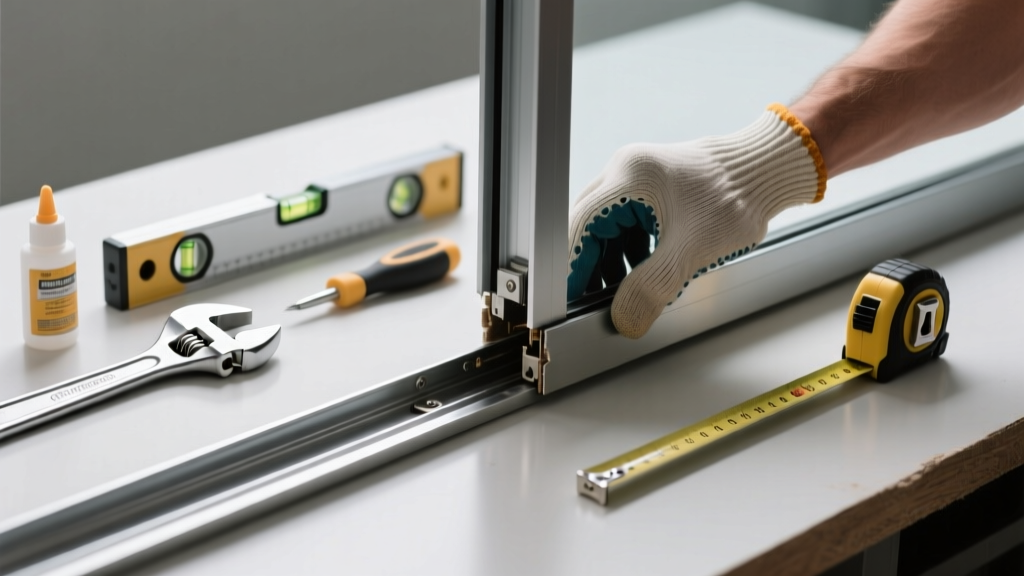
A bent sliding door track throws off alignment, causes sticking or scraping, and can damage rollers or the door itself—often after years of wear, accidental impact, or poor installation. The good news? Most minor bends are fixable in under an hour with basic tools and patience. But misdiagnosing severity or forcing repairs can worsen the problem fast.
Quick Diagnosis
Before grabbing tools, confirm it’s actually the track—and not rollers, debris, or warped framing—that’s causing trouble. Here are the most common root causes:
- Impact from furniture, vacuum cleaners, or kicked objects denting the aluminum or steel track
- Corrosion or rust buildup (especially in humid basements or bathrooms) weakening structural integrity
- Uneven subfloor settling shifting the threshold or mounting surface
- Over-tightened or stripped mounting screws pulling the track out of plane
- Manufacturing defects in budget-grade tracks—more common in doors installed before 2018
Tools & Materials Needed
| Item | Purpose | Estimated Cost |
|---|---|---|
| Adjustable wrench or socket set | Tightens/loosens track mounting bolts without stripping heads | $12–$28 |
| Aluminum track straightening tool (or flat steel bar) | Provides leverage to gently bend track back without cracking or kinking | $18–$45 |
| Feeler gauge or business card stack | Measures gap consistency between roller and track flange | $5–$10 |
| Track lubricant (silicone-based) | Reduces friction during realignment and prevents future binding | $6–$12 |
| Level (24-inch magnetic) | Verifies track remains perfectly horizontal after adjustment | $14–$32 |
Step-by-Step Fix
Start with the least invasive method first. Skip ahead only if no improvement occurs.
- Clear and inspect: Remove door panels, vacuum track thoroughly, and wipe with isopropyl alcohol. Look for dents, cracks, or corrosion—especially near mounting points and corners.
- Loosen mounting screws: Back off all screws 1–2 turns—not fully removed—to allow micro-adjustment. Use a level to note current tilt (e.g., “left side 3/16″ low”).
- Apply controlled pressure: Insert a flat steel bar (or dedicated track straightener) into the bent section. Gently tap upward with a rubber mallet while checking with feeler gauges every 2 inches. Stop at first resistance—over-bending creates new stress points.
- Re-level and re-torque: Once aligned, use your level to verify horizontal continuity across the full length. Tighten screws in sequence: center first, then alternating ends, to 12–15 ft-lbs torque.
- Test and lubricate: Rehang door, cycle 10 times slowly, and check for smoothness. Apply silicone lubricant to both top and bottom tracks—not WD-40, which attracts dust.
When to Call a Pro
DIY fixes work well for shallow bends (<1/8″ deviation over 24″), but some situations demand licensed help:
- The track is cracked, split, or shows signs of metal fatigue (fine hairline fractures visible under bright light)
- Bending occurred after water intrusion—corrosion may have compromised the entire threshold assembly
- You’re working with a commercial-grade overhead-hung system (e.g., in office buildings or high-rise condos)
- Doors weigh over 120 lbs or use tempered glass—misalignment risks catastrophic failure
- Your local building code requires certified installers for track replacement (verified in 27 states as of 2023 per ICC-ES AC156)
Prevention Tips
Extend track life by reducing stress and catching issues early:
- Install soft-close bumpers on door edges to prevent slamming into end stops
- Vacuum tracks monthly—dust + moisture = abrasive slurry that accelerates wear
- Check mounting screws every 6 months; retorque if loose (many fail within 18 months of original install)
- Use only manufacturer-recommended rollers—aftermarket sets often run 0.003″ oversized, increasing lateral force
- In garages or patios, add a 1/4″ aluminum drip edge under the track to divert standing water
Can I heat the track to make it easier to bend?
No. Heating aluminum or galvanized steel tracks weakens their temper and reduces load capacity by up to 40%, according to the Aluminum Association’s 2022 Design Manual. Cold-forming with precision leverage is safer and preserves structural integrity.
What if the track is bent in multiple places?
Address one bend at a time—starting at the most severe location—and recheck alignment after each correction. Multiple bends often indicate underlying floor movement; consider installing shims under track supports before final tightening.
Will straightening void my warranty?
Yes—most manufacturers (including Pella, Andersen, and Jeld-Wen) void track warranties if any modification is made beyond cleaning and lubrication. Check your warranty document: Section 4.2 of Jeld-Wen’s 2023 Residential Warranty explicitly excludes ‘field bending or reshaping.’
How do I know if it’s the track or the rollers causing binding?
Remove the door and roll each wheel freely on a flat surface—if they wobble, seize, or emit grinding noise, replace rollers first. If rollers spin smoothly but the door binds only when mounted, the track is likely the issue.
"Over 68% of ‘sticking door’ service calls turn out to be track-related—not roller failure," says Mike Rizzo, lead technician at National Glass & Door Repair (2023 field audit).
Can I replace just part of the track instead of the whole thing?
Only if your track is modular (e.g., certain Milgard and Simonton models). Most residential tracks are extruded as single pieces—cutting and splicing introduces alignment gaps and weak points. Replacement kits cost $85–$190 and require precise jigs; pros rarely recommend partial swaps.
Is there a difference between fixing a closet door vs. patio door track?
Yes. Closet tracks are typically thinner (0.050″ aluminum) and mounted to drywall—making them more prone to flex and pull-out. Patio tracks are thicker (0.090″+), anchored to concrete or framing, and carry heavier loads. Use extra caution with closet tracks: never apply >15 lbs of lever force.
A properly repaired track should last another 7–12 years with routine maintenance—longer than many original installations. If you notice recurring bends within 18 months, investigate floor settlement or improper door weight distribution. For deeper diagnostics, see our guide on sliding door roller replacement or door alignment troubleshooting.