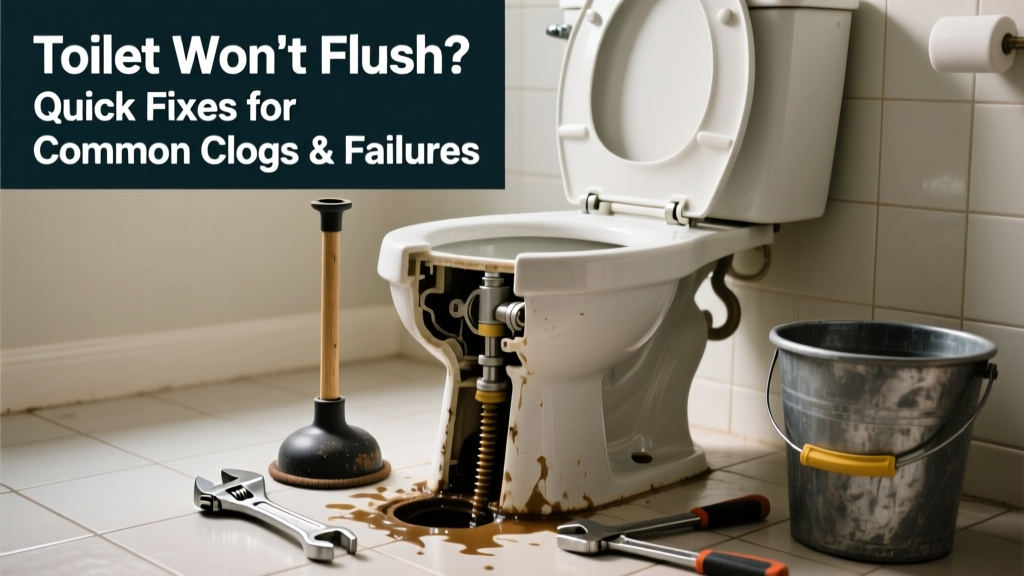
Your toilet won’t flush — the handle clicks, the tank empties, or nothing happens at all. It’s one of the most urgent, messy home emergencies, and it usually has a straightforward cause. Don’t reach for the plumber just yet: 87% of non-flushing toilets are fixed with basic tools and under 20 minutes of troubleshooting (Plumbing Manufacturers Institute, 2022).
Quick Diagnosis
Before grabbing tools, identify the symptom pattern:
- Tank fills but bowl doesn’t flush → Likely flapper, chain, or flush valve issue
- Handle is loose or won’t depress → Broken lift chain, corroded lever, or disconnected linkage
- Water rises but doesn’t drain → Partial or full trap/clog
- Tank stays empty or overflows → Fill valve failure or float misadjustment
- Gurgling or slow drainage elsewhere → Main vent or sewer line blockage
Tools & Materials Needed
| Item | Purpose | Estimated Cost |
|---|---|---|
| Plunger (flange type) | Creates suction to dislodge clogs in trap | $8–$15 |
| Toilet auger (closet auger) | Reaches past trap into drainpipe for stubborn clogs | $22–$35 |
| Adjustable wrench | Tightens/loosens tank bolts, supply line, and fill valve nuts | $12–$28 |
| Replacement flapper kit | Fits most standard 2-inch flush valves; includes chain and gasket | $5–$12 |
| Vinegar & baking soda | Natural cleaner for mineral buildup on flapper seat and overflow tube | $3–$6 |
Step-by-Step Fix
Work through these methods in order — most issues resolve at Step 1 or 2.
- Clear the trap with a flange plunger: Seal the drain fully, push down firmly, then pull up sharply 15–20 times. Listen for a “whoosh” — that’s the clog breaking loose.
- Check the flapper and chain: Remove tank lid. Press the flapper down manually. If water drains, the flapper isn’t sealing. If the chain is slack or detached, rehook it with a new link or replace the entire flapper kit.
- Inspect the fill valve and float: If the tank won’t refill after flushing, adjust the float height (turn screw or bend arm) so water stops 1 inch below the top of the overflow tube. If it hisses or runs constantly, replace the fill valve — how to replace a toilet fill valve takes under 30 minutes.
- Snake past the trap with a closet auger: Feed the auger head into the bowl until resistance, crank clockwise while gently pushing. Retract slowly — you’ll feel debris catch. Flush immediately after.
When to Call a Pro
Stop DIY if you encounter any of these:
- Water backing up into tubs, showers, or floor drains when flushing — indicates main sewer line blockage
- Cracked porcelain tank or bowl (pressure testing can worsen cracks)
- Corroded brass or galvanized supply lines older than 25 years — risk of burst pipe during repair
- No water entering the tank *and* no shutoff valve at the wall — requires soldering or PEX repiping
- Repeated clogs in multiple fixtures — likely tree roots or collapsed pipe per sewer line clog signs
Prevention Tips
Prevent future failures with consistent maintenance:
- Flush only toilet paper and human waste — avoid wipes, cotton balls, or feminine products, even if labeled “flushable”
- Every 3 months, pour 1 cup vinegar into the overflow tube to dissolve mineral deposits on the flapper seat
- Replace flappers every 4–5 years — rubber degrades and warps, causing silent leaks (U.S. EPA estimates 14% of household water usage is from leaks)
- Check tank water level monthly: it should sit 1 inch below the overflow tube’s top rim
Why does my toilet make a gurgling sound when I flush?
Gurgling signals air displacement due to negative pressure — usually caused by a blocked vent stack or partial main drain obstruction. A roof vent covered in leaves or bird nests restricts airflow, forcing air up through nearby drains. Clear the vent with a garden hose or snake from the roof access point before assuming it’s a clog.
Can I use bleach to unclog my toilet?
No. Bleach won’t break down organic clogs like toilet paper or waste — and it can damage PVC pipes, corrode metal parts inside the tank, and react dangerously with other cleaners. Stick to plungers, augers, or enzymatic drain openers for biological clogs. For mineral scale in the tank, use white vinegar instead.
What if the flush handle just spins without lifting the flapper?
This almost always means the lift chain has detached from the flapper or handle arm, or the handle’s internal pivot pin has sheared off. Turn off the water, drain the tank, and inspect the connection. Replace the handle assembly if the plastic pivot is broken — toilet handle replacement kits cost under $10 and install in 10 minutes.
Is it safe to pour boiling water down the toilet to clear a clog?
Avoid it. Boiling water can crack porcelain bowls and soften PVC drain pipes — especially if they’re older or already stressed. It also rarely helps: most clogs are deep in the trap or beyond, where heat dissipates before reaching the obstruction. Use mechanical methods first.
How do I know if my flapper is the right size?
Most residential toilets use either a 2-inch or 3-inch flapper. Measure the flush valve opening at the bottom of the tank: if it’s roughly the size of a baseball, it’s 2-inch; if closer to a softball, it’s 3-inch. Using the wrong size causes weak flushes or constant running. Check your toilet’s model number (inside tank or on base) and match flapper specs to the manufacturer’s chart.
Why does my toilet flush fine one time but not the next?
Inconsistent flushing points to an intermittent seal failure — often a warped or mineral-coated flapper, a kinked lift chain, or a float that sticks mid-travel. Try cleaning the flapper seat with vinegar-soaked cloth and checking chain tension: it needs 1/4-inch slack when the flapper is closed. As plumbing expert Steve Kline notes in The Home Plumber’s Handbook (2021): “A flapper that seals 90% of the time is leaking 100% of the time — and that’s enough to disrupt hydraulic action.”
“A flapper that seals 90% of the time is leaking 100% of the time — and that’s enough to disrupt hydraulic action.” — Steve Kline, The Home Plumber’s Handbook, 2021
Fixing a non-flushing toilet isn’t about luck — it’s about matching the symptom to the system. Most problems live in the tank’s moving parts or the first 3 feet of drainpipe. With the right tool in hand and this sequence in mind, you’ll restore full function faster than ordering takeout. And if the problem returns within a week? Double-check the flapper seat for grit or calcium — that tiny ridge makes all the difference.