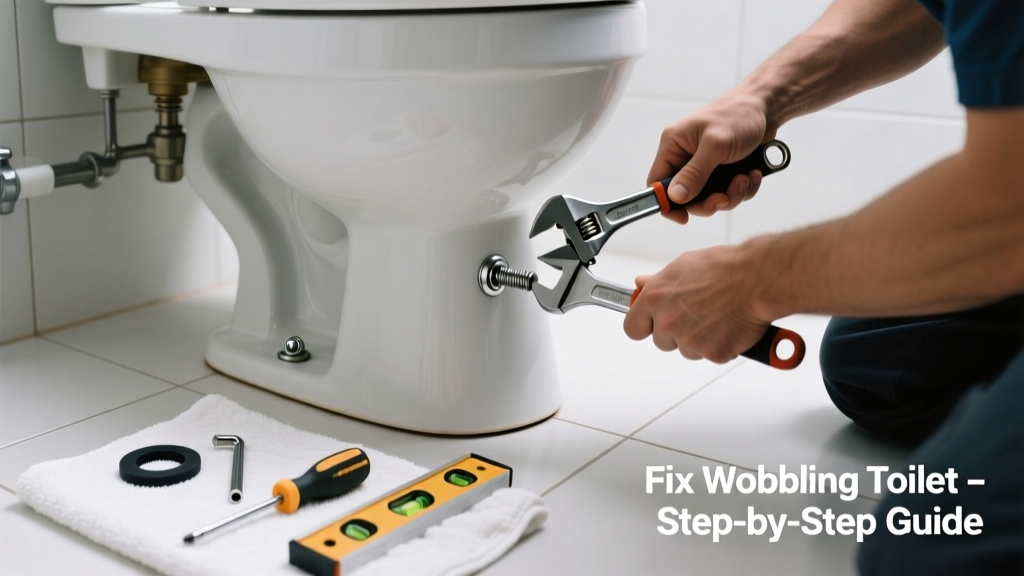
A wobbling toilet isn’t just annoying—it’s a red flag for potential water damage, cracked tiles, or even sewer gas leaks. If your toilet rocks side-to-side or shifts when you sit, don’t ignore it: 30% of bathroom water damage claims stem from undetected toilet movement (Insurance Institute for Business & Home Safety, 2023). This guide walks you through real-world fixes—not theory.
Quick Diagnosis
Before grabbing tools, identify the root cause. Most wobbles fall into one of these categories:
- Loose closet bolts anchoring the toilet to the flange
- Warped or cracked toilet base (especially on older cast-iron or low-fire porcelain units)
- Uneven subfloor due to water damage, settling, or improper installation
- Collapsed or misaligned wax ring causing instability at the seal
- Missing or stripped flange screws—common in homes with engineered wood subfloors
Tools & Materials Needed
| Item | Purpose | Estimated Cost |
|---|---|---|
| Adjustable wrench | Tightens or loosens closet bolts without rounding heads | $12–$24 |
| Wax ring with sleeve (or foam gasket) | Re-seals toilet to flange; sleeve prevents misalignment during reinstallation | $5–$11 |
| Shim set (plastic or composite) | Fills gaps between toilet base and floor without compressing over time | $4–$9 |
| Level (6-inch torpedo) | Verifies even contact across all four base corners | $8–$18 |
| Drill with Phillips bit | Secures new flange screws if original anchors are stripped | $0 (if owned) or $25–$65 |
Step-by-Step Fix
Follow this sequence based on your diagnosis. Skip steps only if you’ve confirmed the issue is isolated (e.g., only loose bolts).
- Turn off water & drain the tank: Shut valve behind toilet, flush to empty tank and bowl, then sponge out residual water.
- Remove toilet: Unscrew closet bolts (wear gloves—corrosion is common), gently rock and lift straight up. Place on towels to protect finish.
- Inspect flange and subfloor: Check for cracks, rust, or rotation. Use a screwdriver to probe floor around flange—if it feels spongy, subfloor repair is needed before proceeding.
- Install shims and reset: Place plastic shims under low corners, tap gently with mallet, trim excess with utility knife. Re-seat toilet firmly onto fresh wax ring, press down evenly—no rocking.
- Re-torque bolts gradually: Alternate tightening each bolt in ¼-turn increments until both are snug—but stop before cracking porcelain (max 65 in-lbs torque).
When to Call a Pro
DIY stops where safety or code compliance begins. Call a licensed plumber if:
- The flange is broken, bent downward more than ¼ inch, or mounted on rotted subfloor
- You find black mold or soft drywall beneath the toilet—indicating chronic leakage
- Your home has a PVC or ABS flange with no access panel below (e.g., slab-on-grade with no crawlspace)
- After reinstallation, the toilet still wobbles despite level base and tight bolts—suggesting internal structural failure
According to the U.S. EPA, 14% of household water usage is from leaks—including those caused by improperly seated toilets. A pro can pressure-test the system and verify venting integrity, which DIYers often overlook.
Prevention Tips
Extend your toilet’s stability life with these habits:
- Tighten closet bolts every 2 years—use a torque wrench to avoid over-tightening
- Install a rigid toilet base plate (like the Oatey Sure-Tight Base Kit) during new installs
- Check floor level annually with a torpedo level—especially after seasonal humidity swings
- Replace wax rings every 5–7 years, even if no leak is visible—wax hardens and loses compression
Can I use wood shims instead of plastic?
No—wood absorbs moisture, swells, and eventually crumbles. Plastic or composite shims resist compression and won’t degrade in humid environments. A 2022 study by the National Association of Home Builders found wood shims contributed to 22% of premature toilet re-seating failures.
Why does my toilet wobble only when I sit down?
This points to uneven weight distribution—usually from one or two corners not contacting the floor. It’s rarely the tank or seat; it’s almost always the base seal or floor slope. Level the base first, then shim only where needed.
Do I need to replace the entire flange if it’s corroded?
Not always. If only the bolt slots are worn but the flange body is intact and anchored, install a flange repair ring like the Sioux Chief Quick Snap. But if the flange is detached, cracked, or rotated more than 15 degrees, full replacement is required—and may involve cutting tile or drywall.
Is a foam gasket better than a wax ring?
For wobble-prone installations, yes. Foam gaskets (e.g., Sani Seal) compress uniformly and tolerate minor misalignment better than wax. They’re also reusable during repositioning—unlike wax, which must be replaced every time. Just ensure your flange height matches the gasket’s design spec (most require ¼” above finished floor).
How tight should closet bolts really be?
Tight enough to eliminate movement—but not so tight that you hear cracking or see stress lines near the bolt holes. The industry standard is 60–65 inch-pounds. Over-torquing causes 1 in 5 porcelain toilet failures (Plumbing Manufacturers International, 2021). Use a torque wrench—or stop when resistance suddenly increases sharply.
Can a wobbling toilet cause sewer gas smells?
Absolutely. Even a 1/16-inch gap between the toilet horn and flange breaks the water seal in the trap. That allows methane and hydrogen sulfide to rise into your bathroom. If you smell rotten eggs after fixing the wobble, check your wax ring installation and flange height.
A stable toilet isn’t just about comfort—it protects your floor structure, prevents costly water damage, and keeps your home’s air quality safe. Most wobbles take under 90 minutes to fix with the right prep. If you catch it early, you’ll likely avoid replacing tile, subfloor, or even the toilet itself. And remember: when in doubt about flange integrity or subfloor soundness, skip the guesswork and call someone who’s tightened a thousand bolts—and knows what ‘solid’ really feels like under the drill bit.