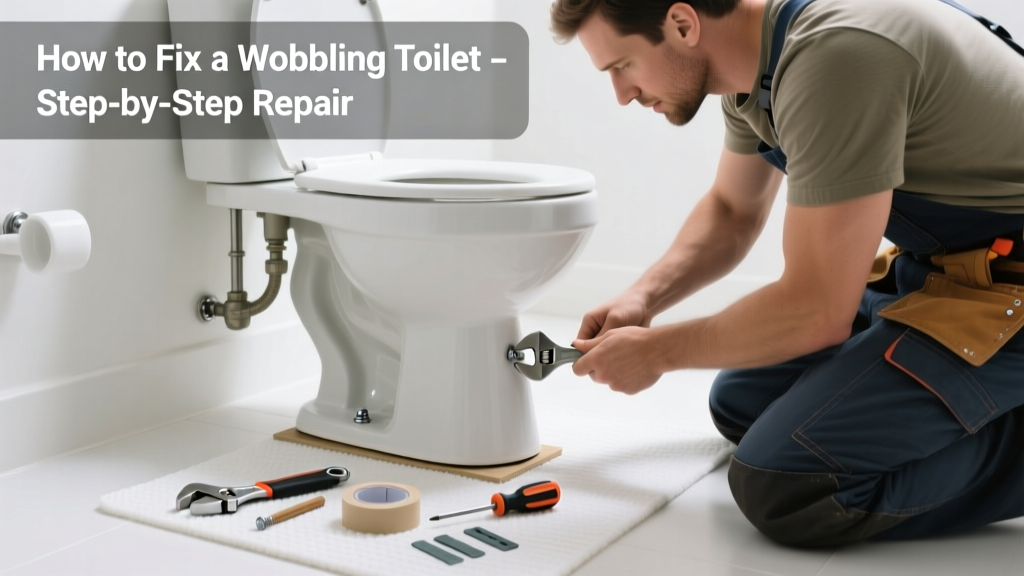
A wobbling toilet isn’t just annoying—it’s a red flag for potential leaks, floor damage, or even sewer gas infiltration. If your toilet rocks side-to-side or shifts when you sit, don’t ignore it; most cases are fixable in under an hour with basic tools and a little know-how.
Quick Diagnosis
Before grabbing tools, identify the root cause. Wobble usually stems from one (or more) of these issues:
- Loose or corroded closet bolts anchoring the toilet to the flange
- A cracked or warped toilet base (often near the front or rear)
- An uneven or rotted subfloor beneath the toilet
- A damaged, misaligned, or improperly installed wax ring
- A flange that’s broken, bent, or sitting below floor level
Tools & Materials Needed
| Item | Purpose | Estimated Cost |
|---|---|---|
| Adjustable wrench | Tightens or loosens closet bolts without stripping them | $12–$25 |
| Wax ring (or premium rubber seal) | Creates watertight seal between toilet and flange | $3–$12 |
| Closet bolt kit (stainless steel) | Replaces rusted or stripped bolts and washers | $8–$15 |
| Shim set (plastic or composite) | Fills gaps between toilet base and floor without compressing | $5–$10 |
| Level (6-inch) | Verifies stability after tightening and shimming | $6–$18 |
Step-by-Step Fix
Follow these methods in order—start simple, escalate only if needed:
- Tighten the closet bolts: Gently tighten each bolt a quarter-turn at a time, alternating sides to avoid cracking the porcelain. Stop when resistance increases sharply—overtightening is the #1 cause of cracked bases (per The National Association of Home Builders’ Plumbing Handbook, 2022).
- Shim the low side: If rocking persists, insert plastic shims (never wood or cardboard—they compress and degrade) under the toilet base where the gap is largest. Trim excess with utility knife, then caulk base edges with 100% silicone.
- Replace the wax ring and bolts: If the toilet lifts easily or you see water stains on the floor, shut off water, drain the tank and bowl, unbolt the unit, and replace both the wax ring and bolts. Inspect the flange for cracks or corrosion during this step.
- Repair or replace the flange: If the flange is broken or sits more than 1/4" below finished floor, use a stainless steel repair ring (e.g., Oatey Twist-N-Seal) or epoxy-reinforced flange extender.
When to Call a Pro
DIY stops where safety and code compliance begin. Call a licensed plumber if:
- You discover significant subfloor rot or mold beneath the toilet
- The flange is embedded in concrete and requires cutting or welding
- There’s persistent sewer odor after resealing—indicating a vent or trap issue
- Your home has cast-iron drain pipes older than 1970 and the flange is leaded or soldered
According to the Insurance Institute for Business & Home Safety's 2023 report, 68% of water damage claims linked to toilets involved delayed response to early wobble or leak signs.
“A toilet that moves more than 1/8 inch in any direction should be addressed within 48 hours—especially in homes with engineered wood subfloors, which swell rapidly when exposed to moisture.” — Mike Ruggiero, Master Plumber & IAPMO Code Trainer, 2024
Prevention Tips
Maintain stability long-term with these habits:
- Check for wobble every 6 months—press down firmly at front and back edges
- Never use abrasive cleaners on the toilet base; they degrade caulk and hide hairline cracks
- Install a flexible supply line instead of rigid copper—it reduces stress transfer to the base
- If replacing flooring, ensure the new surface is perfectly level before resetting the toilet
Can I reuse the old wax ring?
No. Wax deforms permanently once compressed and heated by wastewater. Reusing it almost guarantees a slow leak. Always install fresh wax—or better yet, a reusable rubber seal like Fluidmaster Better Than Wax.
Why does my toilet wobble only when I sit down?
This points to uneven load distribution: likely a slight floor dip under the front of the bowl or a partially compressed wax ring. It’s rarely the tank—it’s almost always the base-to-floor interface.
Do I need to caulk around the entire base?
Yes—but leave a 2-inch gap at the back. Full perimeter caulking traps moisture if a leak develops, hiding it until damage is severe. The gap allows early visual detection of seepage.
What if the bolts won’t tighten and just spin?
The flange anchor tabs are likely broken or stripped. You’ll need a flange repair kit that secures to the existing pipe (like the Sioux Chief Mission Line), or a professional to install a new flange through the subfloor.
Can I shim with pennies or business cards?
Avoid metal, paper, or foam shims. They corrode, compress, or disintegrate—creating instability over time. Use only non-compressible, moisture-resistant plastic shims designed for plumbing (e.g., Danco Shims).
How tight should the closet bolts really be?
Tighten until the bolt head contacts the washer and the toilet no longer moves—then stop. If the base creaks or the tank shifts, you’ve gone too far. A torque of 5–7 ft-lbs is ideal; most hand-tightening achieves this if done evenly.
Fixing a wobbling toilet isn’t about brute force—it’s about precision, patience, and respecting how tightly interconnected your bathroom’s structure really is. Get it right once, and you’ll add years to your toilet’s life while protecting your floor, your walls, and your peace of mind. For related help, see our guides on toilet leaking at base and how to replace a wax ring.