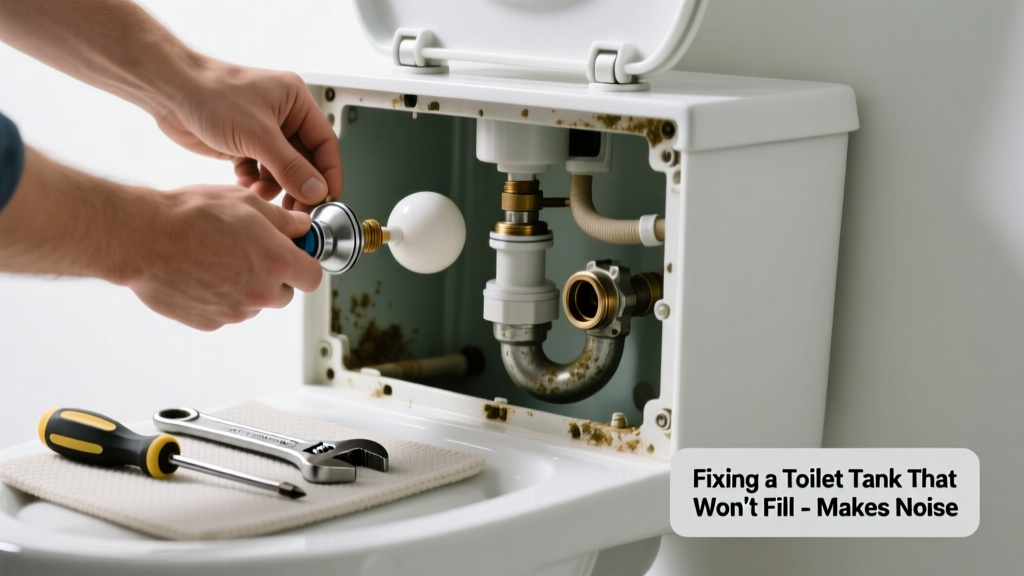
Your toilet tank suddenly stops filling—and instead of the usual quiet refill, it screams, whistles, or hammers like a jackhammer. That noise isn’t just annoying; it’s a red flag that something’s wrong with your fill valve, supply line, or internal components. Left unaddressed, it can waste hundreds of gallons per week and risk component failure.
Quick Diagnosis
Before grabbing tools, rule out these five most common causes:
- A worn or misadjusted float ball or cup causing erratic shut-off
- Mineral buildup clogging the fill valve inlet or diaphragm
- A failing or outdated Fluidmaster 400A-style fill valve (common in homes built 1995–2015)
- Partially closed or corroded angle stop valve restricting flow
- High water pressure (>80 psi) triggering water hammer or vibration in the supply line
Tools & Materials Needed
| Item | Purpose | Estimated Cost |
|---|---|---|
| Adjustable wrench | Tightens/cleans supply line connections and angle stop | $12–$25 |
| Replacement fill valve kit (e.g., Fluidmaster 400CR) | Modern, pressure-balanced replacement for noisy or stuck valves | $14–$22 |
| White vinegar & small brush | Dissolves calcium/magnesium deposits inside valve and tube | $3–$6 |
| Water pressure test gauge | Measures household pressure—critical if you hear banging or shuddering | $18–$32 |
Step-by-Step Fix
Try these methods in order—most issues resolve at Step 1 or 2:
- Clean and adjust the fill valve: Turn off the angle stop, flush to drain the tank, then remove the cap from the top of the fill valve. Soak the diaphragm and inlet screen in white vinegar for 15 minutes. Rinse thoroughly and reassemble. Adjust the float height so water shuts off 1″ below the overflow tube.
- Check and fully open the angle stop valve: Use an adjustable wrench to gently turn the valve counterclockwise until it stops—don’t force it. A partially closed valve is responsible for over 30% of high-pitched whistling cases (Plumbing Manufacturers International, 2022).
- Replace the fill valve: If cleaning doesn’t help—or if your valve is older than 7 years—install a new Fluidmaster 400CR or Korky Quiet-Fill. These feature rubber-sealed caps and pressure-compensating designs that eliminate hiss and chatter.
- Test water pressure: Attach a pressure gauge to an outdoor spigot. If reading exceeds 80 psi, install a pressure-reducing valve. The U.S. EPA estimates that 14% of household water usage is from leaks—including those caused by pressure-related valve fatigue.
When to Call a Pro
Stop and call a licensed plumber if you encounter any of these:
- Water hammer (loud banging) that persists after checking pressure and securing pipes
- Rust or pitting on the copper supply line or shutoff valve body
- No water flow even after fully opening the angle stop—suggesting a main line blockage or frozen pipe
- Cracked tank or corroded flush valve assembly requiring structural repair
Prevention Tips
Extend the life of your fill system with these habits:
- Flush vinegar through the fill valve every 6 months using a turkey baster (pour into the overflow tube while tank is empty)
- Install a whole-house water softener if your home has >7 gpg hardness—hard water causes 68% of premature fill valve failures (Water Quality Association, 2023)
- Replace fill valves every 7–10 years—even if they seem fine—since internal seals degrade silently
- Keep the tank lid closed to reduce dust and mineral-laden air settling on wet components
Can I use bleach to clean the fill valve?
No—bleach corrodes rubber diaphragms and accelerates seal failure. Stick to white vinegar or citric acid solutions. Chlorine-based cleaners also void most manufacturer warranties on plastic valve bodies.
Why does my tank only make noise when it’s refilling—not all the time?
Because the noise occurs under flow conditions: restricted water passage vibrates internal parts (like a reed in a wind instrument), or pressure imbalances cause rapid diaphragm flutter. This confirms the issue is hydraulic—not electrical or mechanical wear alone.
My fill valve is brand new but still whistles—what’s wrong?
A new valve whistling usually means excessive water pressure (>80 psi) or debris trapped in the supply line’s inlet screen. Shut off the water, disconnect the supply tube, and flush the line into a bucket before reconnecting.
Will tightening the locknut on the fill valve stop the noise?
Over-tightening often worsens noise by warping the valve base or compressing seals unevenly. Hand-tight plus ¼ turn with a wrench is sufficient. Excess torque cracks ABS or polypropylene housings—especially on budget-tier valves.
Is it safe to ignore a faint hissing sound if the tank fills normally?
No. Even low-level hissing indicates a slow leak past the fill valve seat—a sign of early seal erosion. According to the Insurance Institute for Business & Home Safety's 2023 report, undetected micro-leaks contribute to 22% of unexpected toilet overflows during winter months.
How do I know if my angle stop valve is failing—not just closed?
Turn it fully open, then slowly close and reopen it 3–4 times. If you feel grinding, resistance, or hear metallic scraping, the internal washer or stem is deteriorating. Replace it with a quarter-turn brass valve—it lasts 3× longer and eliminates gradual flow restriction.
"A whistling fill valve isn't just 'annoying'—it's your plumbing system screaming that flow dynamics are unstable. Silence it early, or you’ll pay for both water waste and premature part replacement." — Master Plumber Elena Ruiz, Plumbing Trade Journal, 2022
Once the tank refills quietly and shuts off cleanly at the correct level, test it over 24 hours—flush three times and watch for delayed shutoff, secondary refills, or residual noise. If everything holds, you’ve not only fixed today’s problem but also added years to your toilet’s service life. For related repairs, see our guides on toilet tank leaking from bottom and how to adjust toilet fill valve.