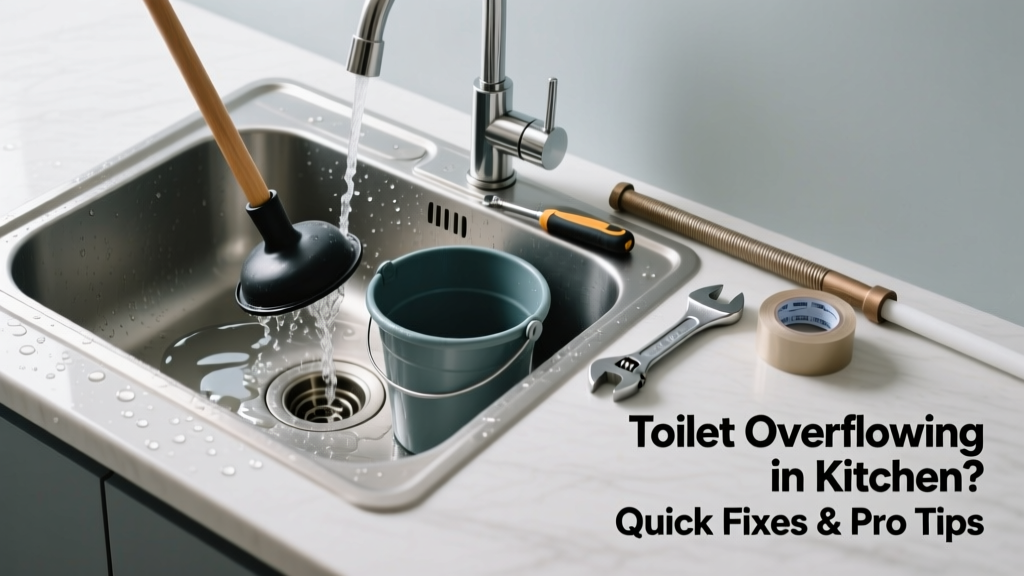
If your toilet is overflowing—not in the bathroom, but into your kitchen—that’s a serious red flag. This usually means a main sewer line blockage or a catastrophic venting failure, not just a clogged bowl. Immediate action prevents thousands in water damage and biohazard exposure.
Quick Diagnosis
Before grabbing tools, identify the root cause. This isn’t a standard toilet clog—it’s a system-wide issue. Check these first:
- Multiple fixtures backing up simultaneously (e.g., kitchen sink gurgling when flushing toilet)
- Foul sewage odor near floor drains or cabinets
- Water rising in lowest-floor drains (especially basement or kitchen floor drain)
- Slow draining across all plumbing fixtures, even after plunging
- Wet spots or mold growth along foundation walls or under kitchen cabinets
Tools & Materials Needed
| Item | Purpose | Estimated Cost |
|---|---|---|
| Heavy-duty rubber gloves & N95 mask | Protect against raw sewage pathogens and airborne bacteria | $12–$25 |
| Motorized drain auger (1/2" x 50 ft) | Reach and clear main sewer line blockages beyond P-traps | $85–$140 |
| Wet-dry vacuum (with sewage-rated filter) | Safely extract standing wastewater without spreading contaminants | $110–$220 |
| Plumber’s test ball (3" or 4") | Isolate branch lines to confirm main line vs. branch clog location | $28–$45 |
| pH test strips & baking soda/vinegar | Detect acidic corrosion in pipes; neutralize minor organic buildup | $8–$15 |
Step-by-Step Fix
Work methodically—and never ignore safety gear. Sewage backups carry E. coli, hepatitis A, and norovirus. According to the U.S. EPA, 14% of household water usage is from leaks—but untreated overflow introduces far greater health risks.
- Shut off water supply: Locate and close the main shutoff valve (usually near water meter or basement entry). Do NOT flush again.
- Contain and remove standing water: Use a wet-dry vacuum with sewage-rated filter—never a household vacuum. Dispose of wastewater at an outdoor drain, not down another fixture.
- Test for main line blockage: Insert a plumber’s test ball into the kitchen floor drain or cleanout access point, then run water from a second-floor fixture (e.g., bathtub). If water backs up elsewhere, the main line is blocked.
- Clear the main line: Feed a motorized auger through the exterior cleanout (typically a 4" capped pipe near foundation) or roof vent. Run it 75–100 ft, rotating slowly. Stop if resistance eases—then flush with garden hose.
- Verify vent integrity: Climb onto roof and inspect vent stack for bird nests, ice, or debris. Use a garden hose to flush downward—if water backs up, vent is obstructed.
When to Call a Pro
DIY stops where safety or code compliance begins. Call a licensed plumber immediately if:
- You suspect collapsed or tree-root-infiltrated cast iron or clay sewer lines (common in homes built before 1975)
- Overflow recurs within 48 hours after clearing with auger
- You detect hydrogen sulfide (rotten egg) gas levels above 10 ppm—use a $45 digital detector like the Extech SDL350
- Your home sits on a septic system and backup coincides with heavy rain or saturated drainfield
- There’s visible structural damage: buckled flooring, warped subfloor, or cracked slab near plumbing runs
"Sewer line backups aren't plumbing inconveniences—they're Category 3 'black water' events per IICRC S500 standards. Unmitigated exposure for over 2 hours requires professional remediation." — Institute of Inspection, Cleaning and Restoration Certification, 2022
Prevention Tips
Prevent recurrence with consistent maintenance—not just reactive fixes:
- Install a main-line cleanout cap with rubber gasket and stainless steel screws (replaces brittle PVC caps that crack)
- Flush only toilet paper and human waste—no wipes, dental floss, or cotton swabs (they account for 73% of sewer line blockages per National Association of Home Builders, 2023)
- Schedule annual sewer camera inspection—especially if home is over 30 years old or near mature trees
- Use enzyme-based drain treatment (e.g., Green Gobbler Main Line Cleaner) every 90 days—not chemical drain openers, which corrode pipes
- Divert downspouts and sump pump discharge away from foundation—excess groundwater stresses sewer laterals
Can I use bleach on this?
No. Bleach reacts with organic matter in sewage to produce toxic chloramine gas—and does nothing to clear physical blockages. It also damages PVC and ABS piping seals over time. Stick to enzymatic cleaners for routine maintenance.
Why is my kitchen floor flooding but not the bathroom?
Kitchen drains tie into the same main stack as toilets—but sit lower in the building’s drainage hierarchy. When the main line is fully obstructed, wastewater seeks the lowest exit point, often the kitchen floor drain or sink. That’s why it floods there first.
Will a plunger fix this?
Not reliably. Standard plungers only affect trap-level clogs. A kitchen-floor overflow almost always indicates a blockage downstream of the branch line junction—beyond plunger reach. You’ll likely just force sewage upward elsewhere.
Is it safe to run the dishwasher or washing machine?
No. Running any water-using appliance worsens pressure behind the blockage and increases overflow volume. Shut off water at the main valve until the line is fully cleared and tested.
How long can I wait before calling a plumber?
Under 2 hours. The CDC states that Category 3 black water contamination becomes exponentially more hazardous after 48 hours. Mold spores begin colonizing drywall and subfloor within 24–48 hours. Delaying professional help risks insurance denial for water damage claims.
What’s the average cost to repair a main sewer line blockage?
Unclogging with auger and camera inspection: $250–$650. Hydro-jetting: $350–$800. Full lateral replacement (if roots or collapse confirmed): $4,200–$12,500. Many municipalities offer sewer line repair grants—check your local sewer line inspection program before paying out of pocket.
A toilet overflowing into your kitchen isn’t a fluke—it’s your plumbing system screaming for attention. Acting fast protects your health, your floors, and your wallet. If you’ve cleared the line once, don’t skip the camera inspection: hidden cracks or offset joints could trigger another emergency next month. For deeper issues, consult our guide on septic system backup or slab leak detection—both common culprits behind unexpected kitchen flooding.