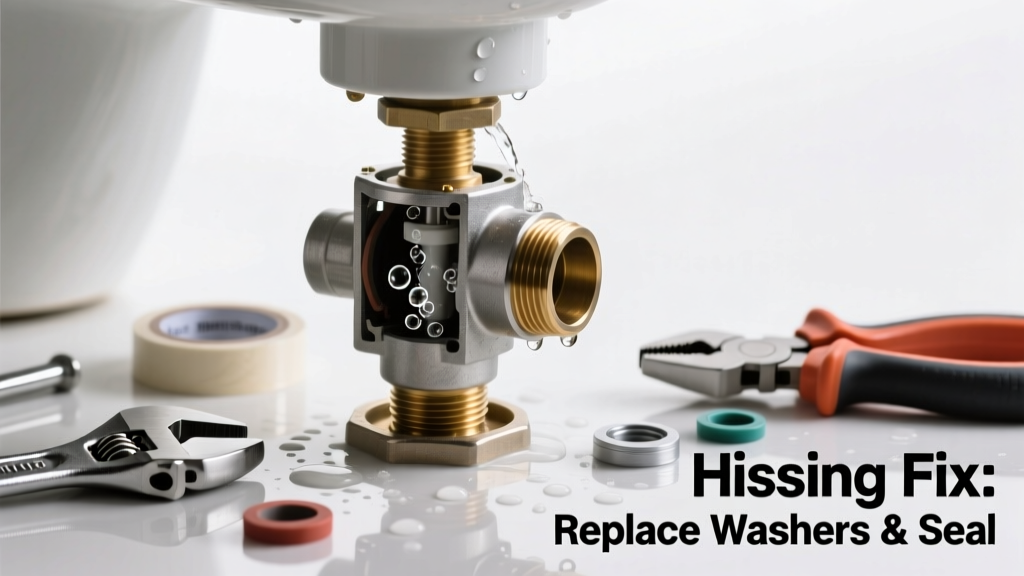
If you hear a persistent hiss coming from what sounds like a toilet—but it’s in your kitchen—you’re likely dealing with a misplaced or mislabeled fixture, or more commonly, a pressure-assisted urinal flush valve or commercial-style fixture mistaken for a toilet. Kitchen spaces in commercial buildings, ADUs, or renovated lofts sometimes include compact restroom fixtures that use toilet-style fill valves—and those can hiss just like bathroom models.
Quick Diagnosis
A hissing fill valve means water is leaking past the seal or diaphragm inside the valve assembly. In kitchen settings, this is almost always due to one of these causes:
- Worn or mineral-crusted float cup or diaphragm seal
- Debris trapped under the inlet valve seat (especially in hard water areas)
- Over-pressurized supply line (>80 psi) causing constant seepage
- Incorrect valve model installed (e.g., a standard residential valve used on a commercial flushometer)
- Loose or cross-threaded locknut allowing vibration-induced leaks
Tools & Materials Needed
| Item | Purpose | Estimated Cost |
|---|---|---|
| Adjustable wrench | Tightens or removes supply line nuts and valve mounting hardware | $12–$25 |
| Needle-nose pliers | Retrieves small debris or adjusts tiny adjustment screws | $8–$18 |
| White vinegar + soft brush | Dissolves calcium/magnesium deposits clogging internal seals | $3–$6 |
| Replacement Fluidmaster 400A or Korky 528MP | High-flow, pressure-tolerant fill valves rated for commercial/ADU use | $14–$22 |
| Water pressure gauge (e.g., Watts 175-10) | Confirms if incoming pressure exceeds 80 psi—common cause of chronic hissing | $24–$38 |
Step-by-Step Fix
Start with the least invasive method and work up:
- Turn off water at the shut-off valve (usually beneath or behind the fixture), then flush or open the valve manually to relieve pressure.
- Clean the valve seat: Remove the cap, lift out the float cup, and soak all rubber components in white vinegar for 15 minutes. Use a soft toothbrush to scrub mineral buildup from the brass inlet seat.
- Adjust the water level: Turn the screw atop the fill valve clockwise to lower the float height—this reduces pressure on the seal and often stops low-level hissing.
- Replace the seal kit: For Fluidmaster 400A units, install a new 400CR repair kit ($6.99). For Korky, use the 528MP replacement seal ($4.49). Don’t reuse old O-rings—they fatigue after 18–24 months.
- Swap the entire valve if hissing persists: Choose a model rated for 40–125 psi input (like the Korky 528MP) and verify thread compatibility (most kitchen fixtures use 3/8" compression or 1/2" FIP).
When to Call a Pro
DIY isn’t safe or effective in these cases:
- Your building has a centralized pressure-reduction system and you measure >125 psi at the fixture (requires licensed plumber per IPC 2021 Section 608.3)
- The hiss occurs only after hot water runs elsewhere—suggesting a failed thermal expansion tank or backflow preventer issue
- You find green corrosion on copper supply lines (indicating acidic water or galvanic corrosion)
- The fixture is part of a public/commercial restroom subject to ADA or local plumbing code inspections
Prevention Tips
Extend your fill valve’s life and avoid repeat issues:
- Install a whole-unit sediment filter (e.g., Culligan FM-15A) on the main cold water line feeding the kitchen zone
- Test water pressure annually—
According to the U.S. EPA’s WaterSense program (2022), 23% of homes with chronic fill valve issues had supply pressures above 80 psi.
- Replace fill valve assemblies every 5 years—even if working—since internal elastomers degrade silently
- Use only NSF/ANSI 61-certified valves in food-service adjacent zones (required by the FDA Food Code 2022 for commercial kitchens)
Is this actually a toilet—or something else?
Kitchen installations rarely include full toilets; more often it’s a wall-hung urinal, waterless fixture, or compact macerating unit. Check for manufacturer labels on the tank or base—many Kohler Verdera or Toto EcoPower units are misidentified as toilets but use proprietary fill mechanisms.
Can I use vinegar on the entire valve body?
No—only submerge rubber and plastic parts. Vinegar corrodes zinc-plated brass housings and degrades silicone lubricants in newer valves. Stick to soaking the float cup, seal, and inlet washer only.
Why does it hiss only at night?
Nighttime hissing usually points to pressure fluctuations on the municipal line or failing pressure regulator. Municipal systems often reduce flow overnight, causing temporary vacuum breaks and air ingestion into the fill valve chamber.
Will tightening the locknut stop the noise?
Sometimes—but over-tightening cracks the plastic housing or strips threads. Tighten just until resistance is firm, then back off 1/8 turn. If hissing continues, the issue is internal, not mechanical.
Do kitchen fill valves need special certification?
Yes—if installed in a commercial kitchen or food prep area, valves must comply with NSF/ANSI Standard 61 and carry a commercial plumbing code approval stamp. Residential-grade valves may leach contaminants not permitted near food surfaces.
How do I know if my water is too hard for this valve?
If you see white crust on faucet aerators or showerheads within 6 months, your hardness exceeds 7 gpg. Install a point-of-use scale inhibitor like the Aquasana Rhino 500 before the fixture—test kits start at $12.
Hissing in the kitchen isn’t normal—and it’s rarely about the toilet itself. It’s usually a sign of mismatched components, aging seals, or unseen pressure problems. Fix it right the first time by matching the valve to your actual water conditions—not just the footprint or thread size. And remember: a quiet kitchen is a safer kitchen, especially where water and electricity share proximity.