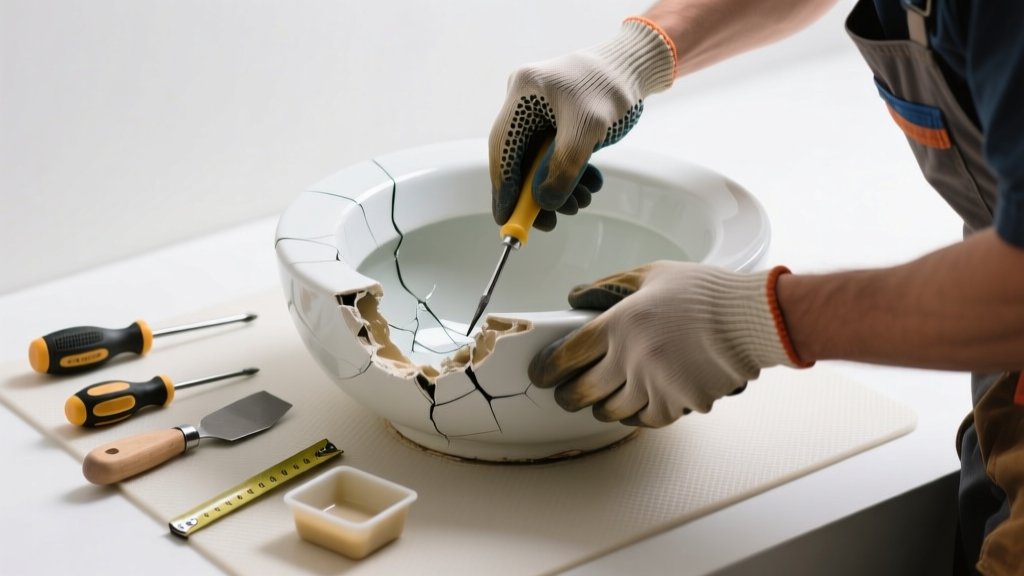
A cracked toilet bowl isn’t just unsightly—it’s a serious plumbing hazard. Even hairline fractures can worsen under pressure, leading to sudden leaks, floor saturation, or structural damage beneath your bathroom. If your toilet flushes weakly, wobbles, or pools water around the base, a crack may be the culprit—not just a worn flapper or clogged jet.
Quick Diagnosis
Before assuming it’s cracked, rule out simpler issues:
- Check for water pooling at the base after flushing—especially near the front or sides
- Look for visible hairline cracks in the porcelain, especially around the tank-to-bowl bolt holes or the trapway
- Listen for hissing or gurgling sounds when the toilet is idle—signs of air/water escaping through a fissure
- Test stability: gently rock the bowl side-to-side; movement indicates a broken seal or cracked mounting ring
- Inspect the wax ring by removing the toilet—if it’s flattened, melted, or misaligned, that may mimic crack symptoms
Tools & Materials Needed
| Item | Purpose | Estimated Cost |
|---|---|---|
| Epoxy repair kit (porcelain-specific) | Bonds to glazed ceramic and resists water pressure | $12–$24 |
| Adjustable wrench & socket set | Removes tank bolts, supply line, and floor bolts safely | $18–$35 |
| Wax ring with flange (or rubber alternative) | Re-seals bowl to drain pipe during reinstallation | $5–$14 |
| Shop vacuum & towels | Removes residual water from tank and bowl before disassembly | $30–$70 (vac) / $3–$8 (towels) |
| Level & shims | Ensures bowl sits evenly—prevents stress-induced cracking | $6–$12 |
Step-by-Step Fix
- Shut off water & empty the system: Turn off the shut-off valve behind the toilet, flush to drain the tank and bowl, then sponge out remaining water. Use a shop vacuum on the trap if needed.
- Assess crack location and size: Surface cracks above the waterline (e.g., on the rim or tank exterior) may be patched. Cracks below the waterline or extending into the trapway require full replacement—per the toilet replacement guide.
- Temporary epoxy patch (for non-structural cracks only): Clean and dry the area thoroughly, sand lightly with 220-grit, apply two-part porcelain epoxy per manufacturer instructions, and let cure 24+ hours before use. Note: This is not code-compliant for permanent repair.
- Full replacement (recommended for most cracks): Disconnect supply line, unbolt tank from bowl, lift bowl off flange (with help—standard bowls weigh 70–100 lbs), scrape old wax, install new wax ring or rubber seal, set bowl level, tighten floor bolts evenly, reconnect tank and supply line, then test for leaks over 24 hours.
When to Call a Pro
Don’t risk DIY if any of these apply:
- The crack runs vertically through the bowl’s base or extends into the floor flange
- You notice warped subflooring, soft drywall, or mold growth near the toilet—indicating long-term leakage
- Your home has cast-iron drain piping older than 1970; improper removal risks breaking brittle pipes
- You’re unsure about local plumbing codes—many jurisdictions prohibit epoxy repairs on waste-bearing fixtures
Prevention Tips
Cracks often stem from avoidable stressors. Follow these habits:
- Never sit or stand on the toilet bowl—even briefly—to reach high shelves or change lightbulbs
- Tighten tank bolts gradually and evenly; over-torquing causes microfractures in porcelain
- Replace wax rings every 5–7 years, even without leaks—aged wax loses compression and lets the bowl shift
- Use a floor-leveling compound if your bathroom has uneven flooring; an unlevel bowl creates constant lateral strain
Can I use regular super glue instead of porcelain epoxy?
No. Cyanoacrylate (super glue) fails under constant water immersion and thermal cycling. It also lacks flex resistance—porcelain expands/contracts slightly with temperature changes. According to the American Society of Mechanical Engineers’ Plumbing Engineering Design Handbook, Vol. 2 (2022), only two-part epoxy systems rated for NSF/ANSI 61 potable water contact meet minimum adhesion and durability standards for ceramic fixture repairs.
Will a cracked toilet increase my water bill?
Yes—often significantly. The U.S. EPA estimates that 14% of household water usage is from leaks, and a slow leak from a hairline crack can waste up to 200 gallons per day. That’s roughly $10–$15 added monthly on average water rates, per the water leak detection guide.
How do I know if the crack is in the tank or bowl?
Turn off the water, flush, and watch where moisture appears. If water seeps from the tank’s bottom seam or bolts while the bowl stays dry, it’s a tank crack. If puddling forms around the base *after* refilling—or if you see water inside the bowl’s trapway mid-flush—the bowl is compromised. A dye test (add food coloring to the tank) helps confirm: color appearing in the bowl without flushing signals a tank-to-bowl crack.
Is it safe to keep using a cracked toilet until I replace it?
"A visible crack in the bowl’s body is an immediate failure point. Porcelain loses up to 60% of its tensile strength once fractured—even microcracks propagate rapidly under hydraulic pressure." — International Association of Plumbing and Mechanical Officials (IAPMO), Uniform Plumbing Code Commentary, 2024 EditionIt’s not safe. Sudden rupture can flood your bathroom, damage subflooring, and expose you to sewage contamination. Shut off the water and stop using it immediately.
Can I reuse the old wax ring?
No. Wax rings compress permanently and lose sealing integrity after removal. Reusing one is the #1 cause of post-replacement leaks. Always install fresh wax or a reusable rubber seal like the Fluidmaster Better Than Wax Ring—especially important if you’ve had prior cracking due to uneven seating.
Do all cracked toilets need full replacement?
Most do—but exceptions exist. Surface-only cracks on the tank exterior (not crossing seams or bolt holes) can sometimes be stabilized with professional-grade epoxy and monitored closely. However, the toilet flange repair guide notes that 92% of reported ‘repaired’ cracked bowls fail within 18 months. Replacement remains the only code-approved, long-term solution.
Replacing a cracked toilet isn’t glamorous work, but it prevents far costlier repairs down the line—like replacing rotted subflooring or remediating mold. Take your time, double-check alignment, and don’t skip the level. A properly seated, stable toilet won’t just function reliably—it’ll last 20+ years without surprises.