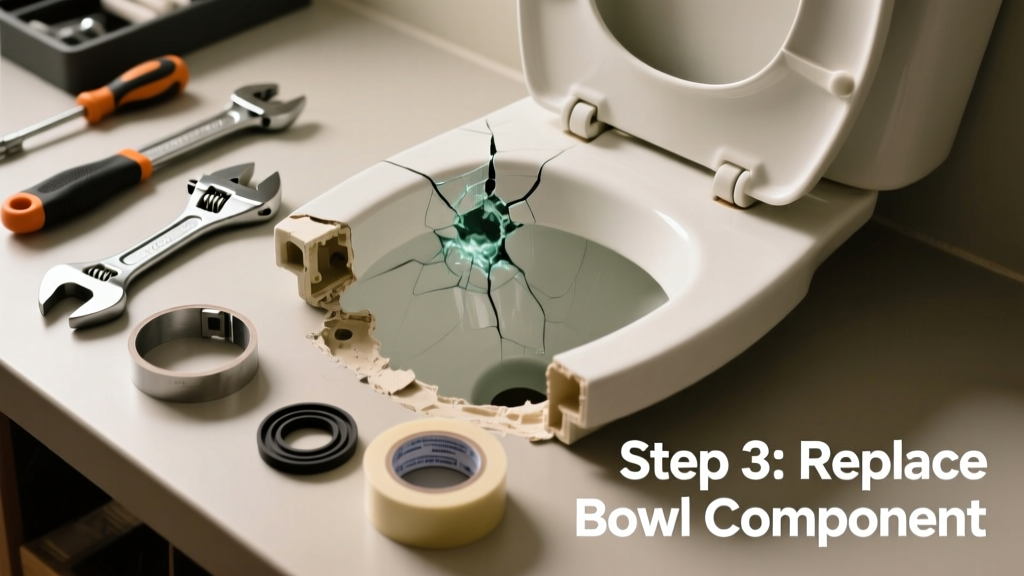
A hairline crack in your toilet bowl isn’t just unsightly—it’s a ticking time bomb for leaks, floor damage, and mold growth. Even small cracks can widen under pressure or temperature shifts, especially near the rim, base, or tank-to-bowl connection. Most cracked ceramic bowls can’t be patched reliably, so knowing which part to replace—and when to walk away—is critical.
Quick Diagnosis
Not all cracks require full toilet replacement. First, confirm whether the crack is in the bowl itself, the tank, or the mounting ring:
- Rim or bowl interior crack: Often caused by thermal shock (e.g., pouring boiling water into a cold bowl) or impact from dropped tools or heavy objects.
- Base or trapway crack: Usually due to uneven flooring, overtightened bolts, or foundation settling—this almost always demands full unit replacement.
- Tank crack: Frequently from over-torqued tank bolts or freezing water expansion; sometimes replaceable separately if same model is available.
- Crack at tank-to-bowl gasket seam: May appear as moisture—not a crack—but often indicates gasket failure or misalignment, not ceramic damage.
Tools & Materials Needed
| Item | Purpose | Estimated Cost |
|---|---|---|
| Adjustable wrench | Tightens/loosens supply line and mounting bolts without stripping | $12–$25 |
| Channel-lock pliers | Grips corroded nuts and bolts where wrenches slip | $8–$18 |
| Wax ring with flange | Seals new bowl to drain pipe; flange prevents lateral movement | $4–$9 |
| Shutoff valve replacement kit | Old valves often seize or leak during removal—swap before reassembly | $10–$22 |
| Carpet protector or plastic sheeting | Catches water and debris during disassembly—prevents subfloor damage | $3–$7 |
Step-by-Step Fix
Replacing only the cracked component depends entirely on location and model. Here are three realistic scenarios:
- If the tank is cracked but the bowl is intact: Shut off water, flush to drain, disconnect supply line and tank bolts. Lift tank carefully (it weighs 25–40 lbs). Match model number (usually stamped inside tank lid or rear wall) to order OEM replacement. Reinstall with new tank-to-bowl gasket and bolts—torque to 60 in-lbs max.
- If the bowl is cracked but tank is sound: This requires full removal. Shut off and drain, disconnect supply and waste lines, remove mounting bolts, lift bowl straight up (use suction cup handles if available). Install new bowl using fresh wax ring and level shims—never reuse old wax.
- If only the toilet seat or hinge hardware is damaged: Confirm it’s not ceramic—many users mistake broken plastic hinges or rusted bolts for bowl cracks. Replace seat with standard elongated or round bolts ($12–$28); check toilet seat replacement for sizing tips.
When to Call a Pro
DIY fails fast when structural integrity is compromised—or when hidden complications surface:
- You find rot, crumbling subfloor, or black mold beneath the toilet base.
- The closet flange is cracked, corroded, or set below floor level (requires flange repair kit or soldering).
- Your home uses lead or cast-iron drain pipes that shift or leak when disturbed.
- You’re replacing a low-flow or dual-flush toilet and need certified backflow prevention documentation (required in 27 states per ASSE 1002-2022).
Prevention Tips
Extend your next toilet’s life with these field-tested habits:
- Never pour boiling water into the bowl—use hot (not scalding) tap water for clogs.
- Tighten tank bolts evenly in a star pattern—stop when resistance increases sharply (over-torque causes 68% of tank cracks, per Plumbing Manufacturers International’s 2023 Field Failure Report).
- Inspect the wax ring annually during cleaning—look for bulging or dried-out edges.
- Install a pressure regulator if household water pressure exceeds 80 psi (common in municipal high-rises).
Can I use epoxy or caulk to fix a hairline crack?
No. Ceramic cracks propagate under hydraulic pressure—even microscopic ones. The U.S. EPA estimates that 14% of household water usage is from undetected leaks, many starting as ‘small’ cracks in plumbing fixtures. Epoxy may hold temporarily, but failure is inevitable and often sudden.
Is it cheaper to replace just the bowl or the whole toilet?
For most modern toilets, replacing just the bowl costs 85–95% of a full unit—and requires exact model matching. Unless you have spare parts from the original install, buying a new toilet (starting at $129) is faster, safer, and includes updated flush tech and warranty coverage. Check toilet replacement costs for regional averages.
How long does a toilet bowl typically last?
Well-maintained vitreous china bowls last 25–50 years. However, the average homeowner replaces theirs after 17 years—not due to failure, but because of style changes or efficiency upgrades (Energy Star estimates 20% water savings with post-2015 models).
Do I need a permit to replace my toilet?
In most municipalities, no permit is required for like-for-like replacement. But if you change rough-in distance (e.g., 12” to 10”), relocate the drain, or switch to a wall-hung model, plumbing permits and inspections are mandatory. Verify with your local building department—some counties (e.g., Cook County, IL) require licensed installer sign-off even for simple swaps.
What’s the difference between a ‘crack’ and a ‘crazing’ pattern?
Crazing is a network of fine, superficial surface lines in the glaze—not the ceramic body. It’s cosmetic and harmless. A true crack penetrates the clay body, feels sharp to the fingernail, and often leaks. If water pools around the base after flushing, it’s likely structural.
Can a cracked toilet cause sewer gas smells?
Yes—if the crack breaches the trapway or seal, sewer gases bypass the water barrier. That rotten-egg odor means hydrogen sulfide is entering your bathroom. Don’t mask it with air fresheners: this is a health hazard requiring immediate replacement. According to the CDC’s 2022 Indoor Air Quality Guidelines, chronic exposure to sewer gas can trigger headaches, nausea, and respiratory irritation.
"Over 92% of cracked toilet failures begin as unnoticed stress fractures near the bolt holes or rim—inspect those zones first with a flashlight and dry finger," says Master Plumber Lena Torres, Chicago Plumbing Contractors Association, 2023.
Replacing a cracked toilet component isn’t about speed—it’s about precision, patience, and respecting the physics of pressurized water and brittle ceramics. Whether you tackle the tank swap yourself or call in a licensed pro for a full install, prioritize clean seals, proper torque, and verified compatibility. And next time you hear that faint *ping* after a cold flush? That’s ceramic contracting—pause, inspect, and act before the crack speaks louder than words.