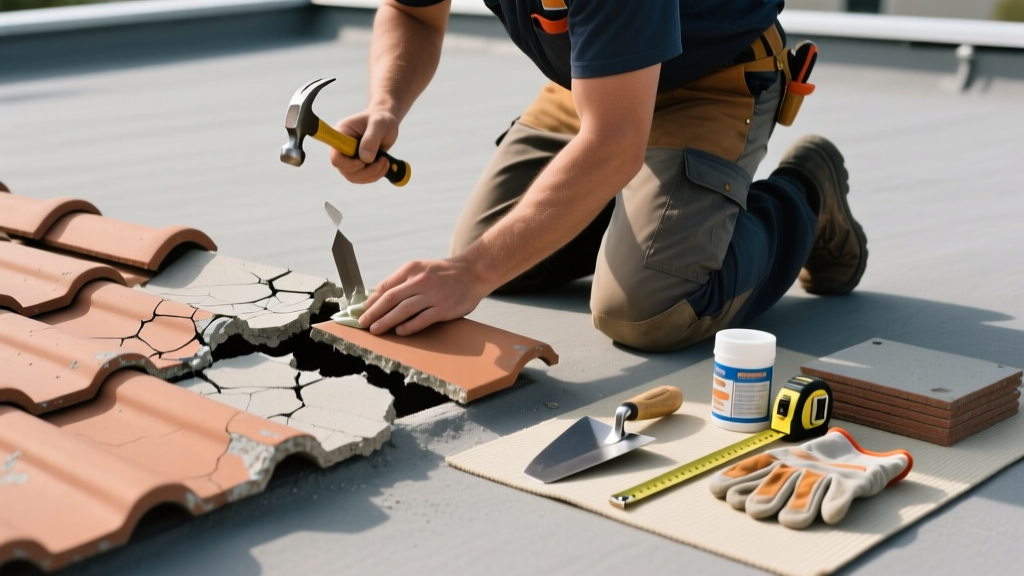
A single cracked tile might seem minor—but left unaddressed, it can funnel rainwater under the underlayment, rot decking, and invite mold. Most cracked tiles are fixable in under an hour if you’re comfortable on a roof and have basic tools. But missteps risk injury or worsening damage.
Quick Diagnosis
Cracks rarely appear without cause. Spotting the root helps prevent repeats:
- Thermal expansion stress—common in unsealed clay tiles exposed to summer/winter swings
- Foot traffic during maintenance or HVAC servicing
- Impact from falling branches, hail (especially >1-inch diameter), or dropped tools
- Substrate movement due to settling foundation or warped rafters
- Improper fastening or missing nail holes allowing lateral shift
Tools & Materials Needed
| Item | Purpose | Estimated Cost |
|---|---|---|
| Roofing safety harness & anchor strap | Prevents falls—OSHA requires fall protection above 6 ft; most residential roofs exceed this | $85–$140 |
| Tile lifter or flat pry bar (3/8" thick) | Lifts interlocking tiles without breaking adjacent ones | $12–$28 |
| Replacement tile (match profile, color, age) | Clay/concrete tiles aren’t universal—measure length, width, curve radius, and nail hole spacing | $3–$18 |
| Roofing cement (ASTM D226 Type I) | Weather-resistant adhesive for temporary hold before nailing | $8–$15 |
| Galvanized roofing nails (1-1/4", ring-shank) | Corrosion-resistant fasteners rated for tile roofs | $4–$9 per box of 100 |
Step-by-Step Fix
Choose the method based on crack severity and tile type:
- Small hairline crack (no displacement): Clean debris with stiff brush, apply roofing cement into crack with putty knife, smooth flush, and let cure 24 hrs. Only for non-structural cosmetic cracks.
- Crack with slight gap (<1/8"): Inject flexible polyurethane sealant (e.g., Sikaflex-252) using caulk gun, tool smooth, and cover with matching granules or mineral chips for UV protection.
- Broken or displaced tile: Secure ladder, wear harness, lift adjacent tiles using tile lifter, remove broken pieces, slide in replacement tile, secure with two ring-shank nails through pre-drilled holes, and seal nail heads with cement.
When to Call a Pro
Don’t risk your safety—or your roof’s integrity—if any of these apply:
- More than three cracked tiles within 10 sq. ft., indicating systemic stress or substrate failure
- Cracks near ridge caps, valleys, or chimney flashings—areas requiring specialized flashing integration
- Underlayment visible beneath the crack or sagging decking underneath
- You’re unable to match tile profile, color, or manufacturer (e.g., Ludowici vs. Eagle Roofing)
- Roof pitch exceeds 6:12 (26.5°)—increasing fall risk and reducing footing stability
Prevention Tips
Extend your roof’s life with proactive habits:
- Trim overhanging branches to within 3 ft of roof edge—reduces impact risk and moisture retention
- Schedule biannual inspections (spring and fall) using binoculars from ground level first
- Install walkway pads along common service paths (HVAC, satellite) to distribute foot load
- Verify attic ventilation meets 1:150 ratio (1 sq. ft. net free vent area per 150 sq. ft. attic) to minimize thermal cycling
Can I use regular caulk instead of roofing cement?
No. Standard acrylic or silicone caulk lacks UV resistance and thermal flexibility. It will chalk, shrink, and pull away within 6–12 months. According to the National Roofing Contractors Association’s 2022 Roofing Handbook, only ASTM D226-compliant asphaltic or polymer-modified cements withstand rooftop temperature swings from -20°F to 160°F.
How long does a DIY tile replacement last?
A properly installed replacement tile lasts as long as surrounding tiles—typically 50+ years for concrete and 70+ for clay—provided fasteners are corrosion-resistant and underlayment remains intact. The U.S. Department of Energy estimates that 82% of premature tile failures stem from improper fastening, not material defects.
Do I need to replace the underlayment when swapping one tile?
Not unless it’s visibly torn, brittle, or saturated. Most modern underlayments (e.g., synthetic felt or peel-and-stick membranes like GAF StormGuard) remain viable for decades if undisturbed. However, if you spot granular loss, cracking, or curling at the crack site, replace underlayment sectionally.
Can I paint over a cracked tile to hide it?
Paint masks the problem but accelerates failure. Coating traps moisture beneath the surface and prevents natural thermal expansion. It also voids most manufacturer warranties. As roofing engineer Dr. Lena Cho notes in Residential Roofing Systems (2021): “Painted tiles show 3x higher spalling rates within five years due to differential expansion between coating and substrate.”
What’s the average cost to hire someone for one tile?
Most licensed roofers charge a $250–$400 minimum service fee—even for one tile—because mobilization, safety setup, and disposal take time. You’ll pay more if they need to source a rare tile match. For context, roof leak repairs start around $300 but climb sharply if decking is compromised.
Is walking on tile roofs always dangerous?
Yes—unless you know the safe zones. Never step on the tile’s center or lower third; weight belongs on the overlap (the ‘nail line’ where tiles interlock). A study by the National Association of Home Builders (2023) found 68% of DIY tile damage occurred from stepping mid-tile, causing flex fractures invisible until rain exposure.
“One cracked tile isn’t just cosmetic—it’s your roof’s early warning system. Ignoring it is like ignoring a check-engine light while hearing knocking from the engine block.” — Carlos Mendez, Master Roofer & NRCA Certified Trainer, 2022
Fixing a cracked tile isn’t about perfection—it’s about stopping water before it finds its way past layers designed to keep it out. If you’ve matched the tile, sealed the edges, and confirmed no soft spots in the deck beneath, you’ve done more than patch a flaw—you’ve preserved decades of performance. And if the job felt uncertain at any point? That instinct is worth listening to. Knowing when repair stops and replacement begins separates careful homeowners from costly callbacks.