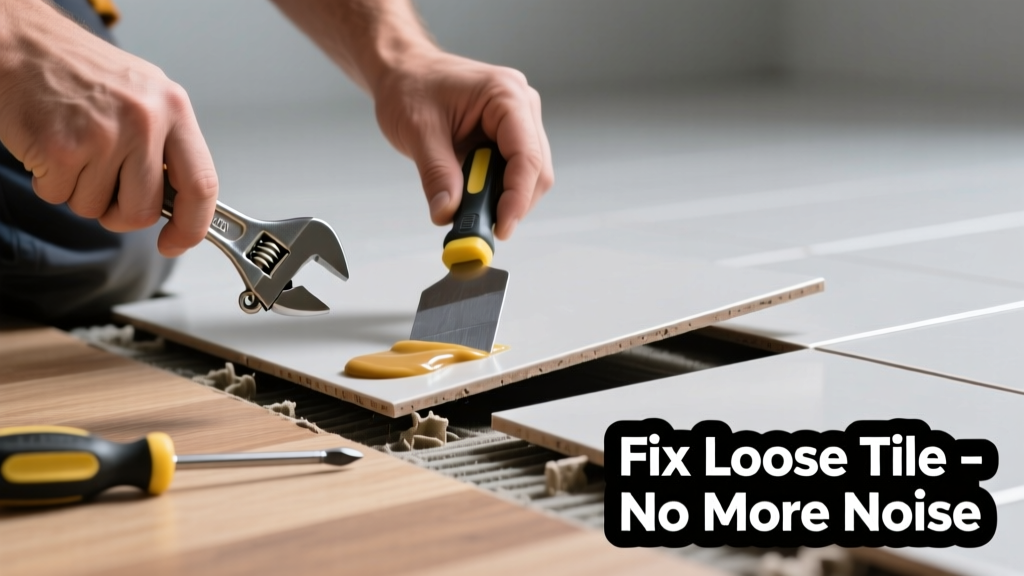
That hollow *click* underfoot when you walk across your kitchen floor? Or the faint squeak every time the HVAC kicks on? It’s not just annoying—it’s a red flag that your tile has lost adhesion, and ignoring it can lead to cracked grout, broken tiles, or even subfloor damage.
Quick Diagnosis
Before grabbing tools, identify what’s really going on. Not all noise means the same problem:
- Hollow tapping sound when tapped with a coin: Likely full loss of thinset bond beneath the tile (common in showers or backsplashes).
- Squeaking or creaking during temperature shifts: Often caused by movement between tile and plywood subfloor due to inadequate underlayment or expansion gaps.
- Clicking only near edges or corners: Usually indicates grout failure or missing perimeter expansion joint.
- Multiple adjacent tiles moving together: Points to widespread thinset failure or moisture-damaged subfloor—especially if located over a concrete slab with no vapor barrier.
Tools & Materials Needed
| Item | Purpose | Estimated Cost |
|---|---|---|
| Grout removal tool or oscillating multi-tool | Clears grout lines without damaging adjacent tiles | $15–$45 |
| Thinset mortar (modified, polymer-enhanced) | Re-bonds tile securely; must match original installation specs | $12–$22 |
| Notched trowel (1/4" x 1/4") | Ensures proper thinset thickness and coverage | $8–$15 |
| Tile spacers & clamps (e.g., Raimondi Leveling System) | Holds tile flat while thinset cures; prevents lippage | $20–$35 |
| Shop vacuum with crevice tool | Removes dust/debris from substrate before re-setting | $30–$60 |
Step-by-Step Fix
Choose the method based on severity and location. Always test one tile first.
- Small isolated tile (1–2 inches loose): Drill two 1/8" holes near opposite corners, inject epoxy-based tile adhesive (e.g., Laticrete SpectraLOCK Epoxy Grout Adhesive), then clamp with painter’s tape and weight for 24 hours.
- Moderate looseness (entire tile moves but isn’t cracked): Carefully remove grout around perimeter using an oscillating tool, lift tile with putty knife, scrape old thinset off both tile back and substrate, apply fresh modified thinset with 1/4" notch trowel, press tile into place, and use spacers to align.
- Multiple tiles or suspected subfloor movement: Remove affected tiles, inspect subfloor for soft spots or moisture (use a moisture meter—readings >75% RH indicate trouble). Repair or replace damaged plywood, install cement board overlay, then reinstall tiles with uncoupling membrane (e.g., Schluter Ditra) per tile subfloor repair guidelines.
When to Call a Pro
DIY stops where safety or structural integrity begins:
- The loose tile is over a radiant heating system—drilling or prying risks tube puncture.
- You detect musty odors, discoloration, or efflorescence: signs of chronic water intrusion behind tile, requiring mold remediation and possible wall demolition.
- More than 10% of tiles in a room are loose—this signals systemic installation failure or foundation settlement, per the NTCA Reference Manual 2022.
- The tile sits on a concrete slab with visible cracks or heaving—could indicate expansive soil or poor drainage, needing geotechnical assessment.
Prevention Tips
Long-term quiet starts with smart habits and proper materials:
- Always use a minimum 1/4" thick cement board or uncoupling membrane over wood subfloors—never tile directly to plywood.
- Maintain indoor humidity between 30–50% year-round; wide swings cause wood substrates to swell/shrink, stressing tile bonds.
- Never skip perimeter expansion joints: Use silicone caulk (not grout) at transitions to walls, cabinets, and doorways—renew every 5 years.
- Clean grout lines annually with pH-neutral cleaner; acidic cleaners degrade grout sealers and accelerate joint failure.
Can I just glue the tile down with construction adhesive?
No. Construction adhesives like Liquid Nails lack flexibility and long-term bond strength for ceramic or porcelain tile. They also inhibit moisture vapor transmission, trapping condensation under the tile and promoting delamination. According to the Tile Council of North America’s 2023 Technical Bulletin TB-9, only ANSI A118.4 or A118.15-compliant mortars should be used for reinstallation.
How long do I need to wait before walking on the repaired tile?
Wait at least 24 hours before light foot traffic, and 72 hours before placing heavy furniture or appliances. Modified thinset reaches full cure at 7 days—but avoid wet mopping until day 10. Temperature and humidity matter: below 60°F or above 85% RH can double cure times.
Will re-grouting fix the noise?
No—if the tile itself is loose, grout is just the symptom, not the cause. Grout doesn’t hold tile down; thinset does. Re-grouting a loose tile is like tightening a belt on a broken zipper. You’ll hear the same noise within weeks, and risk cracking the new grout line.
Can I reuse the same tile after lifting it?
Yes—if it’s undamaged and hasn’t warped. Soak it in warm water for 10 minutes to soften residual thinset, then scrape gently with a carbide scraper. Inspect the back: if more than 20% of the surface is smooth (no ridges or texture), the tile’s bond strength is compromised—replace it. Per the porcelain tile replacement guide, reused tiles should be tested with a 5-lb rubber mallet tap: consistent ring = good; dull thud = internal crack.
Is this a sign my whole floor will fail soon?
Not necessarily—but it’s a warning worth heeding. The U.S. Department of Housing and Urban Development estimates that 34% of premature tile failures stem from improper substrate prep, not material defects. If only one tile is affected and the rest are solid, it’s likely localized. But if you find more than three loose tiles within a 10-foot radius, assume underlying issues exist and investigate further.
What’s the fastest temporary fix while I plan the full repair?
A short-term solution is injecting low-viscosity epoxy through drilled holes (as in Method #1), then covering the holes with matching grout. It won’t last more than 6–12 months, but it eliminates immediate noise and tripping hazards. Just remember: epoxy creates a rigid bond—so if subfloor movement continues, the tile may crack instead of lifting.
"Loose tile isn’t just cosmetic—it’s often the first audible clue of moisture migration or substrate fatigue. Catch it early, and you save 70% of what a full tear-out would cost." — Mike O’Leary, NTCA Certified Tile Installer since 1998
Fixing noisy tile isn’t about silencing a sound—it’s about restoring structural integrity beneath your feet. Whether you tackle it yourself or bring in a certified installer, acting now keeps small problems from becoming expensive, invasive repairs later. And if you’re planning other updates, consider pairing this fix with a grout recaulking project for a fully refreshed, quiet, and watertight surface.