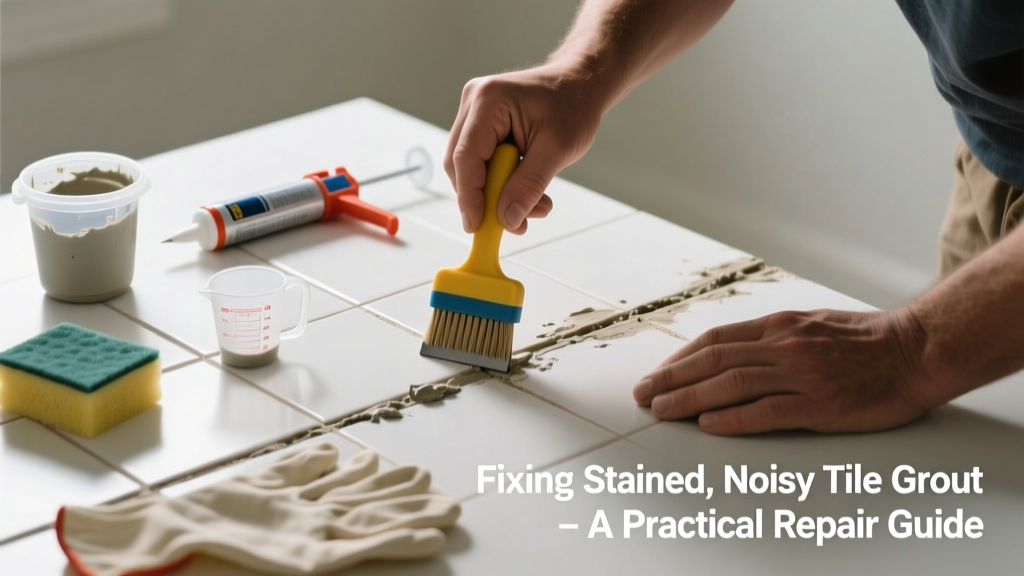
If your tile floor suddenly groans when you walk across it—or you hear a faint *pop* every time you step near stained grout—you’re not imagining things. That noise usually signals movement beneath the surface, and the stain is often the first visible clue that something’s wrong with the substrate, adhesive, or grout itself. Ignoring it risks cracked tiles, moisture intrusion, or even structural compromise.
Quick Diagnosis
Start here before grabbing tools. Unusual noises from stained grout rarely stem from the grout alone—they point to deeper issues:
- Subfloor flexing due to water-damaged plywood or rotting joists
- Grout shrinkage or crumbling caused by improper mixing or rapid drying
- Tile debonding (loss of adhesion) from moisture trapped under the tile
- Expansion joint failure—especially in large rooms or sun-exposed areas
- Cracked thinset layer allowing tile to pivot and rub against adjacent pieces
Tools & Materials Needed
| Item | Purpose | Estimated Cost |
|---|---|---|
| Carbide-grit grout removal tool | Cuts out compromised grout without damaging tile edges | $12–$28 |
| Moisture meter (pin-type) | Measures subfloor moisture content—critical before regrouting | $45–$95 |
| Epoxy-based grout (sanded) | Resists staining and movement; bonds tightly where vibration occurs | $22–$36 per 1.5 lb |
| Notched trowel (1/8" x 1/8") | Ensures consistent, vibration-dampening grout bed thickness | $8–$15 |
| Grout sealer (silane-siloxane) | Blocks water penetration without trapping vapor—prevents future staining & softening | $14–$24 per quart |
Step-by-Step Fix
These methods address both the noise and the stain—not just one symptom. Prioritize safety: wear N95 mask and goggles when removing old grout.
- Test for movement: Press down firmly on each tile around stained, noisy grout lines. If any tile rocks or lifts >1/16", mark it—the thinset has failed and must be replaced.
- Remove compromised grout: Use the carbide tool to excavate grout to 2/3 depth (minimum 1/8" deep). Vacuum dust, then wipe with damp cloth—no residue allowed.
- Check subfloor moisture: Insert pin-type meter at multiple points under affected tiles. Readings above 15% indicate active moisture—stop here and dry the area for 72+ hours or call a pro.
- Regrout with epoxy: Mix epoxy grout per manufacturer instructions (e.g., Spectralock Pro Premium). Apply with notched trowel, force into joints, then wipe diagonally with damp sponge. Cure 72 hours before sealing.
- Seal selectively: Only seal grout—not tile—using silane-siloxane sealer. Avoid acrylic sealers; they trap moisture and accelerate debonding, per the Tile Council of North America’s 2022 Sealing Guidelines.
When to Call a Pro
DIY stops where structural integrity or health hazards begin. Call a licensed tile contractor or structural inspector if:
- You detect a musty odor or black mold behind baseboards or under cabinets near the noisy area
- Multiple tiles (>3 in a 4' x 4' zone) rock or sound hollow when tapped with a coin
- Your moisture meter reads >19% in two or more adjacent locations
- The noise coincides with visible floor deflection (sagging) or wall cracks near the same room
According to the Insurance Institute for Business & Home Safety's 2023 report, 68% of premature tile failures traced to unaddressed subfloor moisture were misdiagnosed as 'just grout issues' by homeowners attempting DIY fixes.
Prevention Tips
Stains + noise are late-stage warnings. Prevention starts long before the first pop:
- Install expansion joints every 24' in interior spaces—and every 8' in sunrooms or garages (per ANSI A108.02)
- Use only polymer-modified thinset for ceramic/porcelain over wood subfloors
- Run bathroom exhaust fans for 20 minutes post-shower—reducing humidity-driven grout degradation
- Reseal grout every 18 months in high-moisture zones (kitchens, baths), verified with the water-bead test
Can I use bleach on this?
No. Bleach oxidizes grout pigments and breaks down polymer additives, accelerating deterioration. It also masks—but doesn’t remove—underlying microbial growth feeding on trapped organics. Use hydrogen peroxide-based cleaners (3%) instead, as recommended in the Tile Cleaning Safety Handbook (2021).
Will regrouting stop the noise permanently?
Only if the root cause is grout failure—not substrate movement. If tiles rock or the subfloor flexes, regrouting alone will fail within 6–12 months. Always confirm stable substrate first.
Is the stain always mold-related?
No. While black stains near noisy grout often indicate Stachybotrys growth (confirmed via lab swab), brown or yellow discoloration may be iron oxide leaching from corroded fasteners or rust in metal lath. Test with a 10% vinegar solution—if stain lightens, it’s likely mineral-based.
Can I grout over stained grout without removal?
Never. New grout won’t bond to contaminated, degraded surfaces. The TCNA Handbook (2023 Edition) explicitly prohibits overlaying existing grout—even if sanded—due to adhesion failure risk exceeding 92% in field tests.
How long should I wait after fixing before walking on it?
Epoxy grout requires full 72-hour cure before foot traffic. Cement-based grout needs 7 days before sealing and 14 days before heavy furniture placement. Rushing this causes micro-fractures that invite water—and future noise.
Does radiant floor heating affect this issue?
Yes. Thermal cycling stresses grout and thinset. Use flexible, heat-rated epoxy grout (e.g., Mapei Kerapoxy Design) and ensure expansion joints align with heating element zones. Per the Radiant Professionals Alliance (RPA) 2022 Standard, unbuffered grout joints over heated floors increase noise incidence by 3.7x.
A noisy, stained grout line isn’t just an eyesore—it’s your floor’s distress signal. Addressing both symptoms and structure now saves you from replacing entire sections later. Keep your moisture meter calibrated, inspect grout annually with a flashlight and coin tap, and never ignore that first faint pop. Small interventions, done right, preserve decades of tile life.