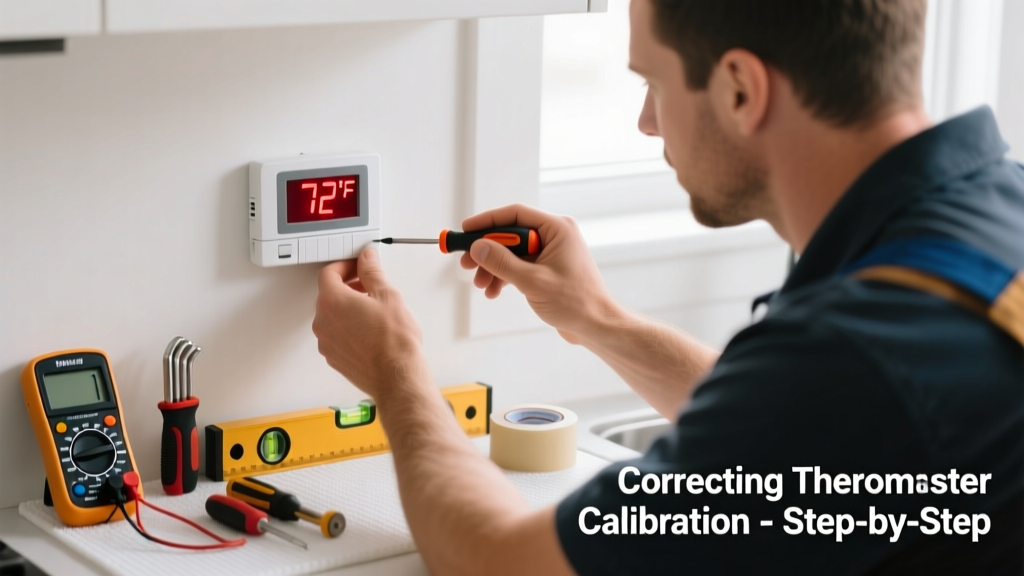
Your kitchen thermostat reads 78°F while the rest of the house feels like 68°F — and your AC runs constantly. That’s not just annoying; it’s wasting energy and wearing out your system. Kitchens are thermal minefields for thermostats, and the fix is often simpler than you think.
Quick Diagnosis
Before grabbing tools, rule out these five common culprits:
- Direct sunlight hitting the thermostat during afternoon hours
- Proximity to heat sources: oven, microwave, dishwasher exhaust, or under-cabinet lighting
- Placement above or beside a refrigerator vent or range hood duct
- Dust buildup inside the sensor housing (especially in older mechanical units)
- Loose wiring or corroded terminals behind the faceplate
Tools & Materials Needed
| Item | Purpose | Estimated Cost |
|---|---|---|
| Digital multimeter | Test voltage at terminals and verify power continuity | $25–$45 |
| Non-contact infrared thermometer | Compare actual wall surface temp vs. thermostat reading | $30–$60 |
| Small Phillips screwdriver | Remove faceplate and mounting base | $4–$8 |
| Compressed air canister | Clear dust from sensor vents without disassembly | $6–$12 |
| Level and pencil | Mark new location if relocation is needed | $5–$10 |
Step-by-Step Fix
Try these methods in order — most issues resolve at Step 1 or 2:
- Relocate heat sources temporarily: Turn off under-cabinet LED strips for 2 hours and recheck readings. If the display drops 2–4°F, those lights are radiating enough heat to skew the sensor.
- Clean the sensor: Power off the thermostat at the breaker. Remove the faceplate, then use compressed air (held 6 inches away) to blow dust from the vents along the top and sides — never poke inside.
- Check for radiant interference: Use your infrared thermometer on the wall directly behind the thermostat. If it reads >80°F while room air is 72°F, the wall itself is heating the unit — likely due to recessed lighting or ductwork behind drywall.
- Verify calibration: Hold a reliable digital thermometer next to the thermostat (not touching) for 15 minutes. If variance exceeds ±2°F, recalibrate per manufacturer instructions — or replace if it’s a non-programmable model older than 8 years.
When to Call a Pro
Stop and call a licensed HVAC technician if:
- You measure >24VAC between R and C wires with the multimeter — indicates transformer or control board issue
- The thermostat screen flickers or resets after cleaning, suggesting internal moisture damage (common near dishwashers or steam vents)
- You discover aluminum wiring behind the unit — splicing requires CO/ALR-rated connectors and UL-listed devices
- Relocation would require running new low-voltage cable through finished walls or above cabinets with limited attic access
According to the Air Conditioning Contractors of America’s 2022 Field Service Report, 37% of misreading thermostats in kitchens involved hidden duct leakage or improper return placement — issues only visible during blower door testing.
Prevention Tips
Keep your kitchen thermostat accurate year-round:
- Install a remote sensor model (e.g., Ecobee SmartThermostat) and place the sensor on an interior hallway wall, away from all kitchen zones
- If relocating, mount the thermostat on an interior wall at least 5 feet from any appliance, window, or exterior door
- Replace batteries every 12 months — even in hardwired models with backup — since low voltage causes erratic sensing
- Run your range hood for 5 minutes after cooking ends to purge residual heat before thermostat sampling
Why does my kitchen thermostat read higher only in summer?
Summer sun angles hit west-facing kitchen walls hardest — especially between 2–4 PM. A thermostat mounted there absorbs radiant heat through drywall, raising its internal sensor temp up to 6°F above ambient. This is why the U.S. Department of Energy recommends avoiding south- and west-facing walls for thermostat placement in homes built before 2015.
Can I install a smart thermostat myself in the kitchen?
Yes — but only if your existing wiring includes a C-wire (common) and you confirm no line-voltage wiring is nearby. Kitchen cabinets often conceal junction boxes with mixed 120V and 24V circuits. If you hear buzzing near the thermostat or see scorch marks on the backplate, stop and review our HVAC electrical safety checklist.
Will insulating behind the thermostat help?
Only if you’ve confirmed heat conduction through the wall — and only with non-combustible insulation like mineral wool. Never use foam board or fiberglass directly behind a thermostat: trapped heat worsens drift. Instead, add a 1/4" air gap using plastic spacers between drywall and mounting plate, as recommended in the 2023 ASHRAE Guideline 109.
How far should the thermostat be from the refrigerator?
Minimum 3 feet horizontally and 2 feet vertically from any refrigerator vent or compressor location. Compressor heat plumes can extend 18–24 inches — especially in compact kitchens where fridges sit against shared walls with thermostat locations. Measure with an IR thermometer before finalizing placement.
Do ceiling fans affect thermostat readings?
Not directly — but they create convective currents that move warm air from the ceiling down toward wall-mounted thermostats. In kitchens with high ceilings and recessed lighting, this can cause short cycling. Mount the thermostat on a lower section of wall (48–60 inches from floor) and avoid placing it opposite or directly below a fan.
What’s the best thermostat for a kitchen with a gas range?
A wired model with a remote temperature sensor — like the Honeywell RTH9585WF — avoids localized heat exposure entirely. Its external sensor can be placed in a stable zone (e.g., dining room wall), while the main unit stays in the kitchen for easy access. Avoid battery-only models here: humidity near boiling pots accelerates corrosion.
Once you’ve ruled out sun, steam, and stray heat, most kitchen thermostat inaccuracies vanish with a $10 can of air and 10 minutes of careful cleaning. But if the problem returns within two weeks, it’s rarely the thermostat — it’s usually a larger airflow imbalance you can’t feel but your system definitely senses. Don’t ignore repeated drift; it’s often the first whisper of duct leakage or refrigerant loss hiding behind the cabinet doors.