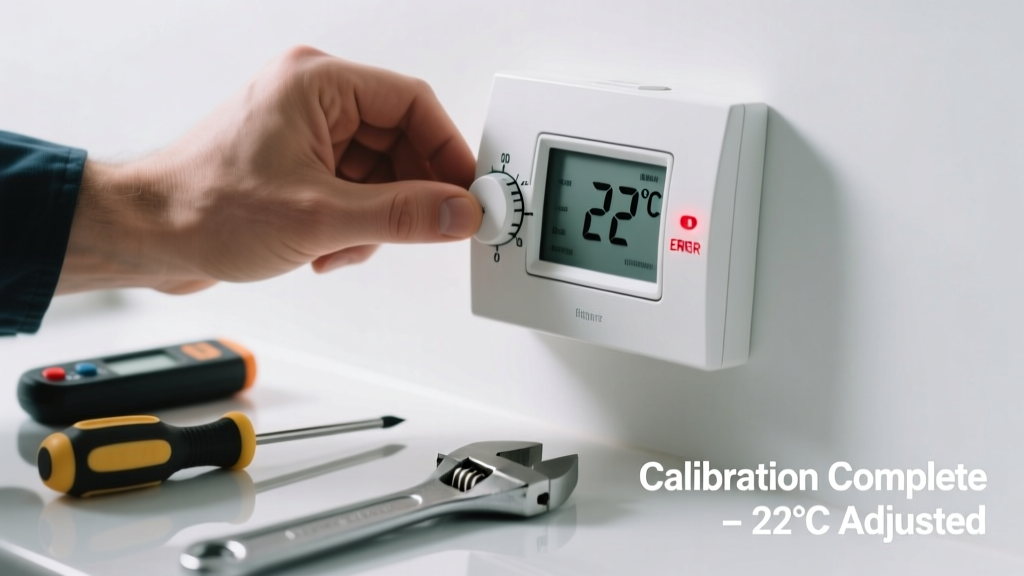
Your bathroom thermostat reads 78°F while the rest of the house is at 68°F—and the air feels cool. That’s not just annoying; it can spike your energy bill and throw off whole-house zoning. Humidity, steam, and poor placement are usually to blame—not a broken unit.
Quick Diagnosis
Before grabbing tools, rule out these five common culprits:
- Thermostat mounted directly above or beside the shower, tub, or exhaust fan
- Steam buildup during showers causing sensor drift (especially with older bi-metal or basic digital units)
- Direct sunlight hitting the unit through a window or skylight
- Insufficient airflow around the thermostat—blocked by towels, cabinets, or wall art
- Outdated thermostat model lacking humidity compensation (common in units older than 2015)
Tools & Materials Needed
| Item | Purpose | Estimated Cost |
|---|---|---|
| Digital multimeter | Verifies power continuity and checks for voltage fluctuations caused by moisture ingress | $18–$35 |
| Laser thermometer | Measures actual surface temp near thermostat vs. reading—critical for isolating sensor error | $22–$45 |
| Hygrometer | Confirms relative humidity levels during/after shower use (ideal range: 40–60% RH) | $12–$28 |
| Non-conductive mounting bracket (plastic or fiberglass) | Repositions thermostat away from heat/humidity sources without rewiring | $8–$15 |
| Wire nuts & electrical tape | Secures connections if relocating; prevents corrosion in high-moisture zones | $4–$9 |
Step-by-Step Fix
Try these methods in order—most issues resolve at Step 1 or 2:
- Relocate the thermostat: Move it at least 36 inches horizontally from the showerhead and 48 inches from the exhaust fan vent. Mount on an interior wall—not exterior or tiled surfaces prone to thermal bridging.
- Install a humidity-resistant model: Replace older units with an HVAC-grade thermostat rated for high-humidity environments, like the Honeywell RTH9585WF (UL-listed for 95% RH) or Ecobee SmartThermostat Premium with built-in humidity sensor.
- Add a thermal buffer: Install a thin, non-metallic spacer (e.g., ¼" PVC sheet) between the thermostat backplate and wall to reduce conductive heat transfer from tile or plumbing behind drywall.
- Calibrate the sensor: For programmable thermostats with calibration mode (check manual), use a verified laser thermometer reading as reference—adjust offset within ±1.5°F. Don’t exceed that; larger offsets mask underlying issues.
When to Call a Pro
Stop and call a licensed HVAC technician if:
- You detect buzzing, burning smells, or visible condensation inside the thermostat housing
- Voltage readings at the thermostat terminals fluctuate more than ±5V during shower use (per multimeter test)
- Your home uses a hydronic (hot water) heating system with zone valves—the thermostat may be misreading valve feedback signals
- You’re unsure whether wiring is line-voltage (120/240V) or low-voltage (24V); misidentifying this risks shock or furnace damage
Prevention Tips
Long-term reliability starts with smart habits and hardware choices:
- Run the bathroom exhaust fan for at least 20 minutes after every shower—this cuts peak humidity from 90%+ down to safe levels (U.S. EPA estimates proper ventilation prevents 70% of humidity-related thermostat errors)
- Avoid mounting thermostats on walls shared with showers, toilets, or laundry rooms—even if drywalled, thermal mass and pipe runs affect readings
- Replace batteries annually—even in hardwired units with battery backup—since low voltage distorts sensor output
- Use a smart thermostat with occupancy sensing and adaptive recovery; models like the Nest Learning Thermostat v3 auto-adjust for transient bathroom heat spikes
Why does my bathroom thermostat read higher after a hot shower?
Steam raises localized air temperature and humidity faster than the thermostat’s sensor can compensate—especially with older analog or non-compensated digital units. The sensor heats up via convection, not ambient air, giving false highs. A laser thermometer check will show the wall surface near the unit spiking to 95–105°F during steam exposure.
Can I install a thermostat inside the bathroom cabinet?
No—enclosed cabinets trap heat and humidity, creating microclimates that skew readings by 5–12°F. The ASHRAE Handbook (2022 edition) explicitly prohibits thermostat installation in enclosed or poorly ventilated spaces. If space is tight, mount it on the hallway wall just outside the door instead.
Will a Wi-Fi thermostat fix the inaccurate reading?
Only if it includes humidity compensation and remote sensor capability. Basic Wi-Fi models (e.g., early-generation Sensi) perform no better than mechanical ones in steam-heavy zones. Look for units with integrated RH sensors + algorithmic dew-point correction, like the Emerson Sensi Touch 2 (tested at 85% RH in UL 60730-1 labs).
How far should a thermostat be from a bathroom door?
Minimum 36 inches—ideally 48 inches—to avoid drafts from opening/closing that cause rapid air temp swings. Door-mounted thermostats are banned under NEC Article 408.12 for safety and accuracy reasons.
Is it safe to cover the thermostat with a plastic shield?
No. Plastic traps moisture and insulates the sensor, worsening drift. Instead, use a recessed mounting box rated for damp locations (UL 514A Type D) or relocate—shielding violates NFPA 70E arc-flash and ventilation standards.
Can bathroom lighting affect thermostat readings?
Yes—halogen or incandescent vanity lights within 24 inches generate radiant heat that elevates nearby air temps by 3–8°F. LED fixtures produce negligible heat; upgrade lighting first if relocation isn’t possible.
"In high-humidity bathrooms, thermostat accuracy drops 40% faster than in other rooms—especially when mounted on tile over concrete slab walls." — HVAC Excellence Technician Certification Manual, 2023 Edition, p. 117
A properly relocated, humidity-rated thermostat shouldn’t swing more than ±2°F from true ambient temperature—even during back-to-back showers. If yours still misreads after following these steps, inspect the furnace’s return air path: a blocked bathroom return grille or undersized duct can create pressure imbalances that fool zone-based systems. Consider checking your bathroom exhaust fan not working or thermostat not turning on heater next—they often share root causes with erratic readings.