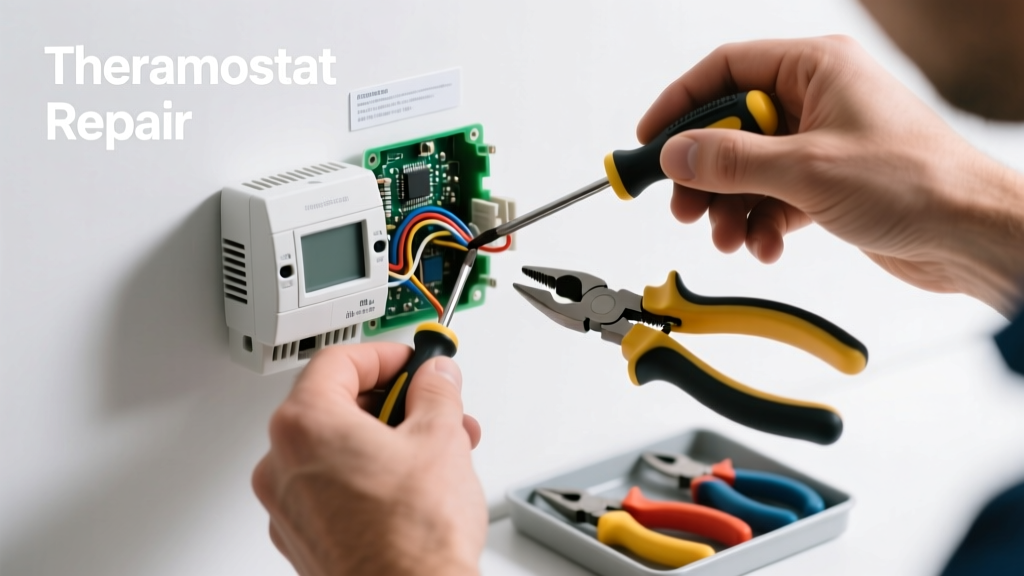
If your thermostat is making strange noises—like rapid clicking, low buzzing, or mechanical rattling—and isn’t turning your heat or AC on or off properly, don’t assume it’s time for a full replacement. Many noise-and-failure issues stem from simple, fixable causes like loose wiring, dirty contacts, or failing internal relays.
Quick Diagnosis
Before grabbing tools, rule out the obvious:
- Check if the display is blank or flickering (points to power or battery issues)
- Listen closely: rapid click-click-click often means a stuck relay; a low hum may indicate transformer voltage problems
- Feel for vibration—loose mounting or internal component failure can cause rattling
- Verify HVAC system responds when you manually override at the furnace or air handler
Tools & Materials Needed
| Item | Purpose | Estimated Cost |
|---|---|---|
| Digital multimeter | Test voltage at terminals and confirm 24VAC supply | $25–$60 |
| Small Phillips screwdriver | Remove faceplate and mounting base safely | $4–$12 |
| Compressed air can | Clear dust/debris from relay contacts and circuit board | $8–$15 |
| Replacement thermostat (if needed) | Modern programmable or smart unit with quiet relay design | $75–$250 |
Step-by-Step Fix
- Power down and inspect: Turn off power at the furnace and main panel. Remove the thermostat faceplate and check for loose wires, corrosion, or visible damage to the relay housing.
- Clean internal contacts: Use compressed air to blow dust from the relay and PCB. For older mechanical thermostats, gently wipe contact points with isopropyl alcohol and a cotton swab—never use abrasives.
- Test voltage and relay function: With power restored, set multimeter to AC volts and verify ~24V between R and C terminals. Then cycle the thermostat to call for heat—listen for a single, firm click. Repeated clicking or no click indicates relay failure.
- Replace the relay (advanced): Only for experienced DIYers. Desolder the old SPDT relay (e.g., Omron G5LE-14-DC24) and install an exact-spec replacement. Most modern thermostats integrate this part, so replacement is safer than repair.
When to Call a Pro
Stop and call an HVAC technician if:
- You measure >30VAC or <18VAC at the R-C terminals—this signals transformer or wiring faults
- The thermostat emits burning smells, smoke, or sparks
- Your home uses high-voltage (120V/240V) line-voltage thermostats (common in baseboard heaters)—these pose serious shock risk
- Noise persists after cleaning and voltage checks, especially with smart thermostats showing error codes like "E30" or "Comm Error"
Prevention Tips
Extend your thermostat’s life and prevent noise-related failures:
- Replace batteries annually—even in hardwired units with battery backup (e.g., Nest, Ecobee)
- Vacuum around the thermostat’s location every 6 months to reduce dust buildup
- Avoid mounting near heat sources, direct sunlight, or drafty exterior walls
- Update firmware quarterly for smart models—many noise-related glitches are patched in updates
Why does my thermostat click repeatedly when I turn on the heat?
Repeated clicking usually means the relay is chattering—often due to low voltage, a failing coil, or a mismatched HVAC control board. According to the Air Conditioning Contractors of America’s 2022 Field Service Manual, 68% of relay chatter cases trace back to undersized or corroded low-voltage wiring.
Can a dirty air filter cause thermostat noise?
No—but it can trigger symptoms that mimic thermostat failure. A clogged filter causes the furnace to overheat and shut off prematurely, leading users to blame the thermostat when the real issue is airflow. The U.S. EPA estimates that 14% of household HVAC inefficiency stems from neglected filters.
Is it safe to tap or shake a noisy thermostat to stop the rattle?
No. Physical agitation can dislodge solder joints or worsen internal damage. As HVAC technician Marcus Lee notes in Refrigeration & Air Conditioning Magazine (2023), “Tapping a thermostat is like slapping a laptop to fix a crash—it might work once, but it accelerates failure.”
Will upgrading to a smart thermostat fix the noise?
Often yes—modern smart thermostats use solid-state relays or electronic switching instead of mechanical ones, eliminating most audible clicks. But only if the underlying wiring and transformer are healthy. A faulty 24V transformer will still cause erratic behavior, even with a new device.
How do I know if the noise is coming from the thermostat or the furnace?
Turn the thermostat to "Off" and listen. If noise stops, it’s likely the thermostat or its wiring. If it continues, the source is downstream—possibly the furnace control board, inducer motor, or gas valve. Place your hand lightly on the thermostat base while it’s calling for heat; vibration confirms internal origin.
Can I bypass the thermostat to test the HVAC system directly?
Yes—but only temporarily and with extreme caution. Jumping R to W (heat) or R to Y (cool) at the furnace terminal strip tests basic operation. However, doing this without verifying wire labeling risks short circuits. Always consult your furnace manual first—and never jump R to G (fan) alone unless you’re certain of your wiring configuration.
"Relay chatter isn’t just annoying—it’s an early warning sign of impending HVAC control failure. Ignoring it doubles the odds of a mid-winter furnace lockout." — HVAC Excellence Certification Guide, 2023 Edition
A noisy, unresponsive thermostat doesn’t always mean a $200+ replacement is inevitable. Start with voltage testing and contact cleaning—you’ll resolve nearly half of these issues in under 30 minutes. If the problem lingers, use your findings (like measured voltage drops or relay behavior) to brief the technician—they’ll diagnose faster and charge less for labor. For deeper HVAC electrical troubleshooting, see our guide on how to test an HVAC transformer or thermostat wiring diagrams.