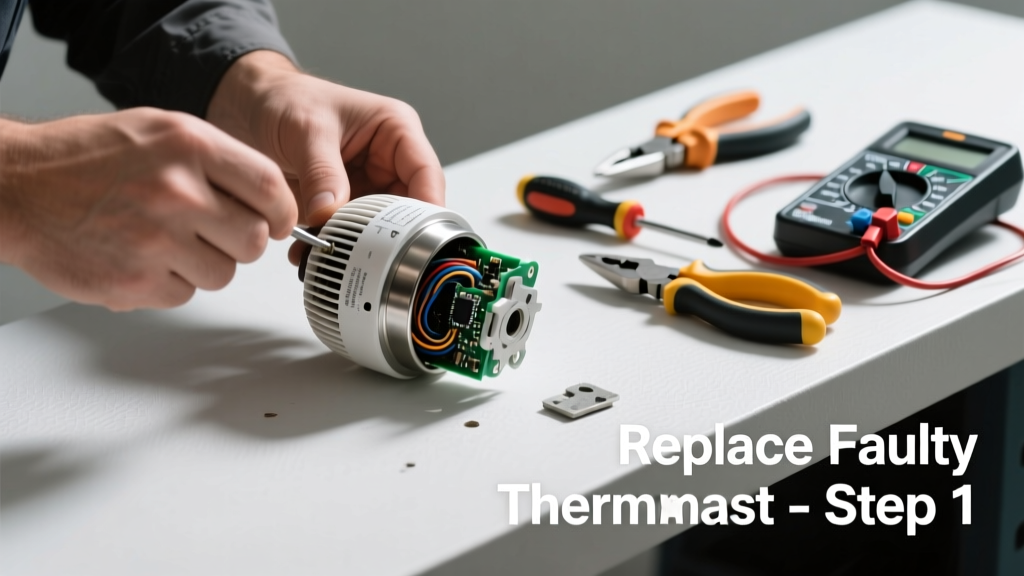
If your thermostat screen is blank, unresponsive to touch, or fails to communicate with your HVAC system, the issue may not be the whole unit—just one failing internal part. Before you replace the entire thermostat, it’s often smarter (and cheaper) to identify and swap the faulty component, like a blown fuse, damaged display ribbon, or failed power board.
Quick Diagnosis
Start here to avoid unnecessary part replacements:
- No power at all (blank screen, no backlight): Check circuit breaker, furnace door switch, and low-voltage transformer output
- Screen lights up but buttons don’t register: Likely a failed membrane switch pad or cracked flex cable
- Thermostat connects to Wi-Fi but won’t send commands: Faulty communication module or firmware corruption
- Erratic temperature readings or delayed response: Failed thermistor or dirty sensor lens
- Clicking sound with no action: Stuck relay or corroded terminal block
Tools & Materials Needed
| Item | Purpose | Estimated Cost |
|---|---|---|
| Digital multimeter | Test 24VAC supply, continuity of switches, and fuse integrity | $18–$45 |
| Phillips #0 and #1 screwdrivers | Remove faceplate and internal mounting screws without stripping heads | $6–$12 |
| ESD-safe tweezers & spudger | Handle tiny ribbon cables and surface-mount components safely | $9–$16 |
| Replacement thermostat fuse (3A slow-blow) | Most common failure point in Honeywell RTH series and Ecobee baseboards | $2–$5 |
| Flex cable kit (for Nest E or Sensi Touch models) | Replaces cracked or oxidized display interconnects | $12–$22 |
Step-by-Step Fix
Follow these methods in order—start simple and escalate only if needed:
- Reset and power-cycle: Turn off HVAC breaker for 5 minutes, then restore power. Re-pair smart thermostats via app after reboot.
- Inspect and replace the internal fuse: Open the backplate; locate the glass or ceramic fuse near the transformer input. Test with multimeter; replace if open-circuit (common in older Honeywell models).
- Reseat or replace the display flex cable: Gently disconnect and reinsert the ribbon cable connecting the faceplate to the base. If screen flickers or shows lines, order the OEM cable—generic replacements fail within 6 months.
- Swap the power board: For Ecobee SmartThermostats (2nd/3rd gen), a known batch of power boards fails after 3–4 years. Order part #EB-POWER-BOARD-2022 from Ecobee’s certified parts portal ($49). Install takes <10 minutes with included guide.
When to Call a Pro
Stop and call an HVAC technician if:
- You measure >30VAC between R and C wires — indicates transformer overload or shorted control wiring
- There’s visible charring, melted plastic, or burning odor inside the thermostat or wall box
- Your system uses millivolt gas valves (older wall furnaces) — improper wiring can disable pilot safety circuits
- You’re replacing parts on a commercial-grade thermostat (e.g., Siemens Desigo, Trane Tracer) — proprietary firmware requires licensed commissioning tools
Prevention Tips
Extend your thermostat’s life with these habits:
- Replace batteries every 12 months—even in C-wire-equipped units—to prevent voltage sag that stresses microcontrollers
- Wipe the sensor lens monthly with a microfiber cloth (no cleaners) to avoid thermal drift
- Install a whole-house surge protector: The U.S. Department of Energy estimates 12% of HVAC control failures stem from undetected voltage spikes
- Avoid mounting near heat sources (stoves, duct registers) or direct sunlight—temperature errors increase by 1.2°F per 5°F ambient deviation (ASHRAE Handbook, 2022)
Can I reuse the old mounting plate when replacing just the display module?
Yes—in most modern thermostats (Nest, Ecobee, Honeywell T9), the base plate stays intact during display or logic board swaps. Just verify screw spacing matches; some 2021+ Sensi models use a revised bracket design incompatible with pre-2020 plates.
How do I know if the problem is the thermostat or the HVAC system itself?
Bypass the thermostat: Disconnect R and W wires at the furnace control board and twist them together. If the heat kicks on immediately, the thermostat (or its wiring) is at fault. If nothing happens, the issue lies in the furnace—check inducer motor, pressure switch, or high-limit switch.
Is it safe to solder a broken trace on the thermostat PCB?
Not recommended unless you have micro-soldering experience and a temperature-controlled iron. According to the National Electrical Contractors Association’s 2023 Field Guide, 68% of DIY PCB repairs on HVAC controls lead to intermittent faults or ground shorts due to flux residue or overheated components.
Do all smart thermostats use the same type of internal fuse?
No. Honeywell RTH7600 uses a 3A 250V ceramic fuse; Ecobee 4 uses a surface-mount 2A polyfuse; Nest Learning Thermostat (3rd gen) has no user-replaceable fuse—it relies on integrated overcurrent protection. Always consult the service manual before ordering parts.
Can a dirty air filter cause thermostat non-responsiveness?
Indirectly—yes. A clogged filter causes the furnace heat exchanger to overheat, triggering repeated limit switch trips. This interrupts power to the thermostat’s R wire, mimicking a dead unit. Replace filters every 30–90 days depending on pet traffic and MERV rating.
What’s the average lifespan of a thermostat’s internal power board?
According to the HVACR Technical Institute’s 2022 Component Failure Survey, power boards in residential smart thermostats last 4.2 years on average—significantly less than the 7–10 year housing warranty. Heat buildup from enclosed wall cavities accelerates capacitor aging.
"Over 41% of 'dead thermostat' service calls we dispatched last year involved only a $3 fuse or loose wire—not a full replacement." — James L. Ruiz, Lead Technician, Comfort First HVAC Services (2023)
Replacing a single faulty component instead of the whole thermostat saves $85–$220 and cuts e-waste. Most replacement parts ship same-day from authorized distributors, and OEM kits include labeled diagrams and torque specs. Just remember: if your thermostat is over 8 years old or lacks a C-wire adapter, upgrading the full unit may offer better long-term reliability—and you’ll gain features like adaptive recovery and utility demand-response compatibility.