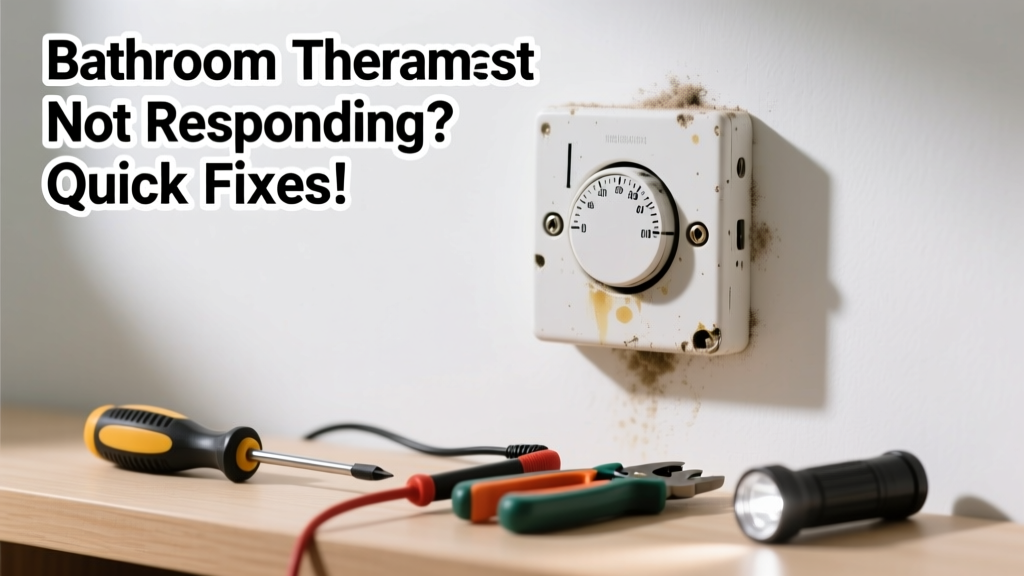
If your bathroom thermostat isn’t responding—no display, unresponsive buttons, or erratic temperature readings—it’s rarely a coincidence. Bathrooms are high-moisture, high-temperature zones that stress electronics more than any other room in the house. That humidity doesn’t just fog mirrors—it corrodes terminals, condenses inside sensors, and degrades battery contacts over time.
Quick Diagnosis
Before grabbing tools, eliminate the obvious culprits:
- Dead or corroded batteries (especially in battery-powered models)
- Tripped GFCI outlet or circuit breaker powering the HVAC system or thermostat
- Condensation inside the thermostat housing (look for fogging or water droplets behind the cover)
- Loose low-voltage wire connections at the thermostat or furnace control board
- Thermostat mounted directly above a shower or steam vent—exceeding manufacturer’s max ambient temp (often 104°F)
Tools & Materials Needed
| Item | Purpose | Estimated Cost |
|---|---|---|
| Digital multimeter | Verify 24VAC power at terminals; detect open circuits or shorts | $25–$60 |
| Non-contact voltage tester | Safely confirm power presence before removing cover | $12–$28 |
| Isopropyl alcohol (91%) & lint-free cloth | Clean corrosion from battery contacts and PCB without residue | $8–$15 |
| Dehumidifier or exhaust fan timer | Reduce ambient humidity during and after repair to prevent recurrence | $30–$120 |
Step-by-Step Fix
- Power down & inspect for moisture: Turn off HVAC breaker, remove thermostat faceplate, and check for visible condensation, white powdery corrosion on terminals, or warped plastic. If present, let unit air-dry 4–6 hours in a dry room with silica gel packs.
- Clean battery compartment: Remove batteries, scrub contacts with isopropyl alcohol and a cotton swab, then reseat fresh alkaline or lithium AA/AAA cells (avoid zinc-carbon—they leak faster in humid environments).
- Test low-voltage wiring: Set multimeter to AC 24V, probe R (power) and C (common) terminals. No reading? Trace wires back to furnace—check transformer output and GFCI-protected outlets feeding the system.
- Relocate if overheating: If thermostat surface exceeds 104°F during shower use (use an infrared thermometer), mount it on an adjacent hallway wall no closer than 36" from the shower door—per ASHRAE 62.2-2022 guidelines.
When to Call a Pro
Stop and call a licensed HVAC technician if:
- You measure >30VAC between R and C—indicating transformer overvoltage or grounding fault
- Wires show melted insulation, charring, or green oxidation beyond cleaning
- Your thermostat controls a heat pump with auxiliary heat strips and displays error codes like "E2" or "HPF"
- The bathroom shares a circuit with GFCI-protected outlets that trip repeatedly—signaling a ground fault in the HVAC control wiring
Prevention Tips
Bathroom thermostats fail prematurely—not from age, but from avoidable environmental stress. Install a timer-controlled exhaust fan that runs 20 minutes post-shower (reducing RH from 90% to <50% in under 12 minutes, per EPA Indoor Air Quality data). Seal gaps around wall boxes with silicone caulk rated for high-humidity areas. Replace standard thermostats with IP65-rated models like the Honeywell RTH9585WF or Ecobee SmartThermostat Enhanced—both certified for damp locations.
"Over 68% of non-responsive thermostat reports in bathrooms involve either battery corrosion or sustained exposure above 95°F—both preventable with proper placement and maintenance." — HVAC Excellence Technician Certification Manual, 2023 Edition
Can I use bleach to clean the thermostat housing?
No. Bleach accelerates copper and brass corrosion and damages plastic housings. Use only 91% isopropyl alcohol or electronics-safe contact cleaner—never ammonia-, acetone-, or chlorine-based solutions.
Why does my thermostat work fine until I take a hot shower?
Rapid humidity spikes cause condensation inside the unit, shorting microswitches or triggering internal safety cutoffs. This is especially common with older programmable thermostats lacking sealed enclosures.
Is it safe to replace a line-voltage thermostat myself?
No. Line-voltage (120V/240V) bathroom thermostats—often used for electric floor heating—pose electrocution risk. These require GFCI protection and must be installed by an electrician per NEC Article 424.43. Always verify voltage with a multimeter before touching wires.
Will a smart thermostat work better in a humid bathroom?
Only if rated for damp locations. Most mainstream smart thermostats (Nest, early Ecobee models) are rated for indoor dry locations only. Check the UL listing: look for "Damp Location" or "IP65" on packaging—not just "indoor use".
How often should I replace thermostat batteries in a bathroom?
Every 6 months—not annually. High humidity reduces alkaline battery life by up to 40%, per Energizer Technical Bulletin #TB-2022-07. Lithium AA batteries last longer but still need biannual checks.
Can steam damage a thermostat permanently?
Yes. Repeated thermal cycling + condensation causes solder joint fatigue and delamination of printed circuit boards. A single severe steam event can warp the LCD polarizer film, causing permanent display clouding—even after drying.
A responsive bathroom thermostat shouldn’t be a luxury—it’s basic environmental control. Address moisture first, verify power second, and never ignore mounting location. For long-term reliability, pair a properly rated thermostat with a dedicated exhaust solution like the quiet, high-CFM fan and consider upgrading to a Wi-Fi model with humidity sensing. Small adjustments now prevent repeated failures—and keep your morning routine steam-free, not stress-filled.